

Article en Français
Messier 27
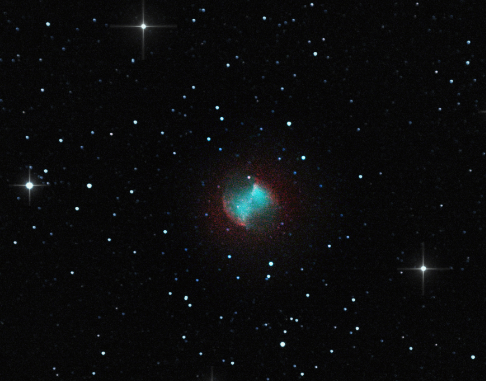
M27, also known as the Dumbbell Nebula or NGC 6853, is a dead star, or rather, one that has suffered the same fate as our Sun will in a few billion years. Located in the constellation Vulpecula (the Little Fox), it is also about 417 parsecs* away from us, or 1,360 light-years. With a magnitude of 7.4, it is the brightest object in its category, known as a "planetary nebula."
Based on its expansion rate of 27 km/s, its age is estimated at 4,000 to 5,000 years, and its current angular diameter is 15 arcminutes, increasing by 6.8 arcseconds per century.
It was Charles Messier who discovered it on July 12, 1764, and included it as the 27th object in his catalog. He was unaware at the time that M27 was the first planetary nebula to appear in his catalog. He described it as an oval nebula without stars. In his original article, dated July 12, Messier wrote: "Starless nebula, discovered in Vulpecula, between the two front paws, and very close to the star 14 of that constellation, of the 5th magnitude according to Flamsteed; it can be seen well with a simple 3.5-foot retractor; it appears to be oval in shape, and contains no stars."
The Dumbbell Nebula is one of only four planetary nebulae listed in Messier's catalog. The other three are Messier 57 (Ring Nebula) in Lyra, Messier 76 (Small Dumbbell Nebula) in Perseus, and Messier 97 (Owl Nebula) in Ursa Major.
William Herschel was the first to designate M27 as a planetary nebula, around 1784. The appearance of this nebula in a telescope was similar to that of the newly discovered Uranus.
*http://www.constellation-guide.com/dumbbell-nebula-messier-27/
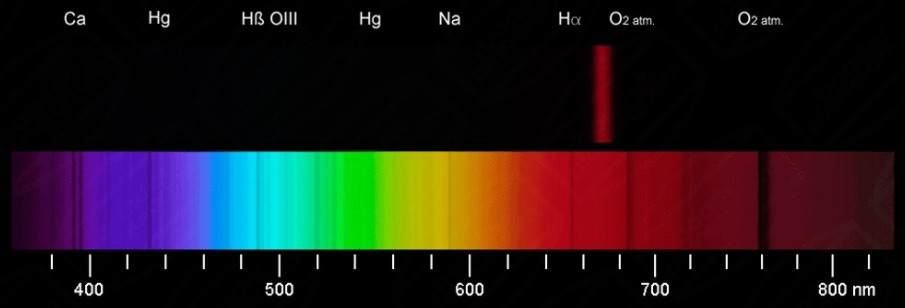
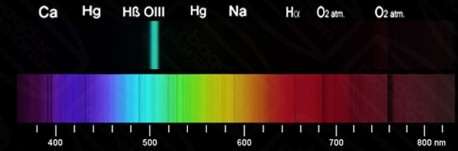
When I first started astrophotography, I took this image with an unmodified Canon T3i and an Orion ED-80 telescope. The colors that appeared during processing intrigued me. As usual, my curiosity led me to search the internet for more information. On one website, I read: "Most of this visible light is emitted in a single spectral line corresponding to 5007 Angstroms, namely green light, as is the case for the majority of planetary nebulae." So, around the OIII spectrum.
* (http://www.astropolis.fr/catalogue-Messier/articles/M27/astronomie-messier-M27.html#caract%C3%A9ristiques)
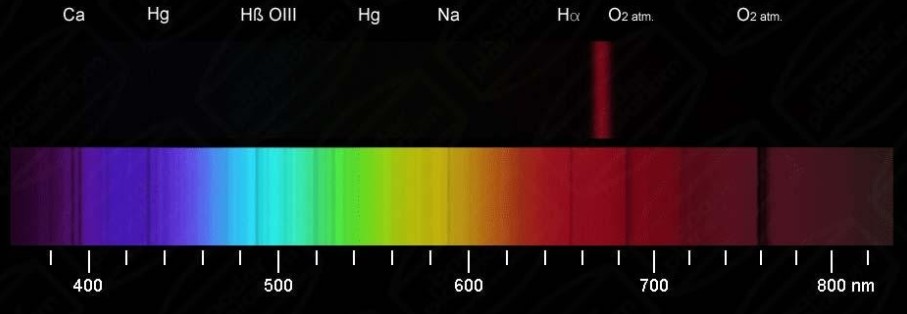
In July 2015, I had the opportunity to work at the Bishop's University Observatory, where I was able to experiment with photographing it using narrow-band filters: H-Alpha, OIII, and SII, as well as a clear filter, of course. The goal was to be able to separate the various components of the object. These three filters can separate the spectrum of light and perform selective separations within the visible spectrum, between 350 nm and 700 nm.
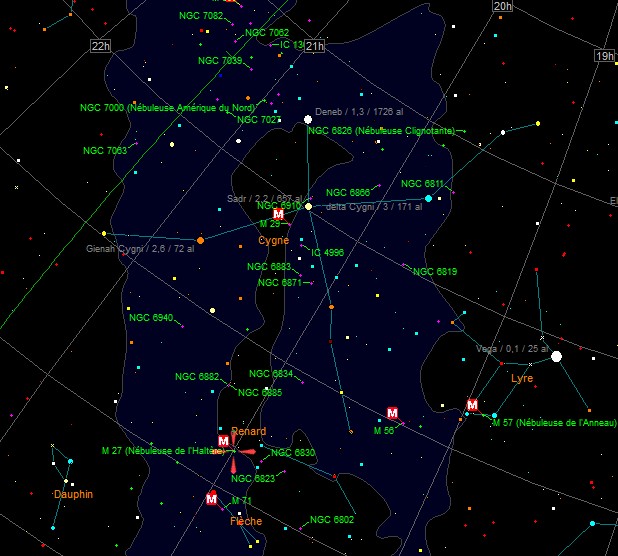 Image tirée de C2A
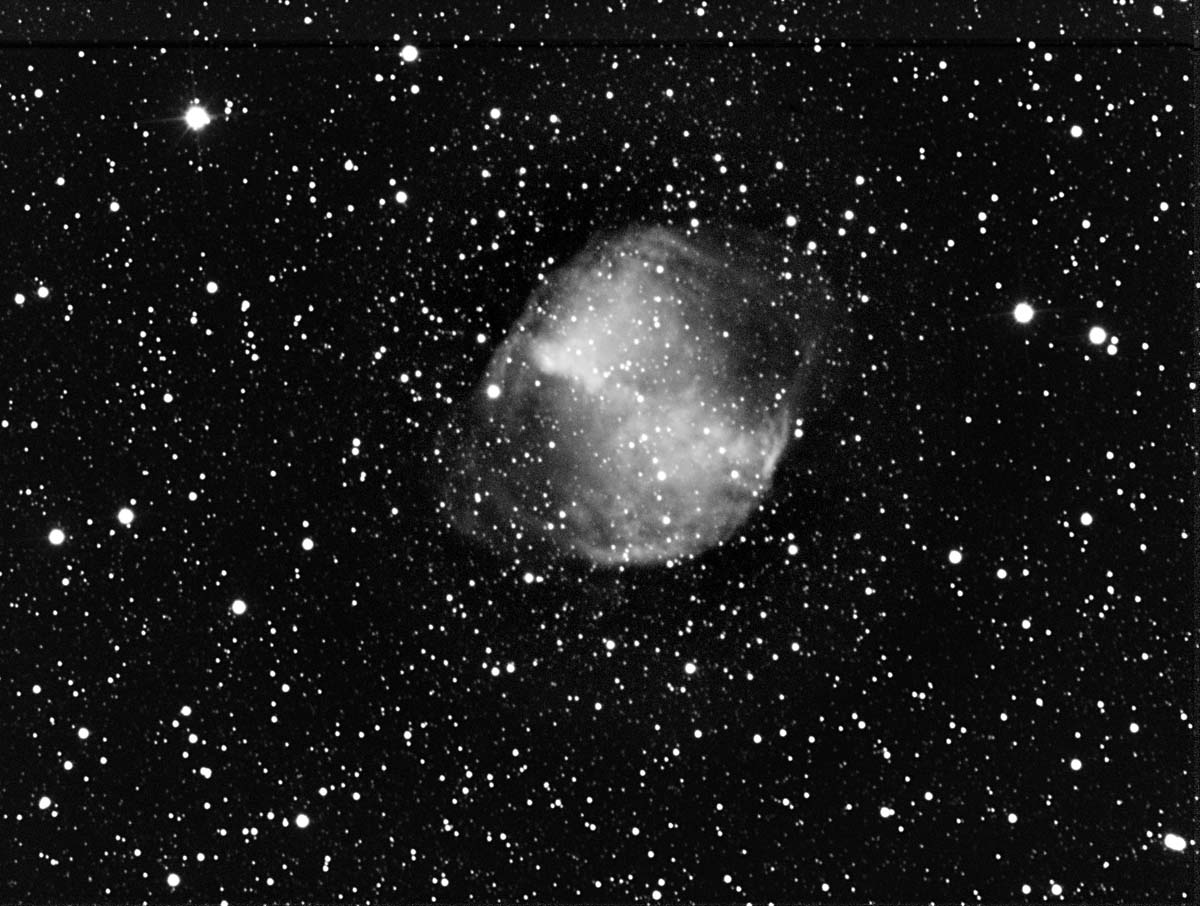 |
In clear filter, here is the result of 25 images of 60 seconds taken with the 17-inch PlaneWave telescope and my STF-8300M camera. |
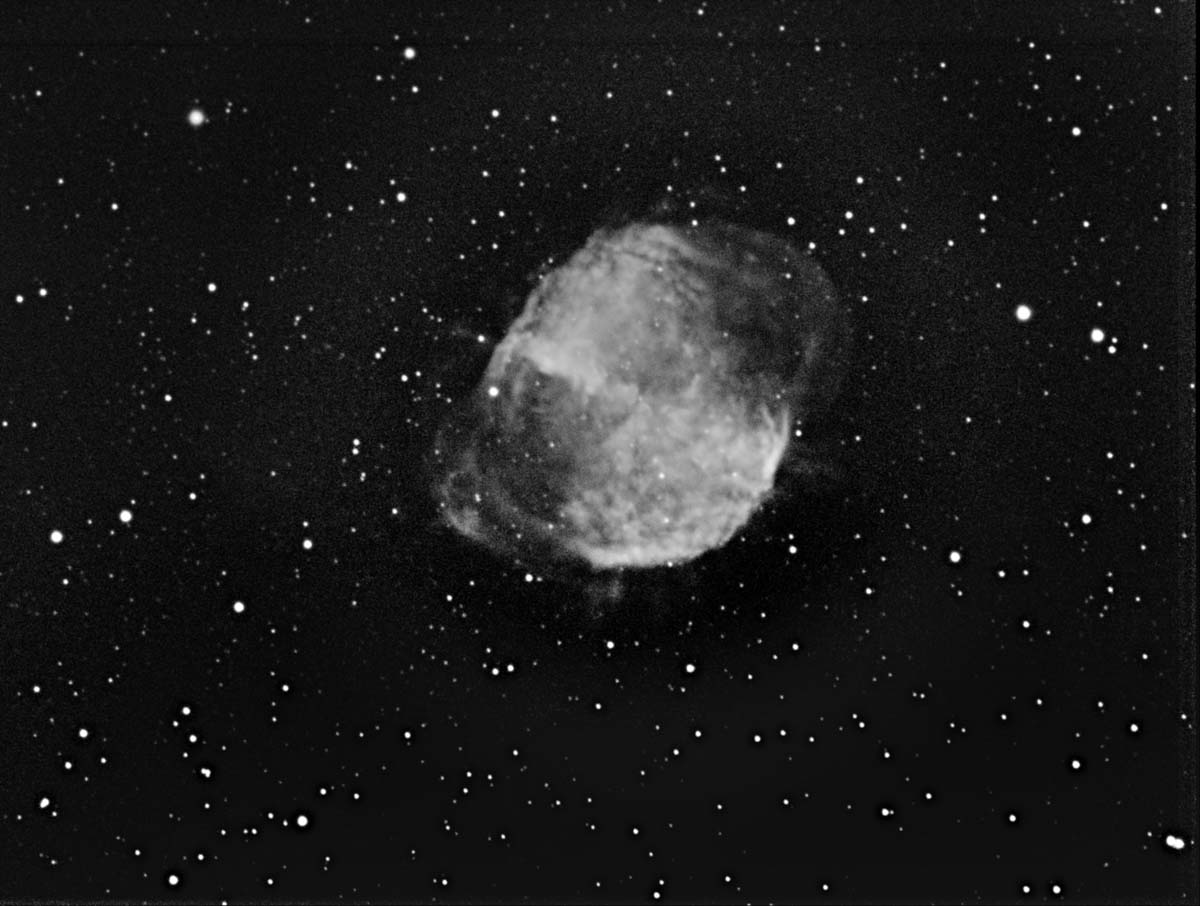 |
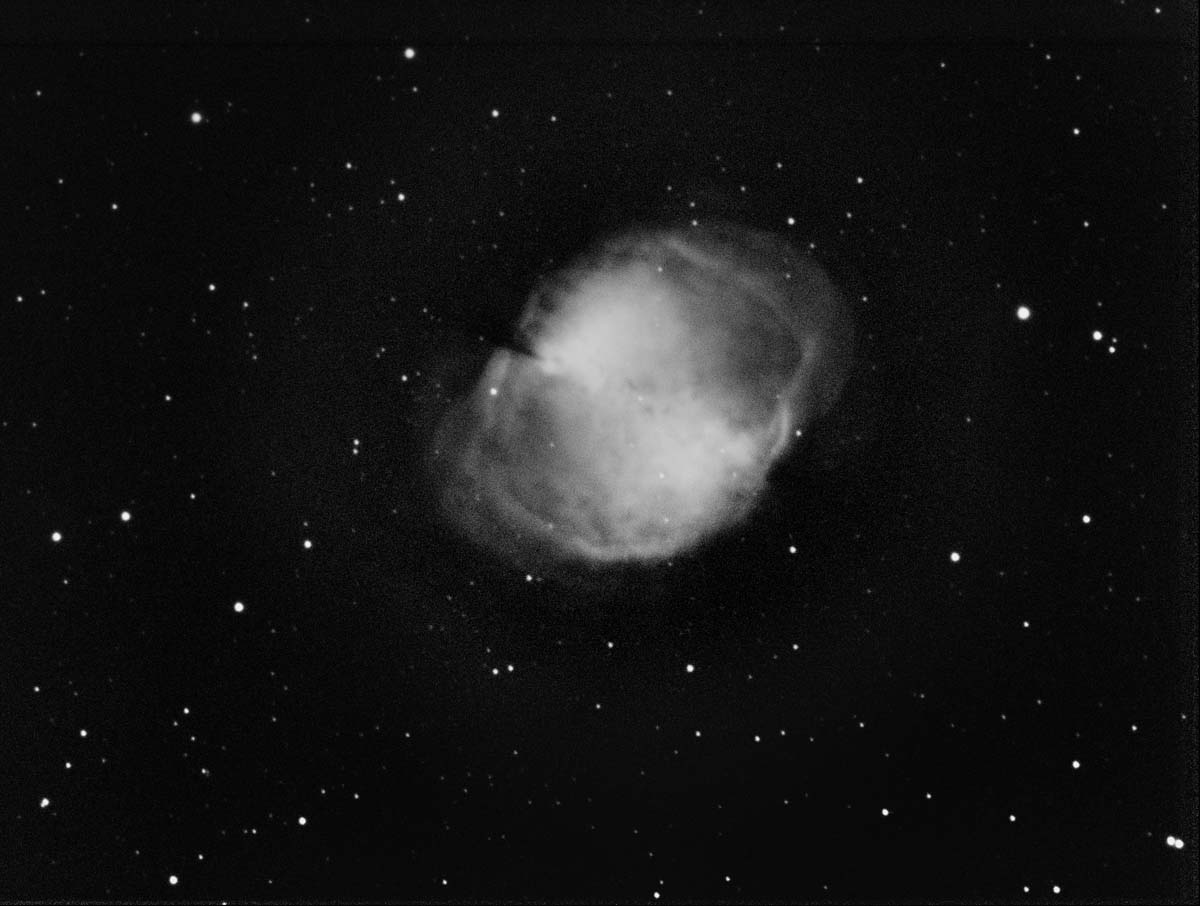
Subsequently, using a 7nm H-Alpha filter, this time with exposures of 5 x 200 seconds, and without guiding.
|
 |
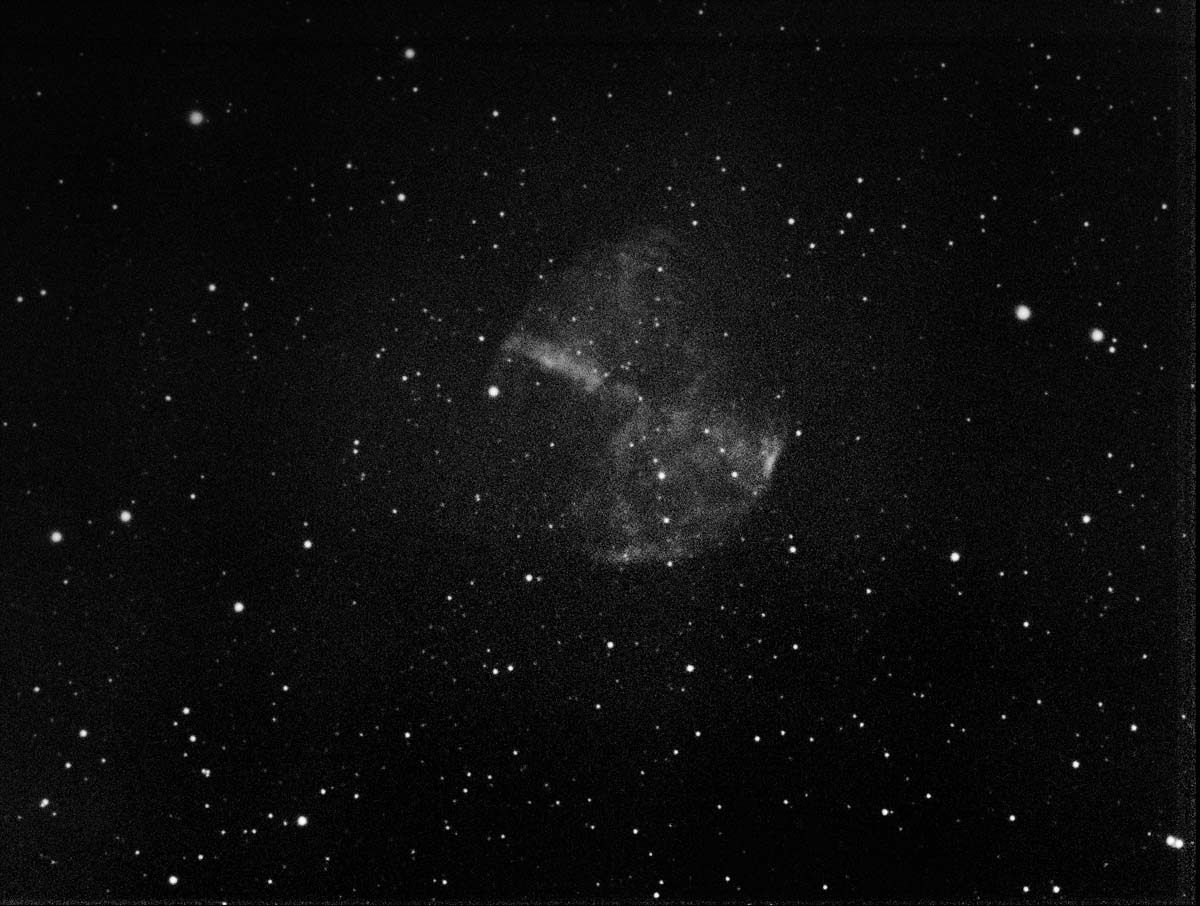
The OIII filter activated another spectral part of the object. Again, this is the result of five 130-second images. This filter isolates the 496 nm and 501 nm bands of the light spectrum, thus allowing the observation of planetary and diffuse nebulae.
|
 |
Finally, to conclude, 5 more 130-second images. These are taken with the SII filter, which activates another part of the spectrum and identifies traces of sulfide in the object. Like the HA filter, the SII filter allows red light to pass through, but at a higher frequency, around 672.4 nm, which is the region of the spectrum corresponding to sulfide.
|
After processing, I couldn't resist combining the images using the LRGB method.
By placing H-Alpha in the red spectrum, OIII in the green, and SII in the blue, the result was magical:
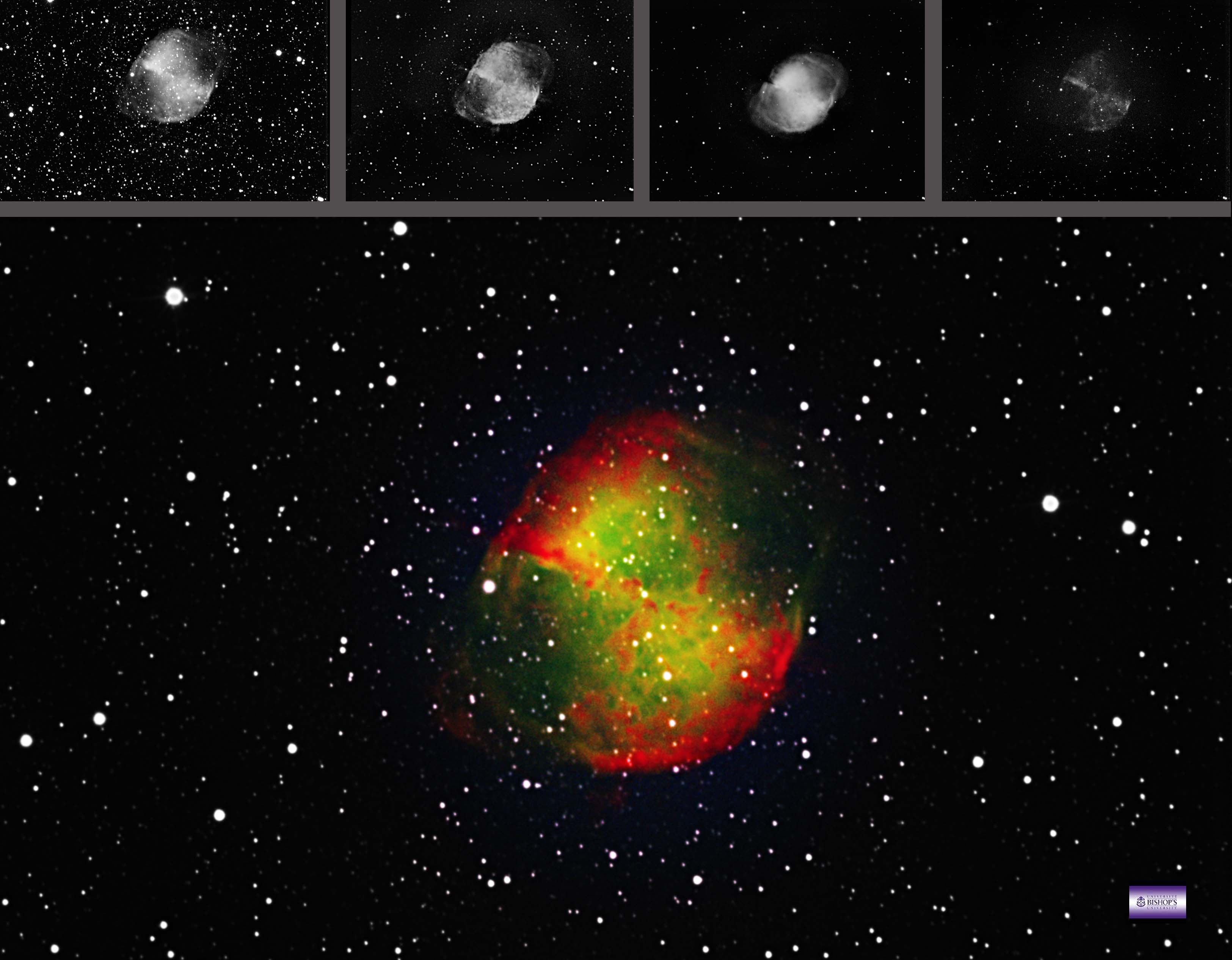
This photo was submitted to the Quebec "24 Hours of Science 2017" competition where it won first prize!
But the interest doesn't end there, because if you look closely...
- You'll notice that the sulfide traces are minimal.
- On the other hand, OIII, or ionized hydrogen, is very abundant towards the center of the object (in green), and the red traces clearly confirm the presence of hydrogen.
- At the center, you can see the bluish white dwarf responsible for the object, which now has a magnitude of only 13.5 and a temperature of 85,000 K.
* It is also accompanied by another, even fainter star with a magnitude of 17.
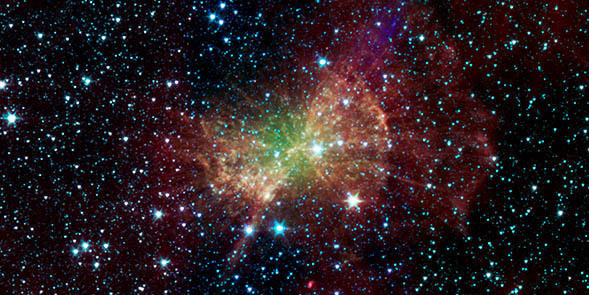
This image was created using data from the Spitzer Infrared Array Camera (IRAC).
Blue represents infrared light with wavelengths of 3.6 microns, green represents light at 4.5 microns, and red represents light at 8.0 microns.
References:
*un parsec = 3,26156 AL
* http://www.spitzer.caltech.edu/images/4409-sig11-011-Weighing-in-on-the-Dumbbell-Nebula
* http://www.astronoo.com/fr/nebuleuses.html
* http://www.astropolis.fr/catalogue-Messier/articles/M27/astronomie-messier-M27.html#d%C3%A9couverte
JBD - Février 2018