

Article en Français
Will Betelgeuse soon explode as a supernova?
For several months, this star has been the subject of much discussion due to a sudden and poorly understood drop in brightness. It has been the subject of much discussion among several science journalists, so much so that one of them even referred to it as another Dyson sphere to explain its new state. Since stars interest me and are the raw material of my passion for astronomy, I tried to gather as much information as possible on the subject to better understand how this star, which was the 9th brightest in our sky, was relegated to 21st place.
Looking at the facts, firstly, Betelgeuse is classified as a semi-regular variable, and therefore, like any self-respecting variable star, it varies!
According to variable star specialists, the AAVSO (American Association of Variable Stars) classifies Alpha Ori as a CRS, meaning a "late-type semi-regular supergiant (M, C, S or Me, Ce, Se) with amplitudes of approximately 1 magnitude and periods of light variation from 30 days to several thousand days."
From a spectral perspective, the AAVSO database indicates its spectral type varies between M1 and M2 la-Iab.
(https://aavso.org/vsx/index.php?view=detail.top&oid=24710)
Using their databases, let's plot the curves of its variations from 1900 to the present day, relying solely on reports of visual observations (black circles) and those using a CCD camera with a "V" photometric filter (green squares). We obtain this graph and discover an estimated period of 423 days, but also cycles that repeat every 5 to 6 years:
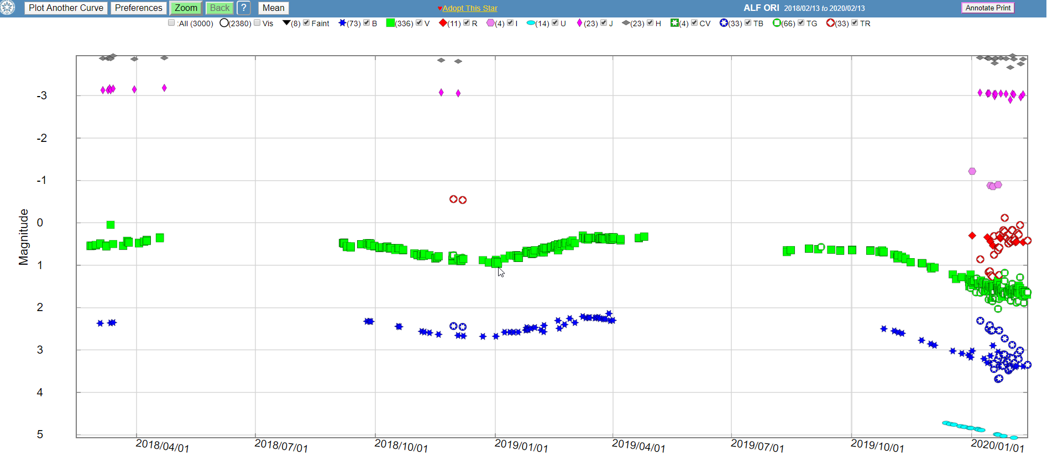
Since its last dip was around January 1, 2019, its next cycle should begin around February 27, 2020. Normally, we will know for sure after this date.
It should also be noted that the star varies both radially (like a Cepheid variable) and non-radially (think of a water balloon being squeezed; its volume doesn't change, only its shape).
On this graph, it's easy to see that this star is much less stable than our Sun, which is classified as "G," much younger and hotter, and still far from becoming a red giant. To better visualize this, the best tool is still the Hertzsprung-Russell diagram, from which we can easily see the star's state, which is far from the main sequence, and its surface temperature, which would not exceed 4000 Kelvin.
This means that the further a star is from the main sequence, the more susceptible it is to variation, transformation, or even imminent death.
Recently, Sara Beck, the AAVSO technical assistant, searched the 36,743 observations of the star compiled in the AAVSO database, starting with the first recorded image on December 10, 1893. Pending a definitive analysis, Sara agreed that the current minimum appears to be one of the weakest in over a century.
However, it should be noted that research by some astronomers reports that the star has indeed dimmed in the U, V, B, R, and I spectral ranges—that is, in the visible spectrum—but has remained unchanged in the J and H ranges of the infrared. This suggests that the star's integrity may not have changed, but that something is blocking its luminosity from reaching us, dusty as we are.
To find out more, see the excellent interview by Guillaume Doyen with two researchers from the Côte d'Azur Observatory, Miguel Montargès and Eric Lagadec.
https://www.youtube.com/watch?v=lE5zQsGUXbI&feature=emb_rel_end
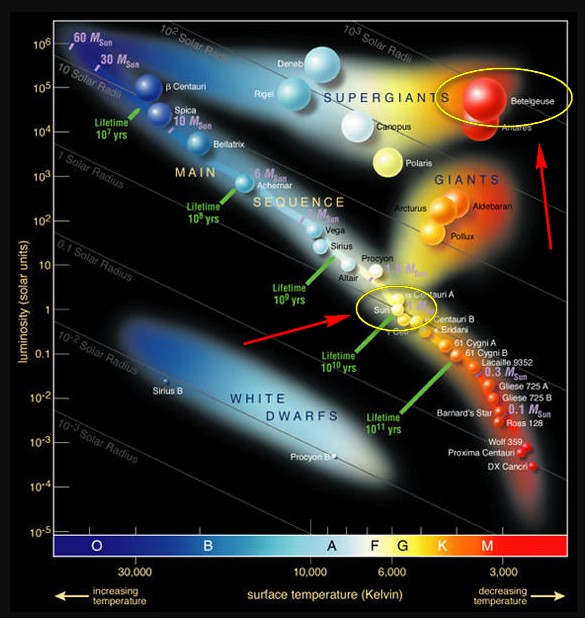
According to the Hertzsprung-Russell (HR) diagram, compared to our Sun, which is only 4.56 billion years old, at the end of its life (in about another 5 billion years), our Sun will grow larger and larger, eventually becoming a red giant. In the Hertzsprung-Russell (H-R) diagram, it will occupy a position "close" to the current location of Betelgeuse. Then, it will lose its outer layers, retaining only its core, a white dwarf that will slowly cool. This alternative version of the H-R diagram allows us to follow its end-of-life trajectory and also compare it with the location of Betelgeuse, which was also, long ago, a star that lived a very stable life on the main sequence.
The Sun's Life Path:
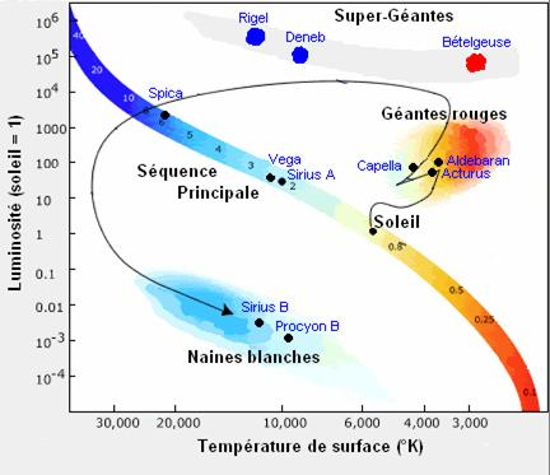
Hertzsprung-Russel diagram life version of the Sun
(source : astrosurf.com/cieldaunis/conf-masse/lumiere)
Because the Sun's mass is much smaller, it will not explode as a supernova, unlike Betelgeuse, which is a much more massive star and, according to models of stellar evolution over time, is estimated to be about 8.5 to 10 million years old. Betelgeuse's death will be spectacular and even visible in broad daylight.
Regarding its mass, it was thought until recently that Betelgeuse was 430 light-years away, which, based on its measurable diameter, would give it a diameter of approximately 7 to 7.5 astronomical units.
It is thanks to the Stefan-Boltzmann law that we can calculate the radii of stars, and it was thought that Betelgeuse's mass had been estimated at 550 times that of our Sun, and therefore with a radius extending to the midpoint of the distance between Mars and Jupiter. It has a mass 10 times greater than that of our Sun, but is 1400 times its size and under normal conditions, it is 14,000 times brighter than the Sun, which made it the 9th brightest star according to Wikipedia.
(https://fr.wikipedia.org/wiki/Liste_des_%C3%A9toiles_les_plus_brillantes).
Note: Thanks to the Stefan-Boltzmann law, astronomers can calculate the radius of stars.
The luminosity L of a star is written: L = 4πσR²T⁴
L is the luminosity, σ is the Stefan-Boltzmann constant, R is the radius of the star, and T is its temperature.
However, new research has now estimated its distance at 720 light-years and even slightly more, which would make its diameter greater than the distance between Jupiter and the Sun, which is 5.2 astronomical units. A diameter of 11 astronomical units was thus suggested before its decrease in magnitude, and since its decrease, a diameter of 9 astronomical units is calculated. (Ciel et Espace 2009-08)
Its temperature was also discussed, not exceeding 4000 Kelvin, but recently the Wasatonic Observatory concluded, after observing Orion's left shoulder, that it has a temperature of 3545 K and has been downgraded to class M3.5lab, meaning it has cooled by 3% (80 K). (http://www.astronomerstelegram.org/?read=13365)
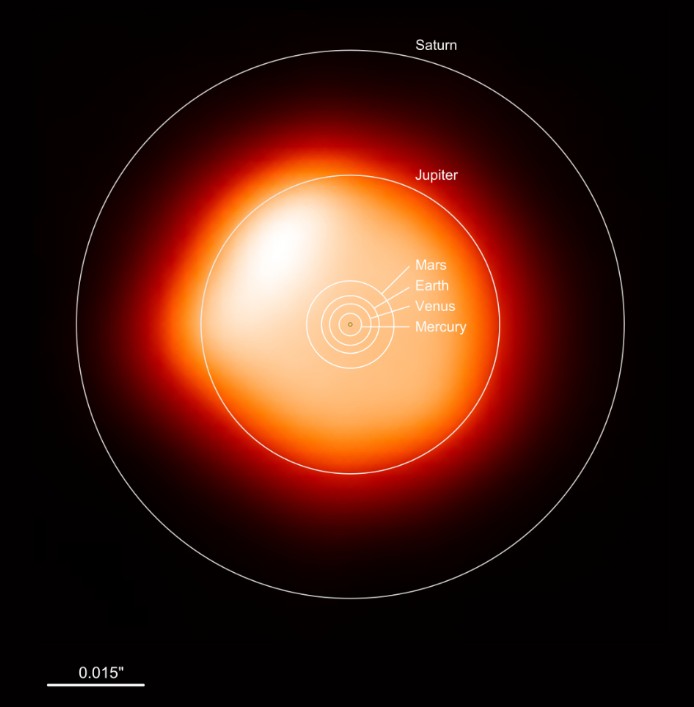
In fact, it has been reported that Betelgeuse has been dimming for about 15 years. An article published by Futura Science on June 14, 2009, mentions that:
"The results obtained by Michelson and Peasa, for example, were in the visible spectrum, but for a long time, astronomers at UC Berkeley's Infrared Spatial Interferometer Array (ISI) atop Mount Wilson in California have been observing and measuring the characteristics of stars in the infrared using aperture synthesis.
With his colleague Edward Wishnow, Charles H. Townes, the renowned 1964 Nobel laureate in Physics for the invention of the laser, has been conducting observations for years using the ISI instrument. They have reached a rather surprising conclusion. Although Betelgeuse's luminosity has not decreased on average since 1993, its diameter has shrunk!
The shrinkage of the supergiant is not negligible. In 15 years, this star's radius has shrunk by a distance equal to that between Venus and the Sun. Even better, the process seems to be accelerating..."
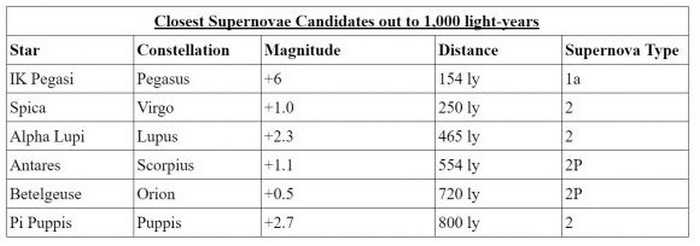
To conclude this report, Betelgeuse is among the next prospect stars to explode as a supernova:
From my side...
Since then, I've wanted to participate in the monitoring and do my part by being proactive.
I first consulted the AAVSO website for the latest observations of Betelgeuse:
https://aavso.org/apps/webobs/results/?star=BETELGEUSE&num_results=200
I immediately noticed three things:
1- The average magnitude is between 1.5 and 1.2 (for December 2019).
2- One of the observers used a CCD to obtain a magnitude of 1.281 with a V filter and an error of only 0.004, which I consider quite accurate.
3- Other observations were made with U and B filters. Betelgeuse radiates at 3.082 with a B filter and 4.799 with a U filter! One of my good physicist friends, Mario Lessard, considered this perfectly normal.
"These cool stars at the end of their lives produce a lot of neutral atoms and molecules/dust, which 'hides' the visible red continuum and even causes an excess in the near-infrared (the dust then radiates like a black body). Carbon stars, for example, show almost no visible red! The blue 'doesn't change' unless the star is located in the plane of the galactic center or in a cocoon of dusty circumstellar matter that absorbs more blue (this is also why blue B-V stars located in the dense regions of the Milky Way's center still appear red to the naked eye)."
From the middle of spectral class K and M-, standard photometric tools (B-V index and others) are often of little use for classifying these stars, and astronomers instead use other tracers such as the ratio of TiO or ZrO bands versus other lines...
These spectral types are very difficult to calibrate, and often the boundary between a K5 and an M0, for example, is very blurry!
So I set up a few beautiful evenings in my observatory (which is rare in December here in Quebec!) and I took spectra which I continued until February 2020 in order to follow the luminosity flux and the chemistry of the star:
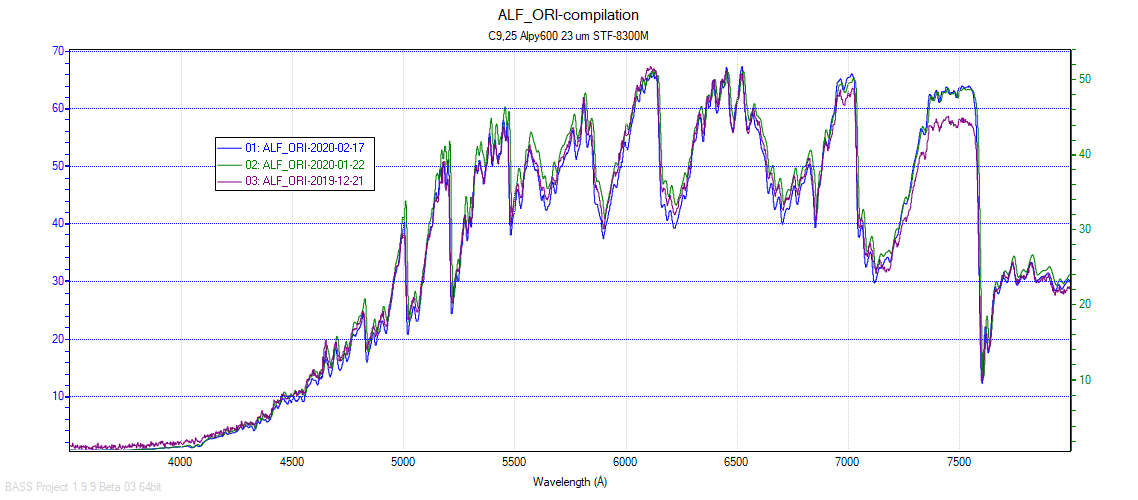
We can already see some differences in the TiO₂ (Titanium Oxide) ranges. I've shared these spectra on the forum and also in the AAVSO database.
A few days later, on December 31, 2019, the well-known English astronomer, Robin Leadbeater, a renowned figure in amateur spectroscopy, posted on the forum Cette adresse courriel est protégée contre les robots spammeurs. Vous devez activer le JavaScript pour la visualiser. a spectral montage with which I was able to compare myself, and where the differences in the titanium oxide (TiO) bands are still visible. Its website is the: www.threehillsobservatory.co.uk
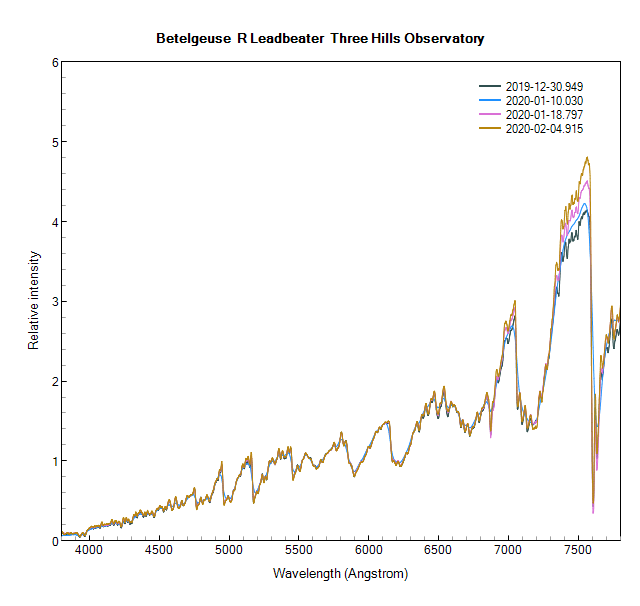 The ultimate goal would be to perform long-term dynamic spectroscopic monitoring, combining over 150 observations to create a picture that follows the arrow of time. This would allow us to obtain a portrait of the changes in this popular star.
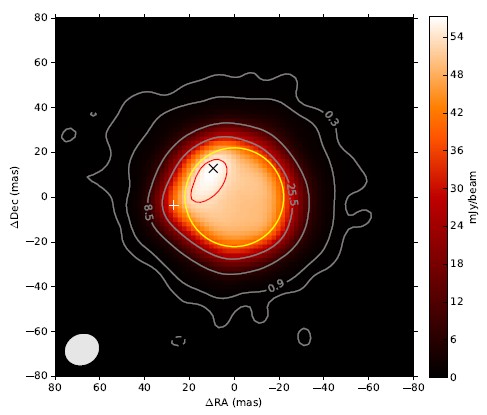
« The inhomogeneous sub-millimeter atmosphere of Betelgeuse »
Astronomy & Astrophysics manuscript no. aanda June 20, 2017
O’Gorman, P.Kervella, G.M.Harper, A. M. S. Richards, L.Decin, M.Montargès, I.McDonald
Conclusion:
We also know that this star is releasing a lot of matter, mainly at its poles.
But if the recent mass loss is equatorial rather than polar, this will be demonstrated in high-resolution spectra (VSINI). The vibrational energy of the molecules formed will also be more visible in radio waves, so I'd bet a small 2 that by the time I'm writing this, there will be more radio observations soon.
So, to answer the first question, yes, Betelgeuse will explode as a type 2 supernova… but not right away, sometime between tomorrow and 100,000 years from now.
So, stay tuned… starting at the end of February.
JBD-2020
References:
Dyson Sphere:
(https://camaraderielimited.fr/la-star-de-betelgeuse-agit-comme-si-elle-etait-sur-le-point-dexploser-meme-si-les-chances-le-disent/)
(*Sphere de Dyson - https://fr.wikipedia.org/wiki/Sphère_de_Dyson)
To learn more:
https://arxiv.org/pdf/1706.06021.pdf
http://www.astronomerstelegram.org/?read=13365
https://www.skyandtelescope.com/observing/fainting-betelgeuse/
https://www.aanda.org/articles/aa/full_html/2017/06/aa31171-17/aa31171-17.html
https://arxiv.org/abs/1012.0377
https://www.researchgate.net/publication/333961832_The_many_faces_of_Betelgeuse
https://arxiv.org/abs/1506.07536
https://arxiv.org/abs/1304.2780
https://arxiv.org/abs/1912.12539
https://arxiv.org/abs/1105.3273