

TITIUS-BODE LAW
I don't remember where I first saw this law, but it was a shock to me, almost a revelation.
That one could predict the position of the planets in the solar system using such a simple formula...
 |
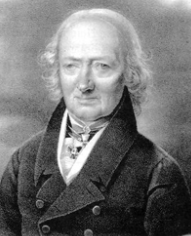 |
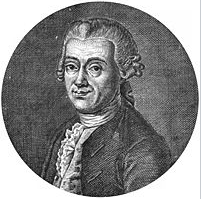
| Johann Daniel Titius | Johann Bode |
The story begins with Johann Daniel Tietz (also known as Titius), a German astronomer and professor in Wittenberg. He noticed that this sequence seemed to explain the average distance of each of the known planets from the Sun. It is thanks to Johann Bode, director of the Berlin Observatory, that this observation, known as the Bode-Titius rule, was popularized.
Since the work of the German astronomer Johann Elert Bode in 1772, astronomers everywhere had been wondering about this hypothetical planet: Bode had found that the positions of the planets in the solar system known at the time agreed with an empirical law discovered in 1766 by the mathematician Johann Daniel Tietz (who signed his work with the Latin pseudonym Titius).
He had established a relationship between the radii of planetary orbits. This relationship was later validated by Hershel in March 1781 by the discovery of Uranus, which prompted Johann Bode to search for the missing planet between Mars and Jupiter.
The law in practice:
By taking a sequence of numbers from the multiplication by 3 sequence: 0, 3, 6, 12, 24, 48, 96, 192, adding 4 to each, and
dividing by 10, we obtain a new sequence: 0.4; 0.7; 1; 1.6; 2.8; 5.2; 10; 19.6
Now, it turns out that the range of distances from the Sun, expressed in astronomical units (AU), of the five planets known in the mid-18th century fits well with this latter sequence. When Titius published this empirical law in 1766, only two planets were missing, which should be located at 2.8 and 19.6 AU from the Sun.
(0 + 4) / 10=0,4 ---> Mercury : 0.39
(3 + 4) / 10=0,7 ---> Venus : 0.7
(6 + 4) / 10=1 ---> Earth : 1
(12 + 4) / 10=1,6 ---> Mars : 1.52
(24 + 4) / 10=2,8 ? : Ceres : 2.8 UA, Vesta : 2,361 UA, Pallas : 2.77 UA et la ceinture d'astéroides entre Mars et Jupiter.
(48 + 4) / 10=5,2 ---> Jupiter : 5.2
(96 + 4) / 10=10 ---> Saturn : 9.55
(192 + 4) / 10=19,6 ---> Uranus : 19.6
(384 + 4) / 10=38,8 ---> Neptune : 30.069
(768 + 4) / 10=77,2 ---> Pluto : Entre 29.7 UA et 49.5 UA
|
Planet |
Titius-Bode Law |
|
Real values |
|
|
|
Error |
|
|
|
Assigned Rank |
Predicted distance |
Semi-major axis |
Periphery |
Aphelia |
Eccentricity |
absolue |
relative |
|
-∞ |
0,4 |
0,387 |
0,307 |
0,467 |
0,206 |
0,013 |
3,4 % |
|
|
1 |
0,7 |
0,723 |
0,718 |
0,728 |
0,007 |
0,023 |
3,2 % |
|
|
2 |
1,0 |
1,000 |
0,983 |
1,017 |
0,017 |
0,000 |
0,0 % |
|
|
3 |
1,6 |
1,523 |
1,381 |
1,665 |
0,093 |
0,077 |
5,1 % |
|
|
4 |
2,8 |
2,765 |
2,547 |
2,983 |
0,079 |
0,035 |
1,3 % |
|
|
5 |
5,2 |
5,203 |
4,953 |
5,453 |
0,048 |
0,003 |
0,1 % |
|
|
6 |
10,0 |
9,537 |
9,022 |
10,052 |
0,054 |
0,463 |
4,9 % |
|
|
7 |
19,6 |
19,229 |
18,325 |
20,133 |
0,047 |
0,371 |
1,9 % |
|
|
8 |
38,8 |
30,069 |
29,798 |
30,340 |
0,009 |
8,731 |
29,0 |
* Pluto : Entre 29.7 UA et 49.5 UA
This law was gaining ground until the discovery of Neptune in 1846 by Urbain Le Verrier, whose characteristics he calculated as a hypothetical cause of the anomalies in the movements of Uranus. This planet, however, was 30 AU from the sun and not 38.8 AU as predicted by Titus' law.
In the asteroid belt between Mars and Jupiter (2-3 AU), a planet was indeed predicted and named Phaethon.
Current thinking maintains that the asteroids of the main belt are remnants of the protoplanetary disk, their accretion into a planet having been rendered impossible by the large gravitational perturbations induced by Jupiter during the formation of the solar system.
However, in March 2002, a new theory was presented by NASA scientists John Chambers and Jack Lissauer at the 33rd Lunar and Planetary Science Conference. Based on simulations, such a planet could have existed approximately 3.9 billion years ago.
Is this theory correct, but have there been significant changes in the solar system? Could the Late Heavy Bombardment have created these differences? Or is this law merely a curiosity, and are these distances simply a matter of chance that science cannot explain?
We'll likely find out with future exoplanet discoveries! It's crazy, isn't it?
Suggested readings and references:
http://www.cosmovisions.com/Titius.htm
https://fr.wikipedia.org/wiki/Johann_Daniel_Titius
https://fr.wikipedia.org/wiki/Loi_de_Titius-Bode
https://fr.wikipedia.org/wiki/Urbain_Le_Verrier
https://fr.wikipedia.org/wiki/Phaéton_(planète)
https://fr.wikipedia.org/wiki/Némésis_(étoile_hypothétique)
http://www.messagetoeagle.com/mystery-of-planet-v-was-there-once-a-5th-planet-between-mars-and-the-asteroid-belt/
JBD-2018