

Article en Français
NGC 2261 - A peculiar Herbig...
As early as 1990, a colleague and friend, Gilbert St-Onge, was scientifically observing this star, R MON. It fascinated the renowned Edwin Hubble, who even made it the first object observed by the Polomar telescope, named Hale, in January 1949, during its "first light." Other images dating from 1908 were added to the collection to search for any changes in the object over time. Gilbert continued the project by observing changes in the nebulosity. In 2020, he enlisted the help of an astrophotographer to encourage observations and formed a group for annual monitoring of the star R MON and its nebula, NGC 2261, in order to detect any changes.
NGC 2261 (also known as the Hubble Variable Nebula or Caldwell 46) is a variable nebula located in the constellation Monoceros (the Unicorn). It is illuminated by the star R Monocerotis (R Mon), which is not directly visible.
|
The star, a Herbig Ae/Be type object: It is a massive star in its adolescence that has not yet reached the main sequence. Its energy source still largely comes from gravitational contraction (the Kelvin-Helmholtz mechanism) rather than stable nuclear fusion, a characteristic of young stellar objects (YSOs) still forming. It is surrounded by a dense protoplanetary disk, which is the true driving force behind the variability of NGC 2261. It is therefore a reflection nebula composed of a fan-shaped cloud of gas and dust, illuminated by R Monocerotis (R Mon), the bright star located at the lower edge of the nebula. Thick dust condensations near the star cast shadows in the nebula, and their movement alters the lighting, explaining the variations initially observed by Hubble. The star itself, located approximately 2,500 light-years from Earth, is directly invisible, visible only through the light scattered by dust particles in the surrounding nebula. R Mon is estimated to have a mass about ten times that of the Sun and an age of only 300,000 years. A symmetrical, fan-shaped nebula likely exists on the southern side of the star, but it is heavily obscured by dust between this lobe and our line of sight. According to L. M. Close et al. (1997), R Mon is a binary star whose two components are separated by a distance of 0.69 arcseconds, at a position angle of approximately 29° ± 1° (northwest) from R Mon. This companion is thought to have a mass of about 1.5 solar masses and to be very young (less than 3 × 10⁵ years), of the classic T Tauri type (it is very red).
|
Figure 1 : Image Credit & Copyright: Tommy Lease (Denver Astronomical Society) |
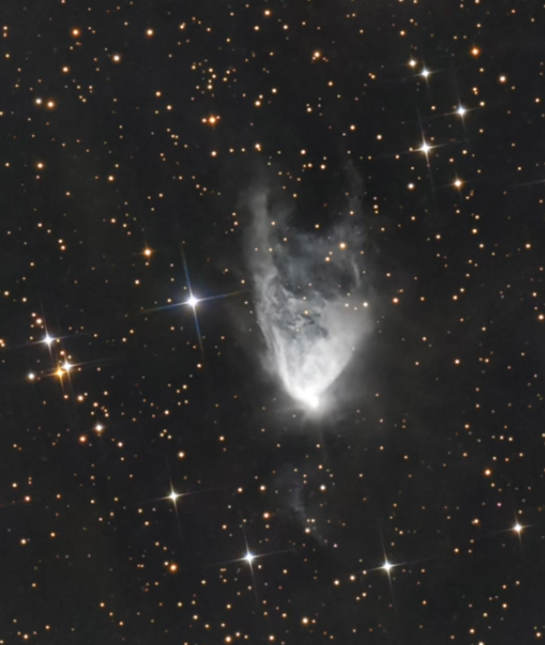
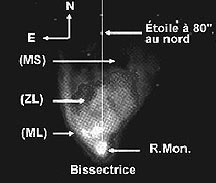
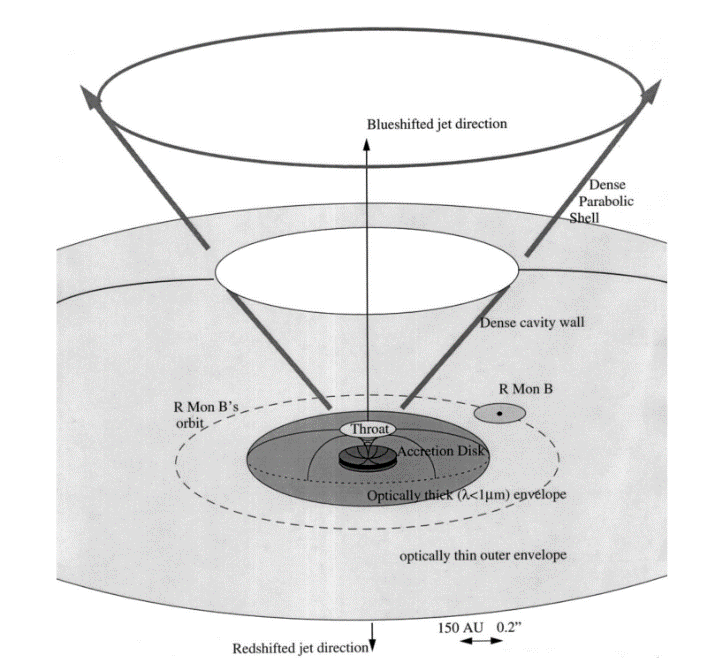
Figure 2 Figure 3
From our point of view:
From our angle of view, we only see the cone of the upper jet. But in reality, a T Tauri star emits two jets of matter, in addition to forming an accretion disk and a nebula that envelops it.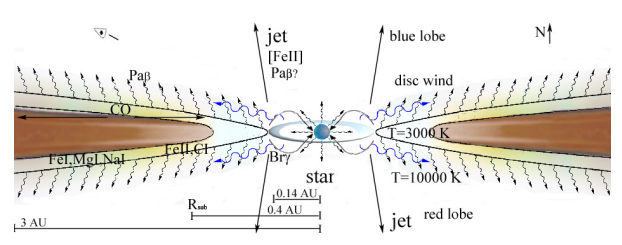
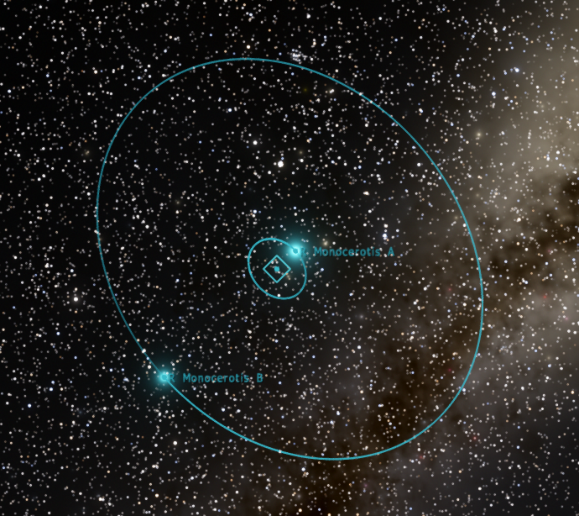
Figure 4 : A&A 554, A66 (2013) - LBT/LUCIFER near-infrared spectroscopy of PV Cephei Figure 5
Other observations since 1993:
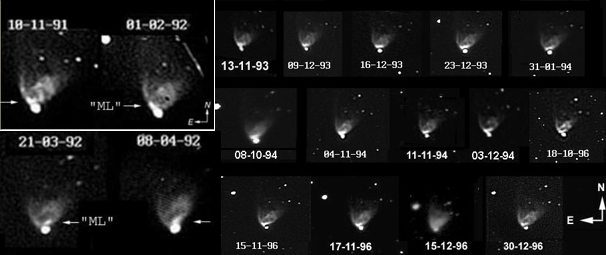
Figure 6
And many more recent observations…
For years, several amateur astrophotographers have joined the research group and provide remarkable images of R MON to ensure good follow-up of the star and its nebula.
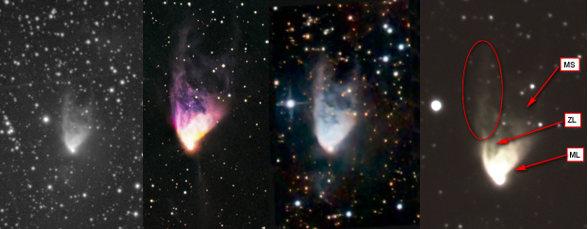
Figure 7 - Courtoisie Gilbert St-Onge
Evolution of the nebula
The nebula spans approximately 1 to 2 light-years. R Monocerotis itself is difficult to observe directly due to the surrounding dust that moves in tandem with the young, rogue star, although it is clearly visible in the infrared. Visually, the rapid changes in NGC 2261 are not due to the movement of matter, but rather to a play of shadows. Clumps of dust orbiting near R Monocerotis obscure its light, casting giant shadows on the nebula's walls. Like a lighthouse sweeping through the fog, a small movement near the star results in a dramatic, large-scale transformation in just a few weeks. For example, since 2015, the disappearance of a jet-like structure (Lightfoot (1989)) has been noted.
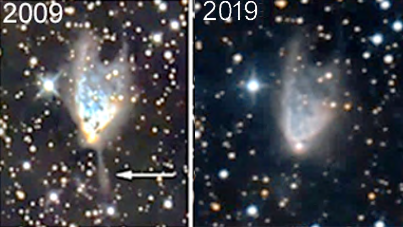
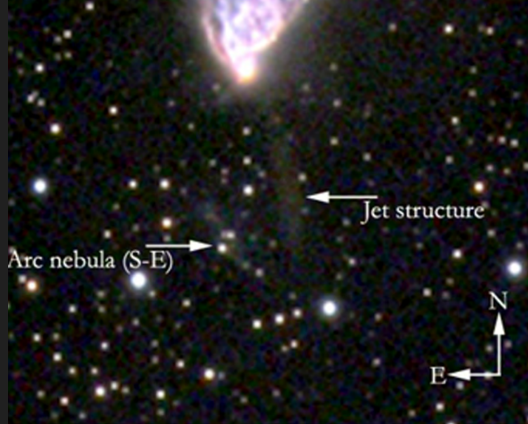
Figure 8-9 -10 - Courtoisie Gilbert St-Onge
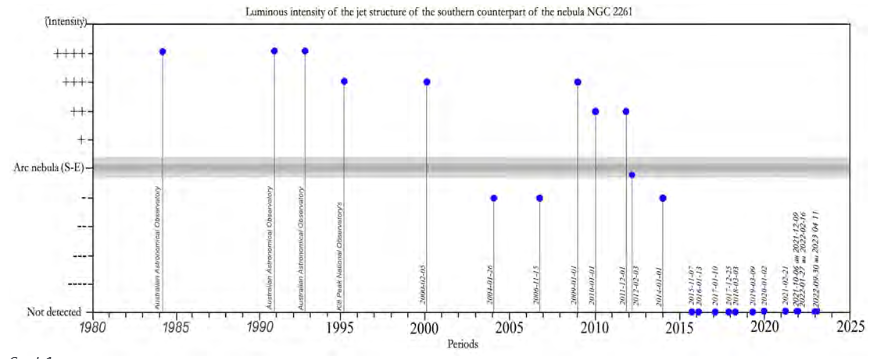
Figure 11- Courtoisie Gilbert St-Onge - From RASC 2025
Involvement of the OMSJ (Mont St-Joseph Observatory)
I joined the group in 2020, my goal being to observe it, not only through astrophotography—because yes, the star and its nebula are very beautiful—but also and especially through photometry and spectroscopy to better understand it… I'm curious!
My first images were analyzed in DS9 to establish reference points for the nebulosity:

Initial photometric observations:
From a photometric point of view, the variability is normal for a HerBig star.
In 2020, the star had a magnitude of 10.92. In subsequent years, its magnitude increased slightly, but by the last observation in November 2024, it had returned to its 2020 level.
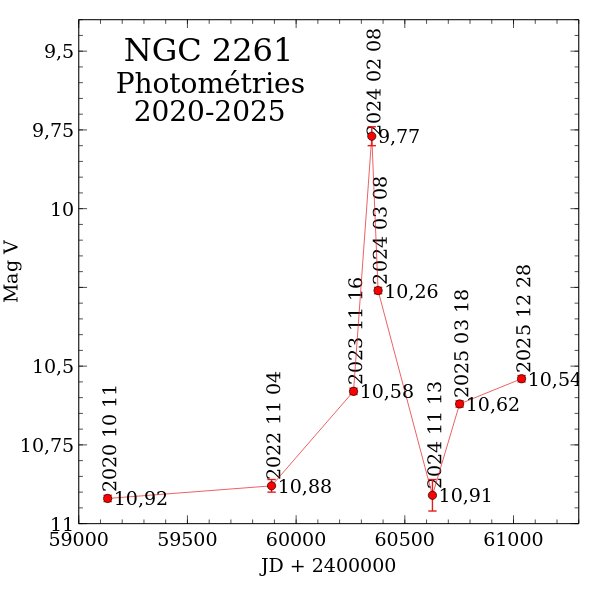
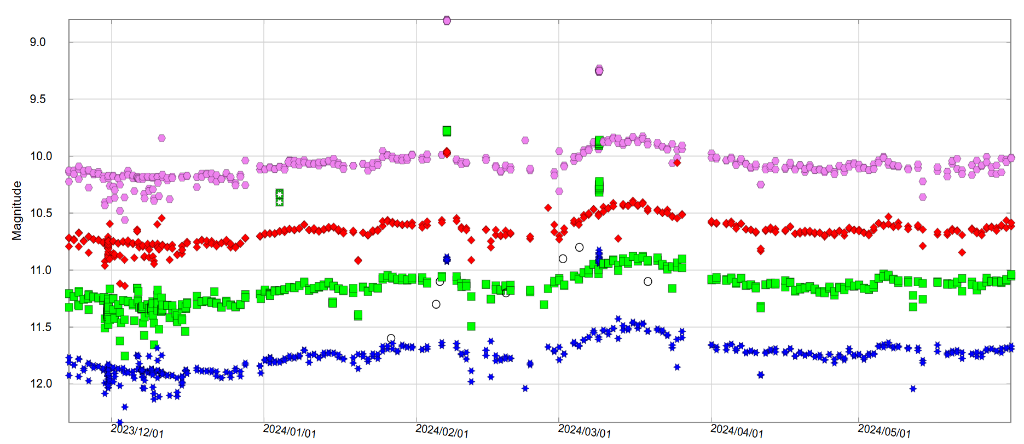
Figure 13 - Photomrtry NGC2261 202-2024 - OMSJ Figure 14 – Source AAVSO

Photometry table 2020-2024 – OMSJ
Then low-resolution spectroscopy.
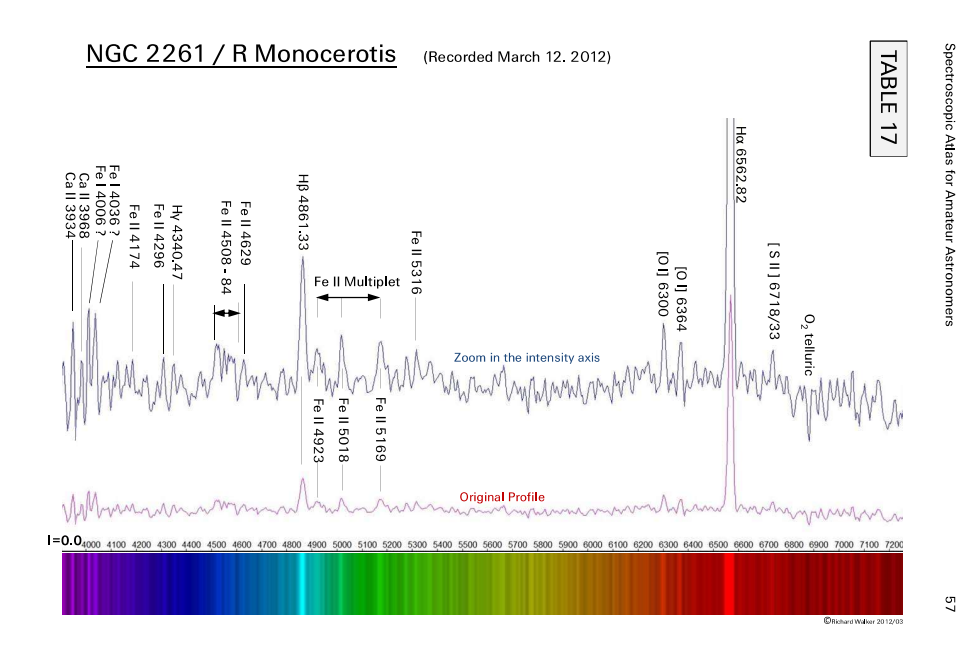
References (Spectral Atlas for Amateur Astronomers, Richard Walker, Table 17 – P57)
Compilation 2020-2024
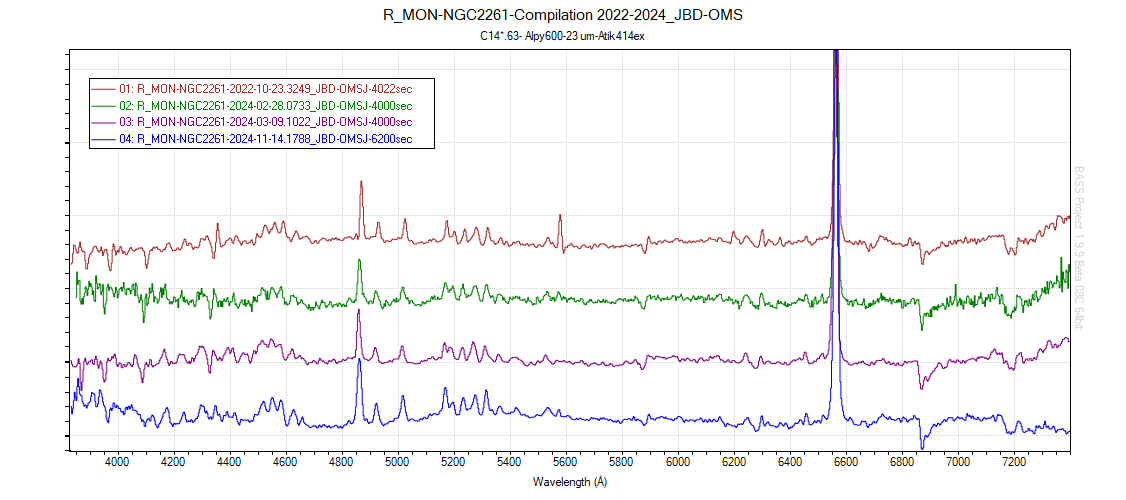
Figure 16
Compilation 2020-2024 – Composition of rays
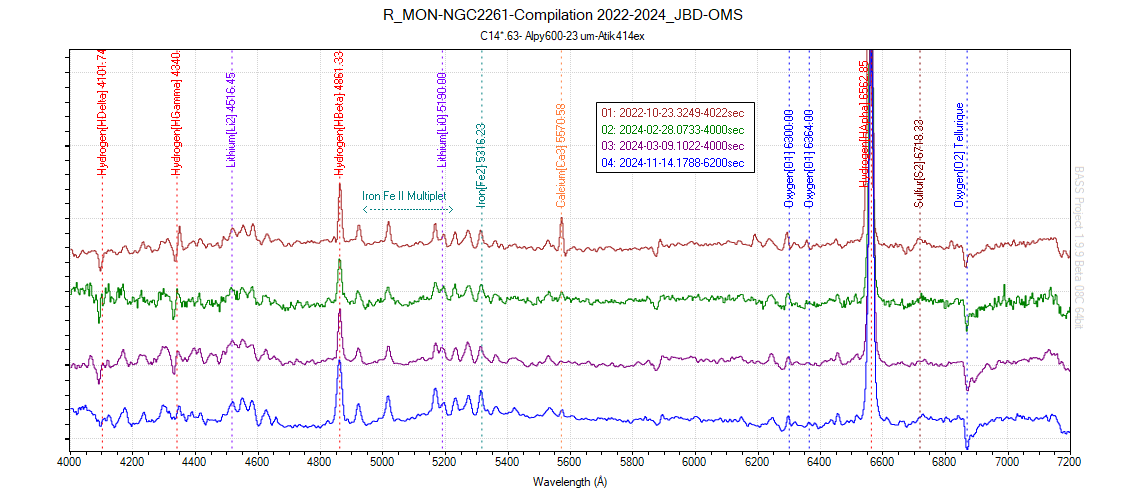
Figure 17
2020-2024 Compilation – Analysis of the main changes over the past 4 years
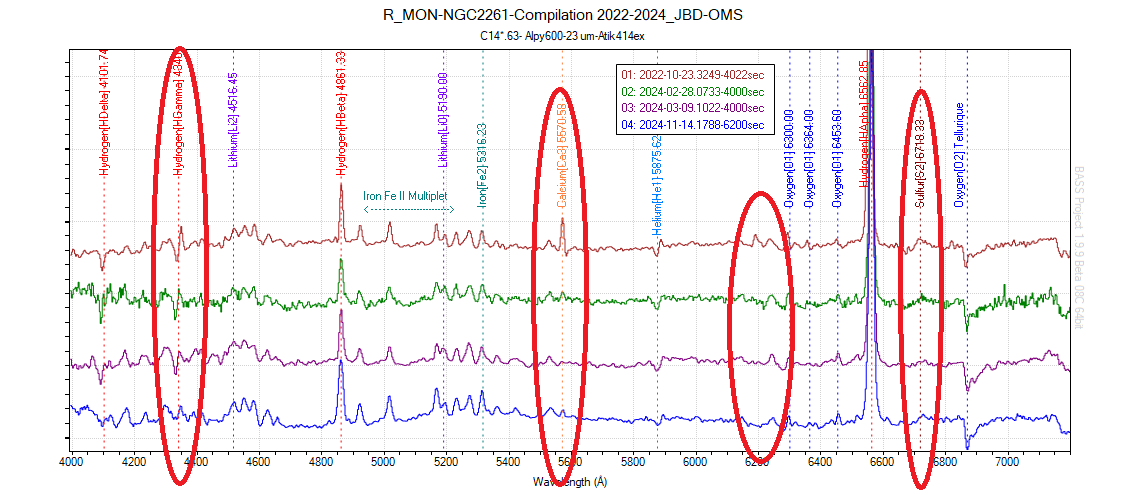
Compilation 2020-2024 – Comparison of spectro/photometric results
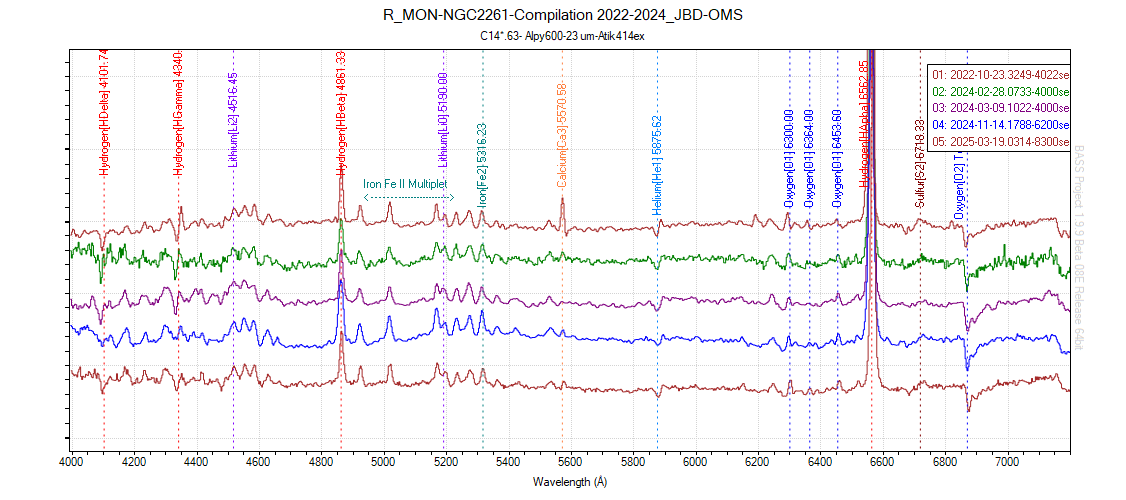
We observe that the emission of the calcium line at 5570.58 Å (Ca II) increases, as does that of all the Balmer lines, contrary to the photometric values. When the star's intensity is high, the emission of calcium and some Balmer lines is low.
According to Kazaryan and Khachikyan (1972), hydrogen and calcium emission is more intense when the star's luminosity approaches its minimum. Then, near maximum luminosity, the emission lines weaken. The hydrogen absorption lines then become dominant in the spectrum; they are larger and deeper.
Greenstein J. L. and E. E. Khachikyan (1974) also observed the opposite phenomenon: strong emission lines, particularly that of Ca II, when the star was near its maximum intensity. Conversely, when the star was near a minimum, the CaII emission lines disappeared, and those of the other elements weakened.
Is this phenomenon common to YSOs or to certain families of young stars? Further research and monitoring are needed to find a common factor and a pattern. However, we already know that these spectral contradictions (the reversal of intensity of the calcium and Balmer lines) illustrate the complexity of accretion processes. The increase in emission lines during luminosity minima suggests that the disk material obscures the star's main body but allows the "chromosphere" or gaseous shocks of the jets to be seen. This phenomenon is typical of YSOs, where the interaction between the star's magnetic field and the inner disk creates episodes of erratic energy bursts, which can also simply translate into more matter in the nebula.
Greenstein & Khachikyan (1975) documented these spectral changes, and more recent studies (such as those by Mora et al. 2001) confirm that stellar winds and accretion vary erratically in these young stars. R Mon is not just a "star"; it is a complex system where a dust disk (the circumstellar disk) plays the main role in shaping the light we see.
Updated in 2025 :
Upcoming projects for 2026
Currently, a group of astrophysics students at Université Laval are studying this case and have even made it one of their research challenges. Astrophysicists are also sponsoring the project.
The results of observations conducted at the Mont-Mégantic Observatory are also expected in 2026. Observations are ongoing…
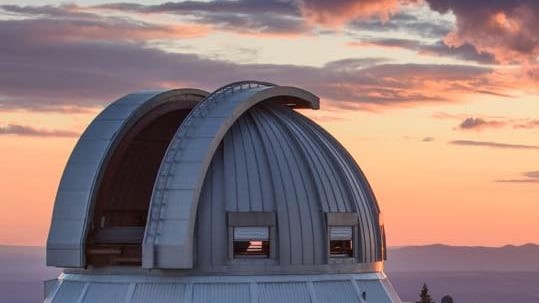
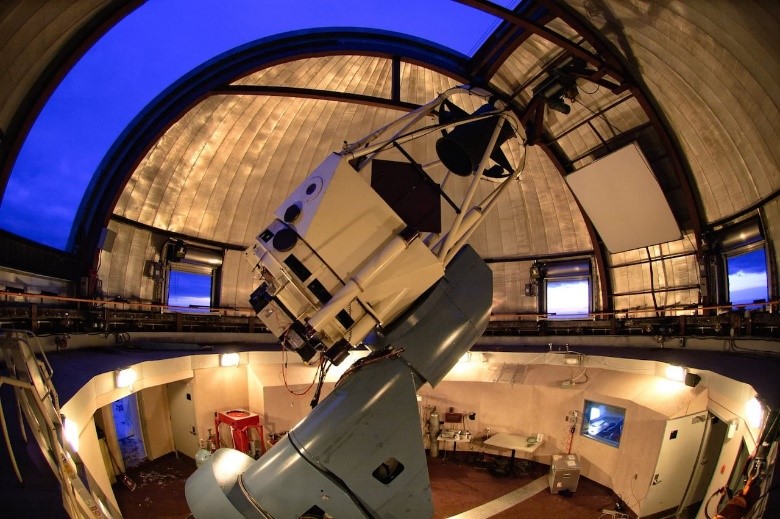
Figure 21 – Courtesy of the OMM Figure 22 – Courtesy of the OMM
The adventure continues…
JBD-2026
Bibliography and Scientific References
On the nature of the object (Herbig Ae/Be):
- Hillenbrand, L. A., et al. (1992). "The nature of the early-type stars associated with reflection nebulae". Astrophysical Journal.
On variability and "shadow puppets":
- Close, L. M., et al. (1997). "Adaptive Optics Infrared Imaging of R Monocerotis and NGC 2261". Astrophysical Journal.
- Lightfoot, K. (1989). "Structure and variability in the Hubble's Variable Nebula (NGC 2261)". Monthly Notices of the Royal Astronomical Society.
On spectral analysis and emission lines (The Kazaryan/Greenstein debate):
- Greenstein, J. L., & Khachikyan, E. E. (1975). "The spectrum of R Monocerotis". Astrophysics.
- Kazaryan, M. A., & Khachikyan, E. E. (1972). "Spectrophotometric study of the nucleus of the nebula NGC 2261". Astrophysics.
Regarding recent developments and observational monitoring:
In the JRASC (Journal de la "Royal Astronomical Society of Canada)
*G St-Onge et al. / Observation of some intense knots of Herbig-Haro 39, which is associated with the star R Monocerotis and the variable nebula NGC 2261
Octobre 2025 / p 180 à 183 et ensuite p 190 à 194
https://rasc.ca/sites/default/files/publications/JRASC-2025-10-lr.pdf
*G St-Onge et al. / In Hubble Nebula (NGC 2261) a jet-like structure to the south has disappeared from images since a decade
Avril 2025 / p 64 à 71 et ensuite p 78 à 80
https://rasc.ca/sites/default/files/publications/JRASC-2025-04-lr.pdf
*G St-Onge et al. / In Hubble Nebula (NGC 2261) a jet-like structure to the south has disappeared from images since 2015
Octobre 2023 / P 181 à p 188
https://rasc.ca/sites/default/files/publications/JRASC-2023-10-lr.pdf
*G St-Onge et al. / In Hubble Nebula (NGC 2261) a jet-like structure to the south has disappeared from images since 2015
Août 2022 / p128 à 134
https://rasc.ca/sites/default/files/publications/JRASC-2022-08-lr.pdf
In the magazine The Skyward de la RASC de Montréal "Royal Astronomical Society of Canada"
https://rascmontreal.org/members-area-library/skyward-issues/
*G St-Onge et al / Dans la nébuleuse variable de (Hubble) NGC 2261, Une structure en jet est disparue sur nos images depuis quelques années
Skyward de juillet - août 2021 / p 21 à p 26
https://rascmontreal.org/SkywardAccess/Skyward_2021/Skyward_Jul-Aug_2021.pdf
* G St-Onge et al / In Hubble‘s Variable nebula, NGC 2261
Skyward de Mar – avril 2022 / p39 à 45
https://rascmontreal.org/SkywardAccess/Skyward_2022/Skyward_Mar-Apr_2022.pdf
* G ST-Onge et L Morin / Nous effectuons un suivit de NGC 2261 avec des CCD depuis 1990, un résumé des plus vieilles observations est disponible sur le site du CDADFS
*G ST-Onge et al / 2020 (mise à jour)
http://astrosurf.com/cdadfs/CDADFS2/recherches/N2261_2020_V243.pdf
*G St-Onge et al / 2020
La nébuleuse variable de (Hubble) NGC 2261 La nébuleuse en jet au sud est disparue sur nos images de 2020!
https://faaq.org/bibliotheque/projetsrecherche/N2261_2020_V33b.pdf
* G St-Onge et L Morin / 1990-1999
L'observation de NGC 2261
http://www.astrosurf.com/stog/Travaux-Recherches-%c9tudes/xngc2261/x2261_b.htm