

Du méthane sur les planètes de glace?
It was by following the blog of an amateur astronomer, Julian Hardy (http://julianh72.blogspot.com/) I loved the idea!
Finding the composition of "Ice Planets" was cool and I wanted to do it myself!
Furthermore, I needed to test my new acquisition, an Alpy-600, and learn how to use it properly.
The primary purpose of acquiring this device was to be able to identify the different types of supernovae, but there's nothing stopping me from having fun observing everything that moves in the sky :0)
Uranus and Neptune are ice planets whose composition differs from other gas giants.
They are composed of approximately 20% hydrogen, compared to Jupiter and Saturn, which contain nearly 90%.
Their bluish colors are due to the presence of methane (CH4), which is composed of molecules of four hydrogen atoms and one carbon atom and vibrates at frequencies of 4860, 5430, 5760, 5960, 6190, and 6680 Angstroms. This can be verified in spectroscopy, because they reflect the same light, that of the Sun, so the first step would be to obtain a spectrum of the Sun as a reference.

Spectrum of the Sun - Alpy-600 - JBD
*On the left, the two calcium lines are clearly visible, followed by gamma hydrogen, magnesium, sodium, O2...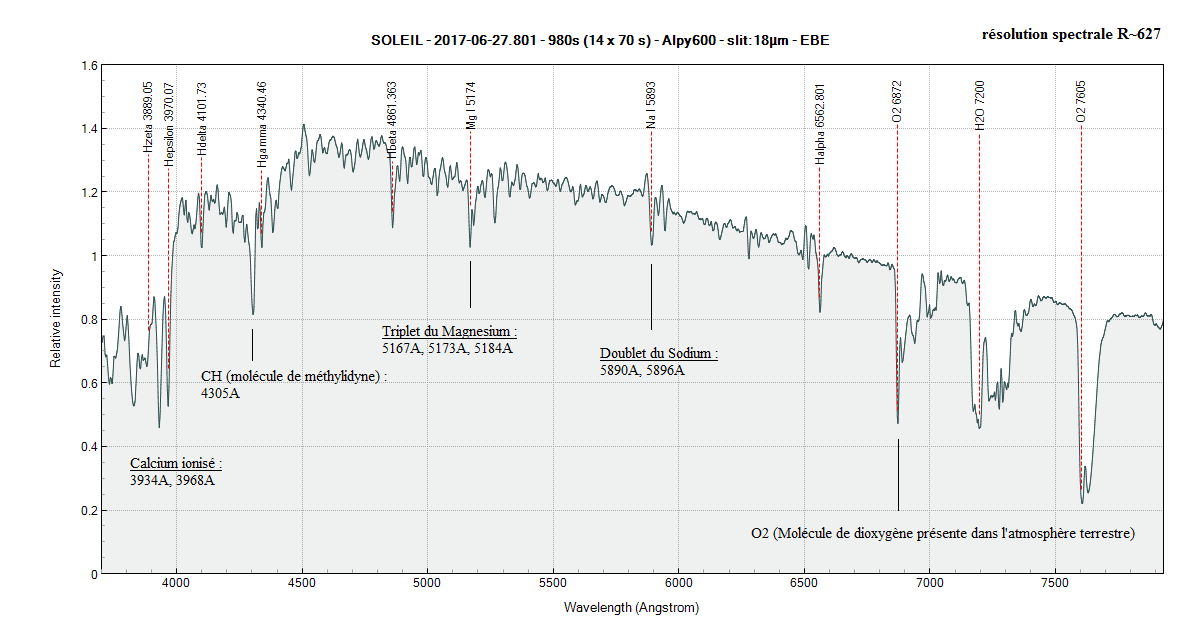
Now, we need a clear night in November, as it's the best time to see both planets at the same time.
My wait wasn't long; on November 11th, the sky cleared, just in time to execute my plan.
This was just before the observatory's scheduled closure, as November and December are normally cloudy and cold months.
I take advantage of this time to perform maintenance and development work.
That evening, Uranus was easily visible; there was no wind, the weather was cold, and the sky was clear. It took a while to activate the guiding and the spectrophotometer's camera...
During the exposure, I couldn't help but think that what my camera was photographing, Uranus, is located between 18.28 and 19.2 astronomical units from the Sun, or on average 2.87 billion kilometers... That its axis of rotation is almost horizontal... On my phone, I consulted Wikipedia, which describes its axis: "It rolls along its orbit!" like a big green billiard ball. Is its axis of rotation due to a shock, a collision with another planet? A bit like Earth and Theia causing the formation of the Moon, but this time, what size collider could have "shifted" the axis of rotation of a planet with an equatorial radius more than four times that of Earth?... Uranus also has the distinction of being larger than Neptune (49,528 km for Neptune versus 51,118 km for Uranus) while being less massive (Neptune has a mass of 1.024 × 10²⁶ kg compared to 8.681 × 10²⁵ kg for Uranus).
I'm getting lost in thought and reading online... It's quite something!

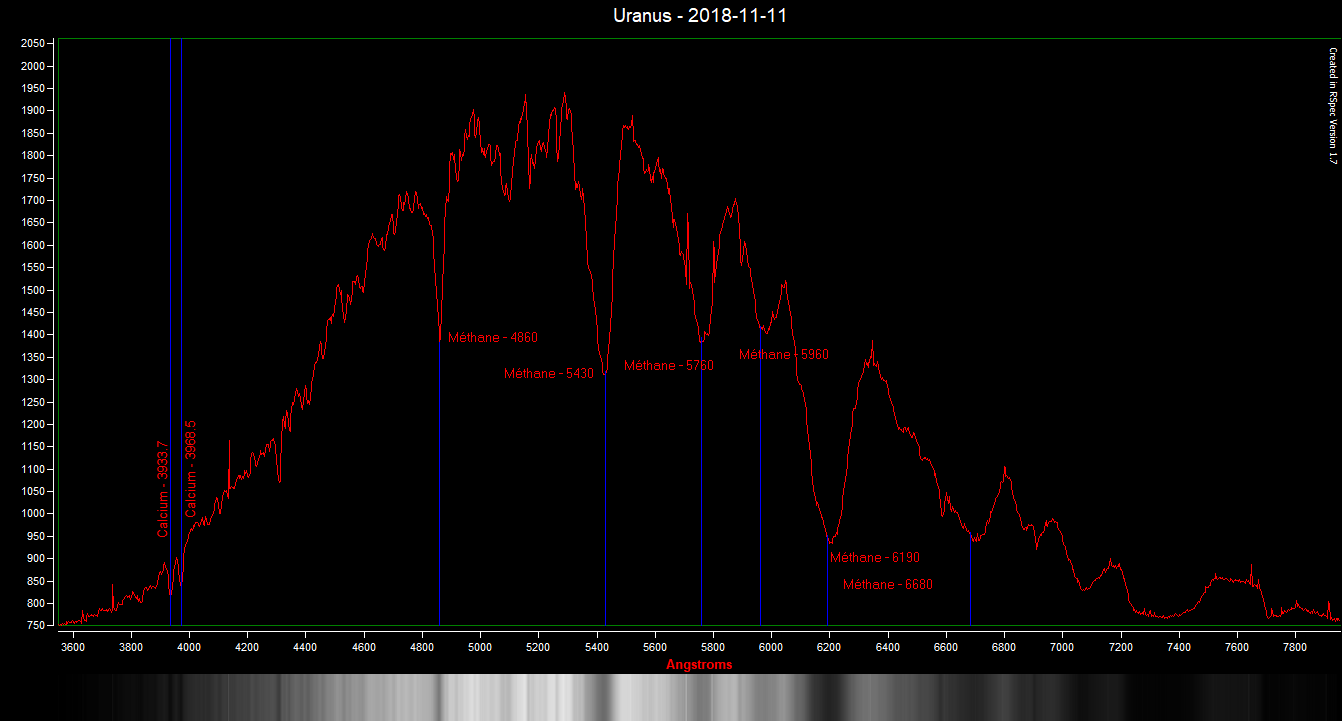
Then Neptune wasn't far away, just a little darker. Quick, another set of a few 350-second guided images.
So this one, about 31.11 AU from the Sun (4.5 billion kilometers)... It's quite right to be darker, with a magnitude of 7.69. Above the limit of human visibility.

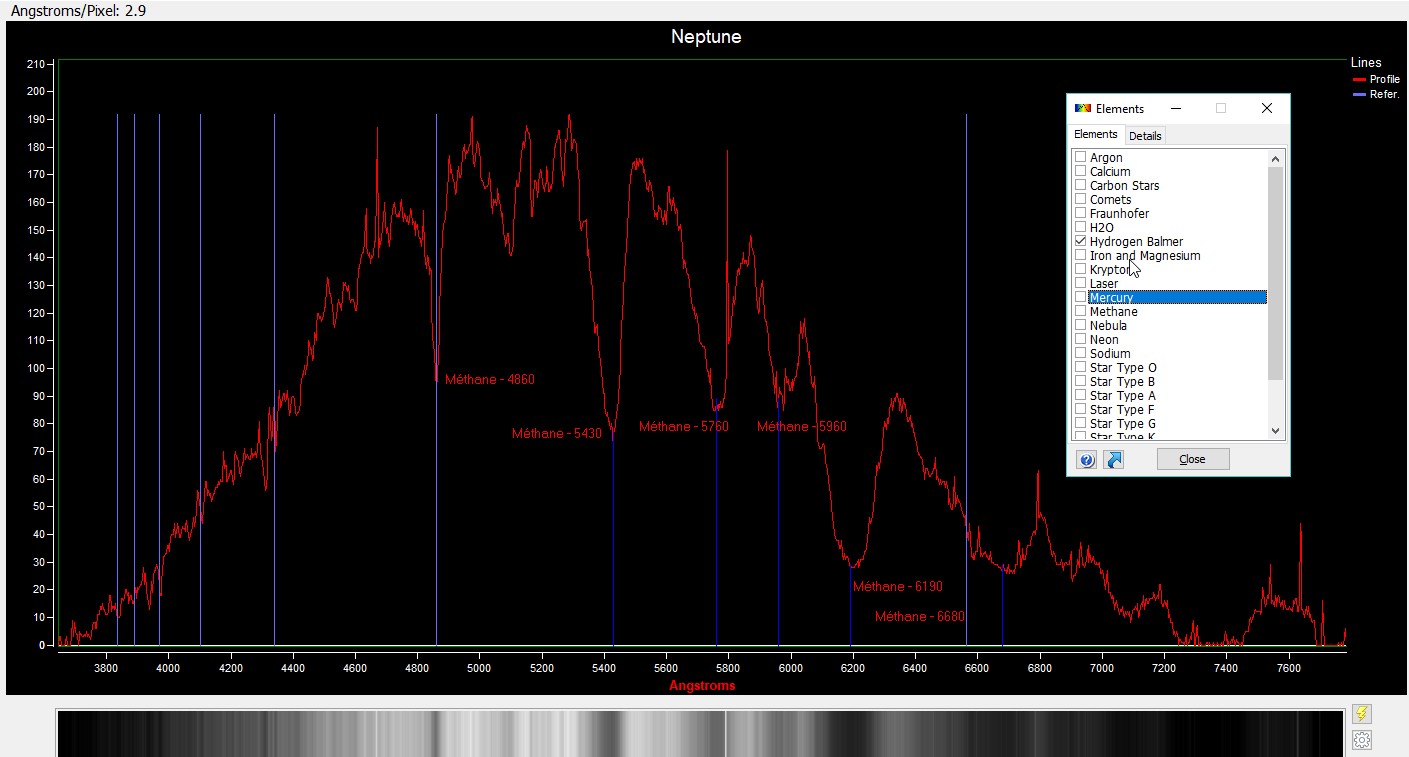
Using the RSpec software, I tried to make other spectral lines appear after calibration.
Spectral processing can become a real labor of love... It's an "astronomical" undertaking!
We certainly have a wonderful pastime!
Meanwhile... There you have it, the proof is in!
There is indeed methane on Uranus and Neptune.
References:
https://fr.wikipedia.org/wiki/Uranus_(plan%C3%A8te)
http://www.les7duquebec.com/7-dailleurs-2-2/uranus-la-planete-du-bouleversement-et-du-je-suis-different-donc-jexiste/
https://fr.wikipedia.org/wiki/Neptune_(plan%C3%A8te)
http://www.astropolis.fr/articles/etude-du-systeme-solaire/Neptune/astronomie-neptune.html
JBD - novembre 2018