

The Big Dipper in Spectroscopy - My First Steps in Spectroscopy
|
The project had tempted me for a long time!... But a real project beckoned… A rumor had it that some of the seven stars of the Big Dipper originated from the same nebula. This well-known circumpolar constellation, shaped like a saucepan, primarily comprises seven stars: Dubhe (α UMa), Merak (β UMa), Phecda (γ UMa), Megrez (δ UMa), Alioth (ε UMa), Mizar (ζ UMa) et Alkaid (η UMa).
Photo OMSJ |
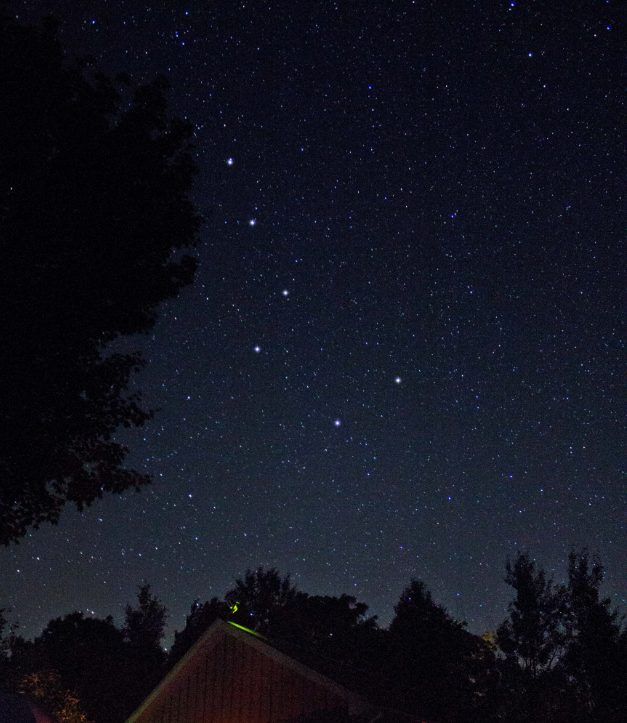 |
Of course, the Big Dipper includes several other stars that complete the constellation, which is actually quite large.
But in my experience, I was only interested in the stars that make up the dipper-shaped asterism.
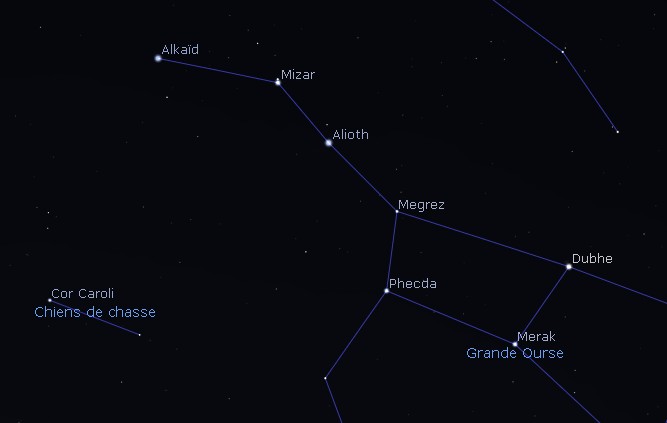
Stellatium
____________________________________________________________
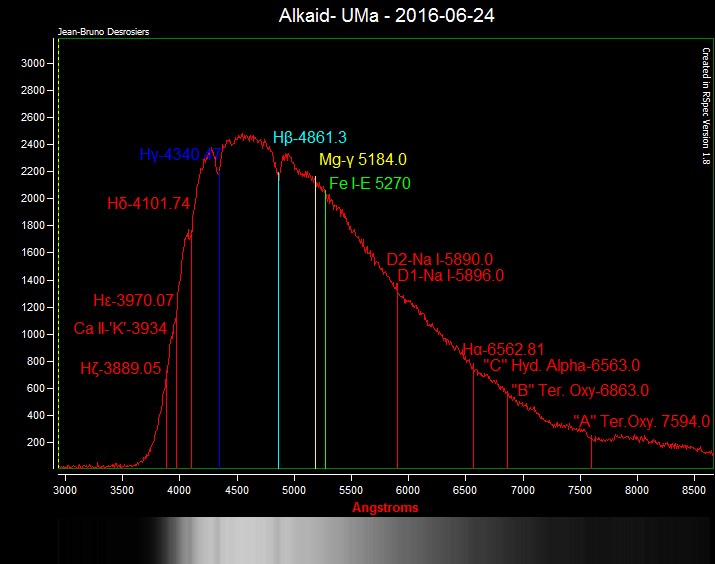
I therefore attempted to identify them using spectroscopy with an ASI120MM camera and an SA-200 filter wheel. With the Rspec software, the video mode allows for live focusing on the lines of interest. Adjusting the gain and exposure time then becomes crucial to avoid overexposing the star and the lines. I processed the image as I would for planetary photography to finally obtain a final image. The remaining work involved identifying the spectral lines and performing a proper calibration.
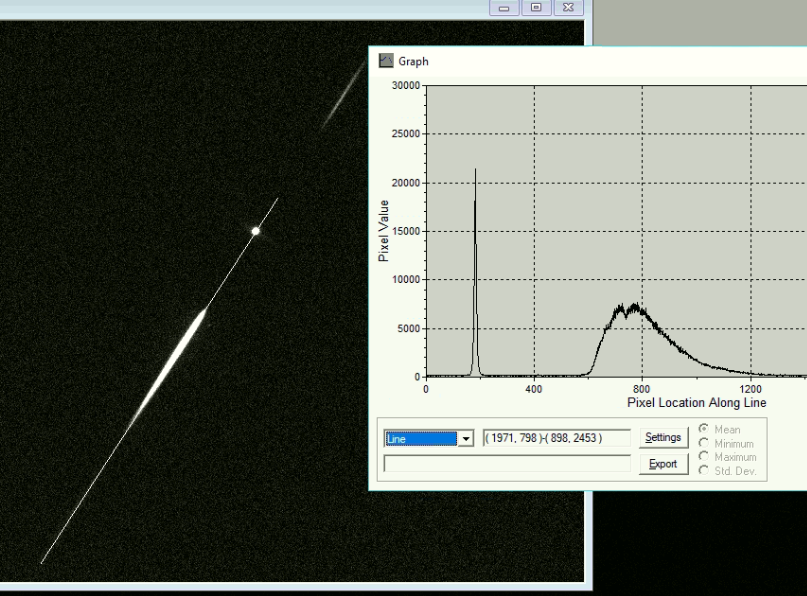
Star light line validated on MaximDL
| ALKAID Other names: AD: 13h 48m 15s |
 |
|
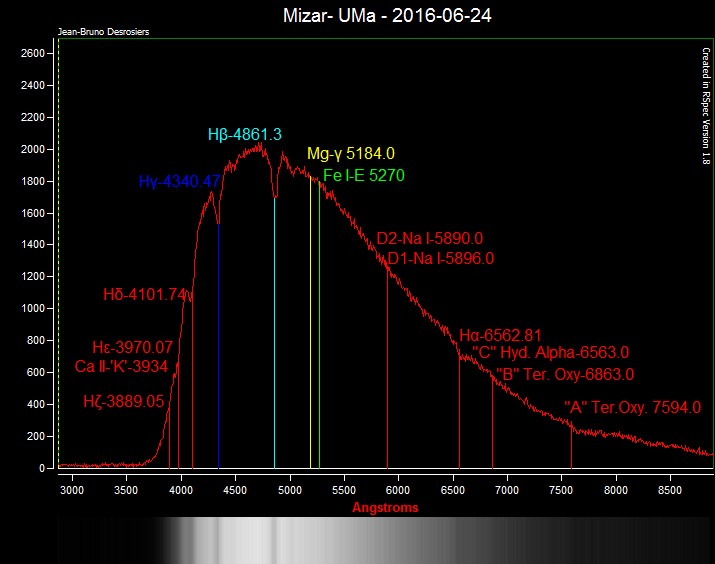
MIZAR AD: 13h 24m 39s
|
 |
|
Mizar... I find this star fascinating... During data acquisition with the SA-200, Photo OMSJ |
|
|
Alioth Other names: AD: 12h 54m 49s *Variable
* From Wikipedia: Alpha2 Canum Venaticorum Variable Star (Redirected from Alpha2 Canum Venaticorum Variable) In astronomy, an Alpha2 Canum Venaticorum variable star is a main-sequence variable star of spectral type B8p to A7p that exhibits a strong magnetic field and spectral lines in silicon, strontium, and chromium. The prototype and best-known of these variables is Cor Caroli (α² CVn), which fluctuates by 0.1 magnitudes over a period of 5.47 days. (https://fr.wikipedia.org/wiki/%C3%89toile_variable_de_type_Alpha2_Canum_Venaticorum) *However, the star Alioth is not registered as a variable star in the AAVSO database.
|
|
|
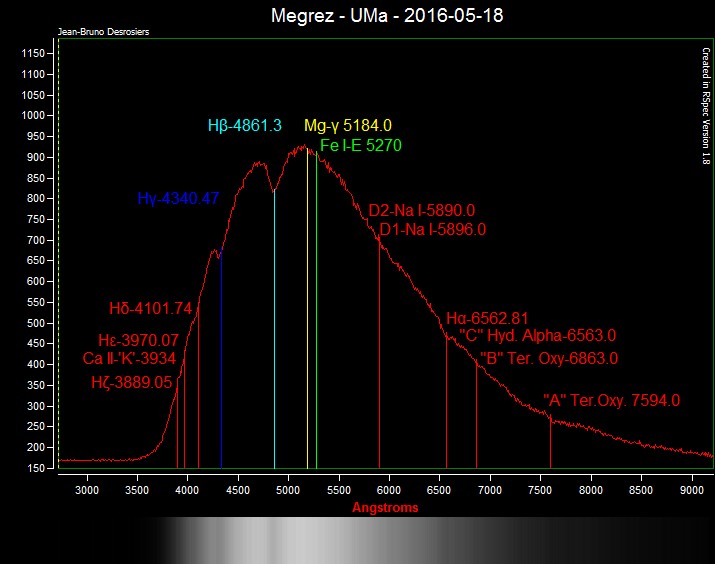
Megrez (Kaffa) Other names: AD: 12h 16m 18s
|
 |
|
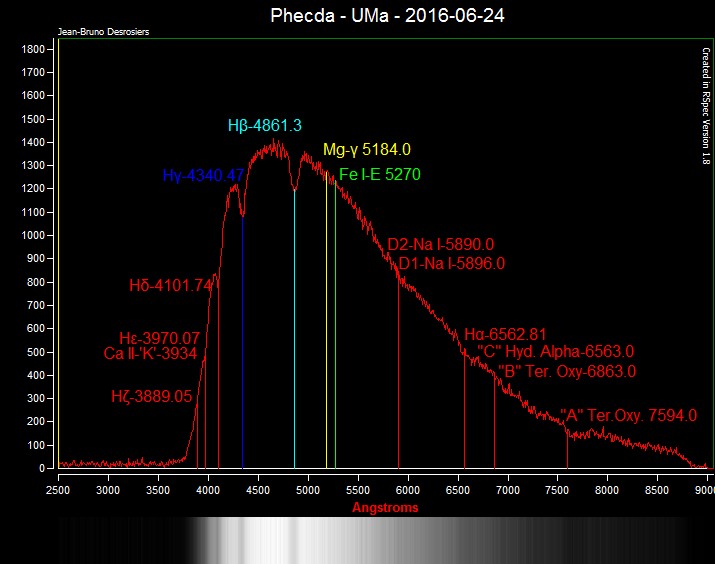
Phecda Other names: AD: 11h 54m 46s
|
 |
|
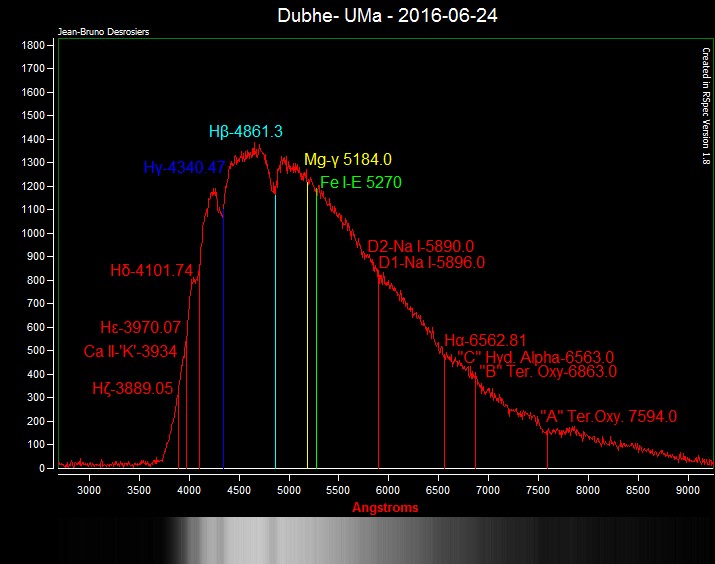
Dubhe Other names: AD: 11h 04m 50s
It is a multiple star; Dubhe A has evolved into a helium-burning star, Dubhe B, a main-sequence star, orbits at a distance of 20 AU, and Dubhe C, at a distance of 8000 AU.
|
 |
|
Merak Other names: AD: 11h 02m 55s |
 |
_________________________________________________________________________
1-Summary Analysis
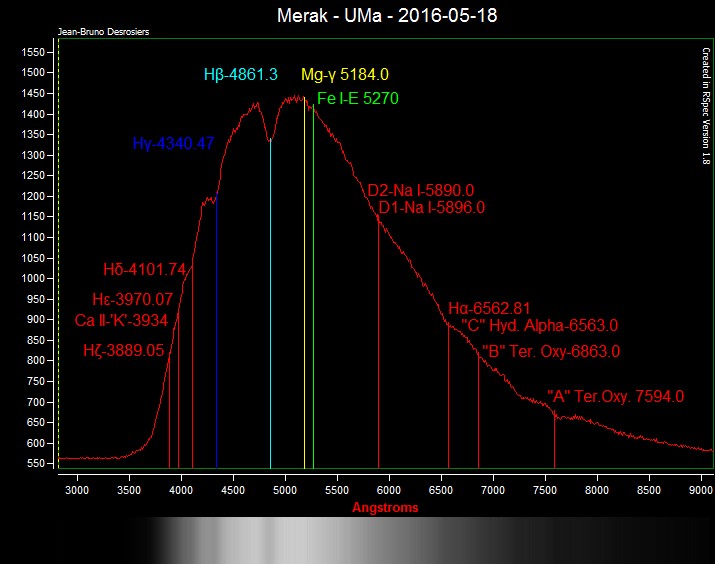
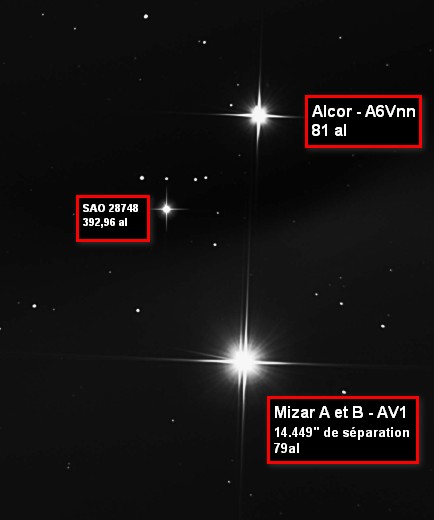
- We immediately notice that Mizar (AB) and Merak are 79 light-years away.
- They are of the same spectral type, A1V.
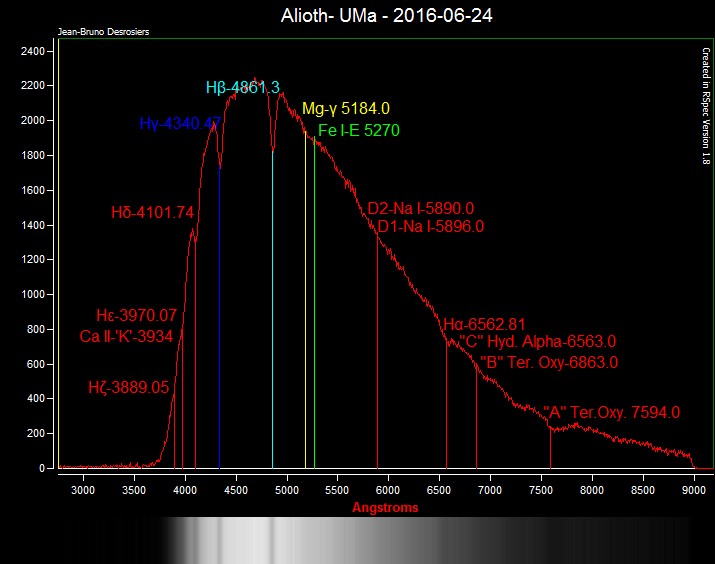
- Alioth is 81 light-years away, which is still close to the other two.
- It is of type A, but A0pCr, therefore slightly different, probably due to its variable nature (α² CVn).
- Phecda and Megrez are 85 and 81 light-years away, respectively, and are also of spectral type A, with variations.
- Alkaid (B3V) and Dubhe (K0IIIa) are completely different.
- Furthermore, Dubhe is 125 light-years away, and Alkaid is 101 light-years away.
| 2-
So we have five stars that are relatively close together and two that are further apart. Here's the plan : |
* Plan derived from « Petit guide du ciel » de Bernard Pellequer – Édition du Seuil - 1990 |
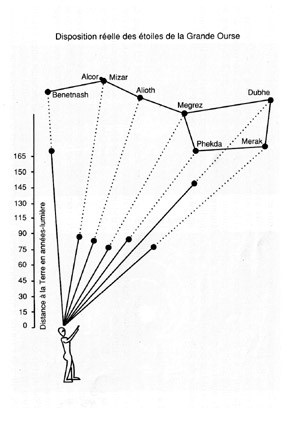
3- Finally, our five stars are type A, and the other two are types K and B.
Another very easy way to do this is to use Stellarium. Simply point to the Big Dipper and enter the desired future date, such as 60,000 AD. You will then notice that Dubhe and Alkaid have moved in different directions, while the other five have followed each other.
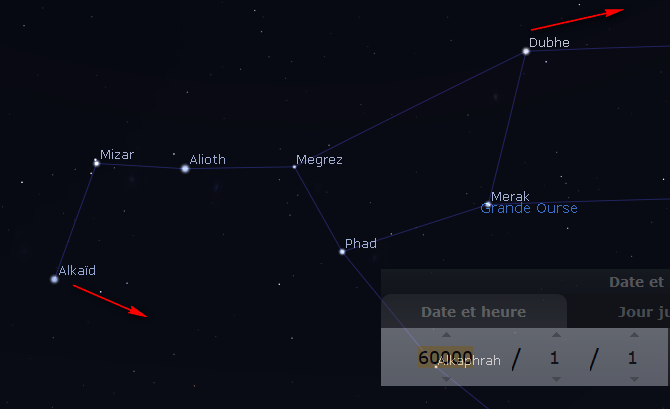
This is a rather simplistic and cursory analysis… Further tests should be conducted, but if the rumor is true, this brief overview might lead one to a tempting conclusion!
JBD 2017