

Spectroscopy at the OMSJ...
Revisiting this website recently made me feel old…
The “Spectro” section hasn’t had an article since 2018 and only has two.
Yet, if there’s one area where I’ve studied and developed my skills, it’s spectroscopy! In fact, my mentor recently told me I was the best-equipped amateur astronomer in Quebec, if not Canada (probably joking…). For years, “my astronomy” has been about studying them individually, their types and families, their particularities—it fascinates me… How can these balls of gas speak to us through the light they emit?
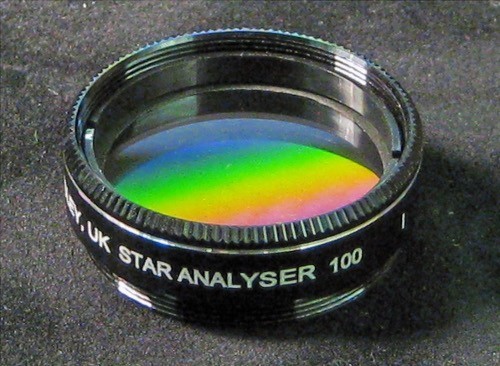 Star Analyser : the front door
From my early days with an SA200 filter (which is still in my filter wheel) (see "The Big Dipper in Spectroscopy"), spectroscopy was a fascinating learning experience, because with this tool, you can go to the hearts of stars, see their composition, how they react, their radial velocities…
Differential photometry is, of course, the foundation, because the U, B, V, Rc, and Ic filters are, in fact, "cut-off" filters that select frequency ranges in order to study them separately. Stars react differently due to their temperatures and masses, and these filters offer the possibility of studying them, also through combinations such as B-V, B-R, V-Rc, V-Ic, etc. Standards have been accumulated over time, which allows us to facilitate the analyses. However, in spectroscopy, everything is right there in front of us!
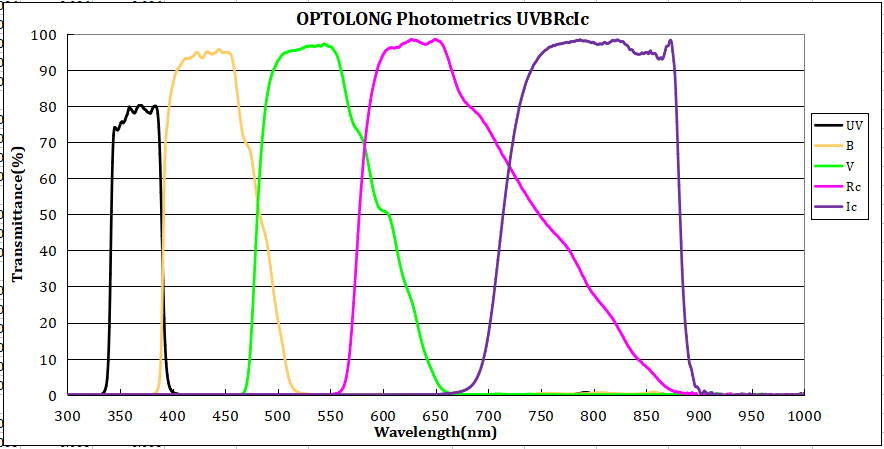
“The sky’s the limit”, but the resolution of the spectroscope used, the type and size of the telescope also play a role, and, of course, the quality of the sky, which is the raw material… What type of observation do you want to make?
In my case, it’s almost everything!… So I started with the Star Analyser SA100 or SA200. This little filter goes in front of the camera, whether it’s a DSLR, CCD, or CMOS, and is a marvel of simplicity for anyone who wants to transform their telescope into a spectroscope without turning their living room into a NASA lab. We’re talking about a budget of around $300.
Here's what you need to know:
The nature of the object: A diffraction grating
Unlike a conventional colored filter that blocks certain wavelengths, the SA200 is a transmission diffraction grating.
Physically: It looks like a completely standard 31.75 mm (1.25 inch) filter.
Optically: Its surface is etched with 200 lines per millimeter. These micro-striations act like thousands of tiny prisms that deflect the light to create a spectrum (a rainbow) alongside the image of the star.
The "Low Resolution" profile
This refers to low-resolution spectroscopy (R = 100 to 200).
It's not the tool for measuring the rotation speed of a binary star, but it's perfect for identifying the chemical composition of a celestial body.
You'll clearly see the broad absorption bands of titanium molecules on a red giant (M type) or the emission lines of hydrogen (Balmer series) on a hot star (A or B type).
Why the "200" rather than the "100"?
The SA200 is the big brother of the SA100. Its main difference lies in its line density:
Doubled Dispersion: At the same distance from the sensor, the spectrum produced by the SA200 is twice as long as that of the SA100.
Low Profile: It's designed to be used closer to the sensor (for example, in a filter wheel). It's the ideal option if you lack back focus or if you're using a CCD/CMOS camera rather than a DSLR.
In short, it's:
Accessible: You screw it onto your camera's nose and you're good to go.
Bright: Because the resolution is low, the light is less spread out, allowing for the analysis of relatively faint objects (distant quasars, nebulae, supernovas).
Educational: It's the best way to understand that stars aren't just white dots, but complex physical objects.
* There are distance calculations relative to the sensor that must be followed...
Here are the links:
https://rspec-astro.com/calculator/
https://rspec-astro.com/calculator-help/
https://www.univers-astro.fr/fr/content/6-le-calcul-d-echantillonnage
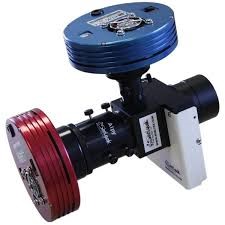 Alpy-600 : the stability of a professional device
Then, once you're hooked, you want more! Better definition, a more serious tool… And so you move on to the Alpy-600 from the French company Sheliak. But often the price is a shock (around $4,000 assembled + tax), of course, apart from the camera.
The Alpy-600 is a fascinating spectroscope, very stable because it requires virtually no adjustments… Once adjusted on a kitchen table, in front of a window, in sunlight, there's often nothing left to do but mount it on your telescope and start exploring. But be aware, the device is divided into several parts, as the unit itself consists of a prism and a slit (around CA$1,300). But without the guiding module, which is more expensive than the spectrograph itself, you can't do anything except in a lab. This module (CAD $1600) allows you to place a target star in the 23-micron slit and then guide the telescope to keep it in the slit for the required time. Personally, I've often done exposures on binary stars of magnitude 10-12, with 5 exposures of 2000 seconds each. This module is therefore essential, although it increases the price.
Next, we need to process our spectra, and the most important thing in spectroscopy is calibration. Therefore, calibration images must be taken before or after each session. Contrary to popular belief, neon is not suitable for calibrating spectra acquired with Alpy telescopes, as this device is not linear. The presence of the prism slightly alters the dispersion of light across wavelengths, meaning that calibration must be performed using multiple spectral lines across the entire spectrum. Since the Alpy has a resolution of r=550 to 600, it covers the entire visible spectrum, from 350 to 800 nanometers (3500 to 8000 Angstroms), depending on the camera used.
I was a longtime advocate of compact fluorescent lamps (CFLs). Economical and with sufficient power for fast imaging, I used them for calibration for several years, paying close attention to their orientation in front of the telescope. I use a 355 cm catadioptric (SCT) telescope, the lamp position may change slightly… Not much, but sometimes it’s just too much!... So, the calibration module ($1200 CAD) is almost mandatory in order to obtain a perfect calibration of your masterpieces, before publishing them and becoming famous.
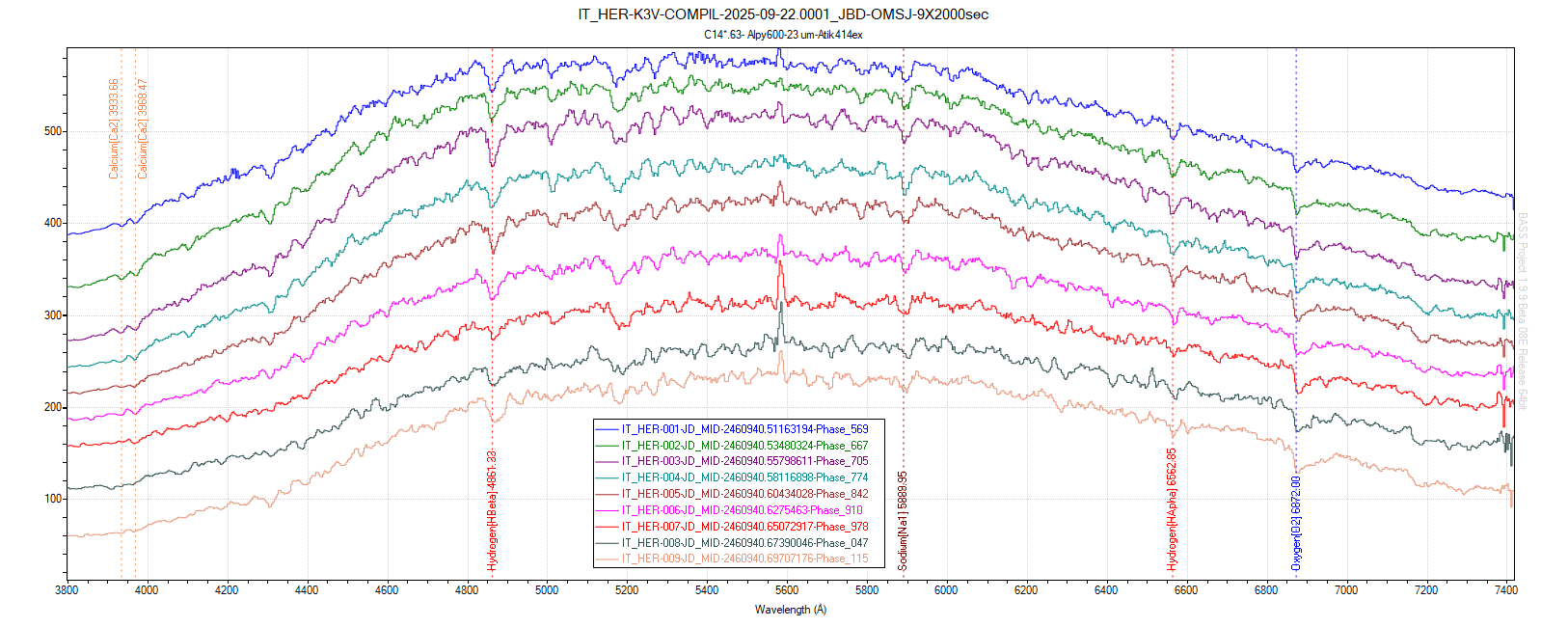
Yessss, IT HER, that star made me lose a few hairs... But I'll tell you more about it soon!
So, we have the first milestone of our "private astronomical photon analysis laboratory."
Some will say that the cost isn't worth it in Quebec, or with such a long, cloudy winter… I'll give you the same answer I gave my neighbor who, every summer, takes off every weekend on his gleaming Harley-Davidson, which cost him an arm and a leg… It's a matter of passion, and in my case, a retirement plan.
But also, a stroke of luck… There are alternatives… For the price of a good 3D printer, you can also do amazing things!…
For references, see the website https://www.shelyak.com/
UVEX : printed ingenuity
The Uvex is a little marvel invented by a French genius, Christian Buil, who is also connected to the Alpy-600. It's 3D printed, and the plans are available for free online. It can easily fill the many spare moments of our cloudy winters.
I won't go into detail, as everything is explained in detail online (see below...).
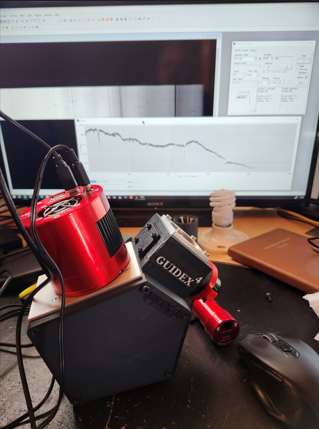 |
To conclude on the subject of Uvex, I'm introducing mine this year (2026) into the observatory. Equipped with an 1800 grating, I should obtain a theoretical resolution of nearly r=4000, but according to several tests, so far I haven't been able to exceed a resolution of more than r=2900, and that's with an ASI294MM PRO camera in bin2. So, it's another adventure… |
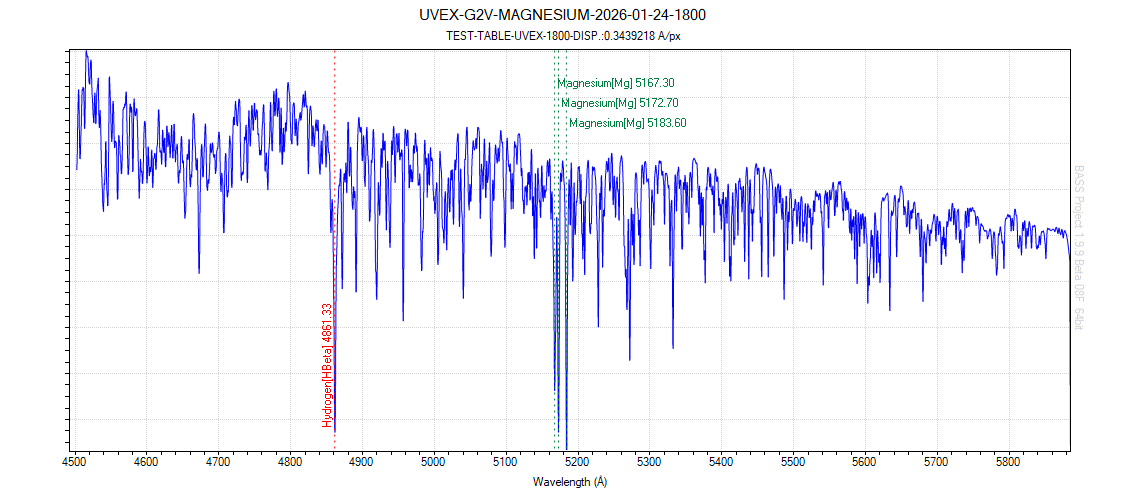
1- Slot width in pixels:
2- Theoretical spectral resolution: (Slit width) * (dispersion in A/px)

3- Theoretical resolving power (r=) at Ha (6562.85 Angstrom) :

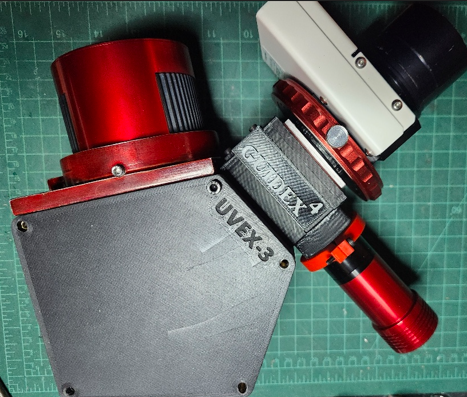
You'll probably notice the additions and modifications I've made to strengthen the device. There's an aluminum mount for the scientific camera as well as for the telescope mount. It's also equipped with a guiding module. I also alternate the Alpy calibration module so it can be used for both. Note that the Uvex project website has plans for building a calibration module called "Calibrex".
Some links:
https://buil.astrosurf.com/UVEX_project/
https://spectro-uvex.tech/
https://spectro-uvex.tech/?p=2198
https://spectro-uvex.tech/?p=9169
StarEx : accessible high resolution
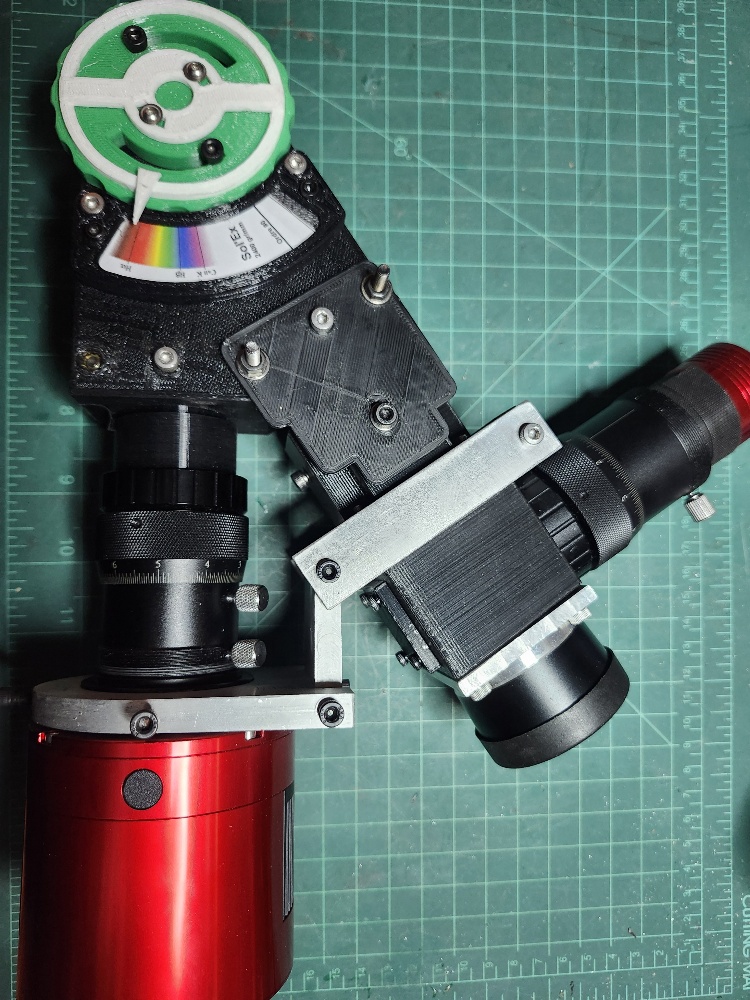
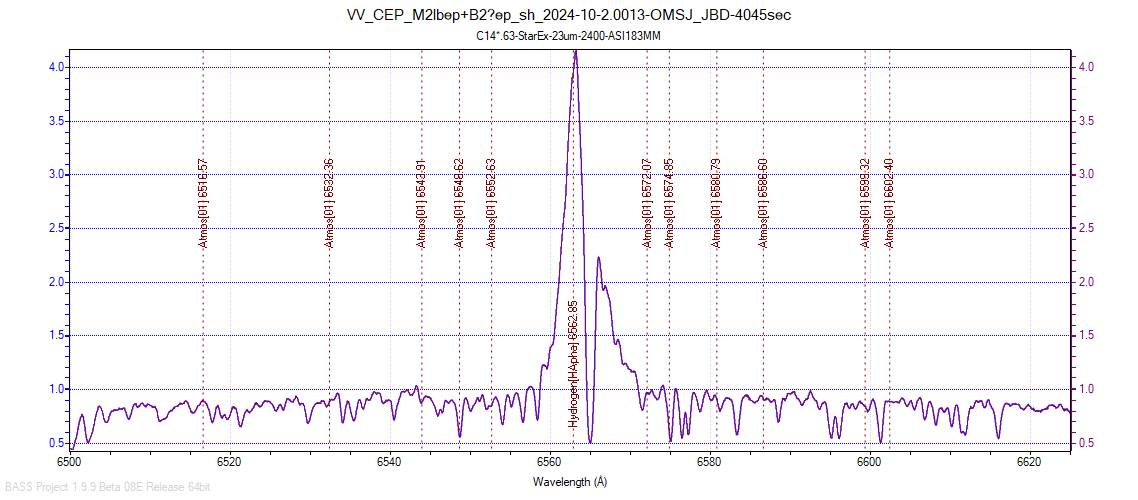
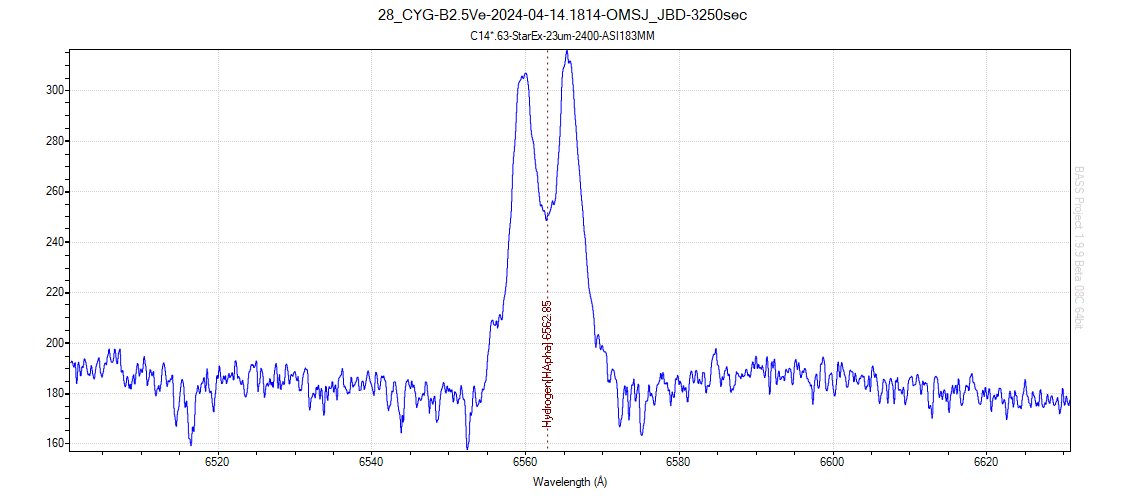
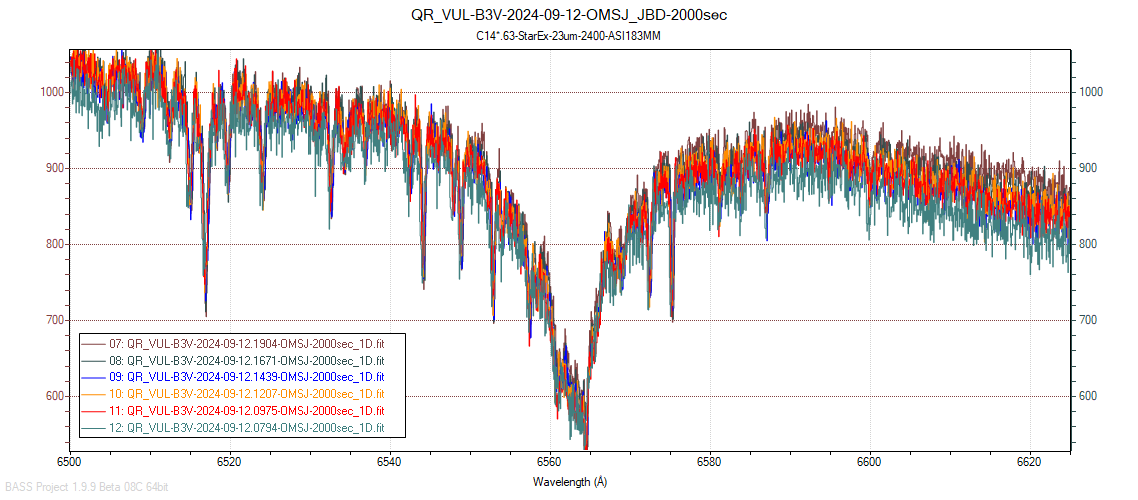
I'll finish with a presentation of the latest spectrograph I loved using to observe Be stars in 2024: the StarEx in its "high-resolution" version, with a 2400 grating. It too has received aluminum reinforcements and even a support against bending for greater precision. It's coupled with an ASI183MM camera, as suggested by its inventor, the Frenchman Christian Buil. Originally, this device was dedicated to observing the sun, then someone probably thought that all it needed was a guiding module to make it a super spectroscope for stars.
Some links about StarEx/SolEx:
https://solex.astrosurf.com/sol-ex-etoiles.html
https://buil.astrosurf.com/solex/Reglage_solex.pdf
https://www.youtube.com/watch?v=m9g-Myo50O0
https://www.youtube.com/@astro-spectro280/videos
Conclusion
In short, like a carpenter who needs several tools to work and build houses,
the observatory has accumulated this equipment over the years to better study and understand the stars.
Differential photometry is a primary method. And just as a photographer has several lenses—zoom, telephoto, and wide-angle—these spectroscopes allow us to observe stars at low, medium, and high resolutions, as well as to participate in several PRO/AM programs and advance our knowledge.
Well, I'm going back to my stars... Cheers!
Other useful links:
https://buil.astrosurf.com/calibration2/absolute_calibration.htm
https://sites.uni.edu/morgans/astro/course/Notes/section2/spectraltemps.html
https://www.shelyak.com/
http://www.astrosurf.com/aras/
https://opg.optica.org/ol/fulltext.cfm?uri=ol-42-21-4323
http://www.threehillsobservatory.co.uk/astro/astro.htm
https://astrojolo.com/more-than-pictures/amateur-measurements-of-radial-velocity/
https://groups.io/g/BassSpectro/files
JBD-2026