

V1117 HER - Type : UXOR
Initially cataloged as NSVS 1639065 + 094755 as a long-period variable (Mira) with an unfiltered mean magnitude of 13.080, an amplitude of 1.938 mag, and a period of 114 days (Wo'zniak et al., 2004b), it was subsequently cataloged as a UXOR in 2008 (Kazarovets et al., 2008).
(The Aladin software still catalogs it as a Mira.)
According to the GCVS (Samus et al., 2007-2012), the classification of this star has changed to IS, meaning "rapid irregular variables with no connection to diffuse nebulae and showing light changes of about 0.5-1.0 mag over several hours or days." The long-term light curve of V1117 Her exhibits abrupt fadings similar to those of young UX Ori-type stars. This may be one reason why this star has been included in the AAVSO's Young Star Object (YSO) monitoring program since 2006.
AD (eq. date) : 16h 39m 59.1s
DE (eq. date) : +09° 45' 48.1"
L/T/C (loc) : 17h58m / 00h44m / 07h27m
Constellation : Hercule
Numéro 1117 dans Hercule
Type variabilité : IS
Magnitude maximale : 12.3
Mag. min. (ou amplitude) : 15.4
Syst. phot. pour les mag. : p
Référence étoile : 79109
Référence chart : GSC
Since UXOR-type variables belong to the Herbig Ae class of stars, meaning they are intermediate-mass preprincipals, these stars are surrounded by circumstellar dust disks and/or envelopes characteristic of stars in formation. The high infrared luminosity of V1117 Her at 2MASS and WISE wavelengths indeed suggests the presence of circumstellar dust. Photometrically, the V-R, V-I, and R-I indices also support this.
UX Orionis stars are collectively known in the literature as UXORs. This subgroup of young stellar objects exhibits irregular variations with a wide range of amplitudes, from just over 4 magnitudes in the V filter. Most are Herbig Ae/Be stars, but there are a few T Tauri stars with more recent spectral types.
Behavior:
There are two main components:
(1) Irregular variations over time scales of days around an average light level that changes over a much longer time scale (over years), sometimes in a quasi-cyclical manner.
(2) Occasional episodes of minimum depths, occurring at irregular intervals, but more frequently near the low points of brightness cycles. UXs show increased polarization when the star's optical light becomes weaker (presence of clusters in our line of sight) and redder, while in extreme visual minima, there is a color reversal. Currently mixed between the ISA, INA, or INSA classes in the GCVS. Examples: UX Ori, CQ Tau, BF Ori.
Ref.: https://www.aavso.org/vsx/index.php?view=detail.top&oid=46507
http://www.konkoly.hu/cgi-bin/IBVSpdf?5863
http://iopscience.iop.org/article/10.1086/425526/pdf
http://acta.astrouw.edu.pl/Vol52/n4/pap_52_4_4.pdf
http://cds.cern.ch/record/620227/files/0306113.pdf
AAVSO - Alert Notice 590 (August 2017) : https://www.aavso.org/aavso-alert-notice-590
UXOrs are pre-main-sequence stars, typically of intermediate mass, and are distinguished from other pre-main-sequence stars by their large photometric and polarimetric variations, thought to be due to variable extinction by circumstellar dust. Redshifted transient optical and UV absorption lines are a second defining characteristic and have been interpreted in terms of perturbations from cometary bodies. (http://iopscience.iop.org/article/10.1086/305006/fulltext/)
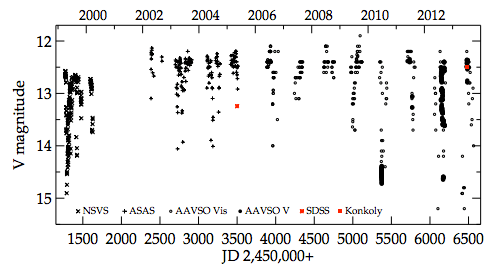
https://www.aavso.org/v1117-her-herbig-ae-star-high-galactic-latitude
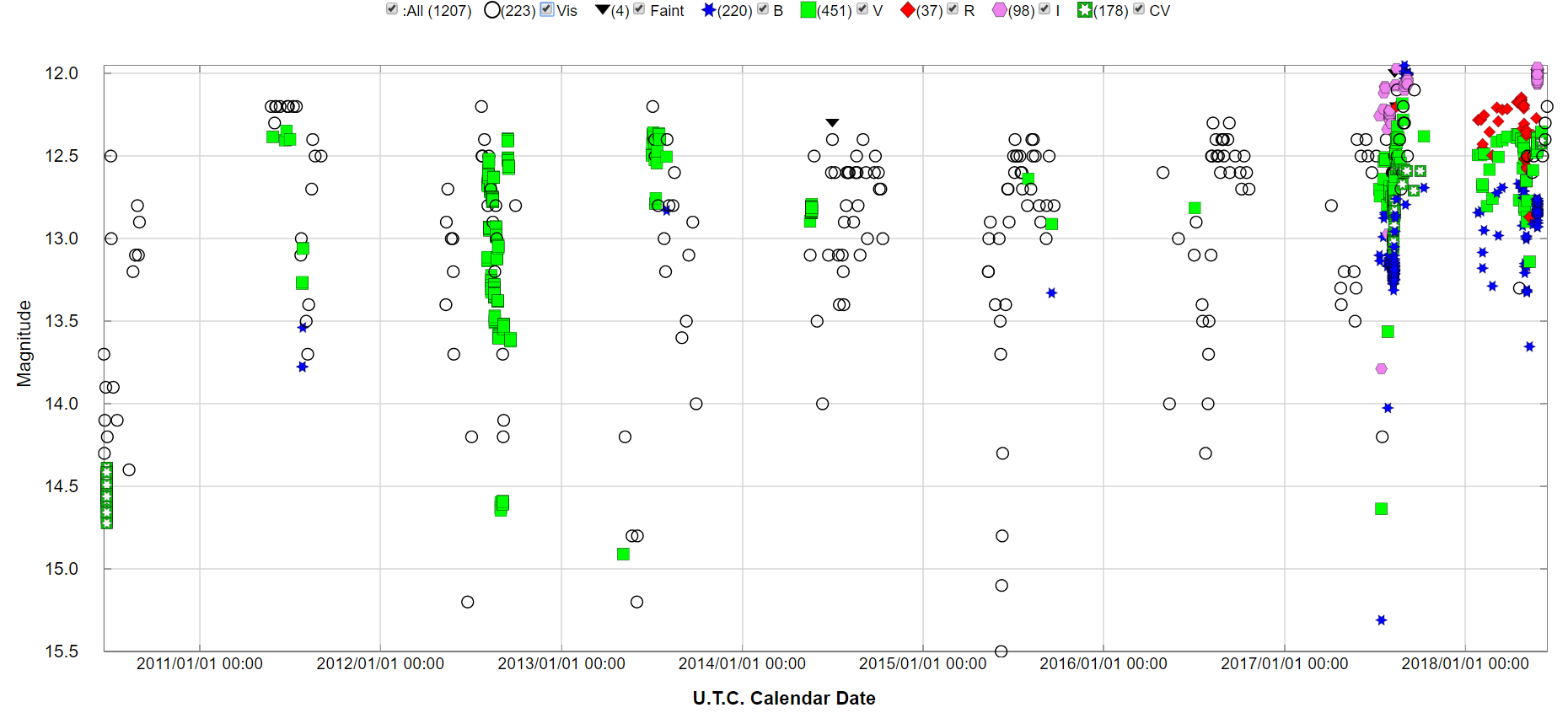
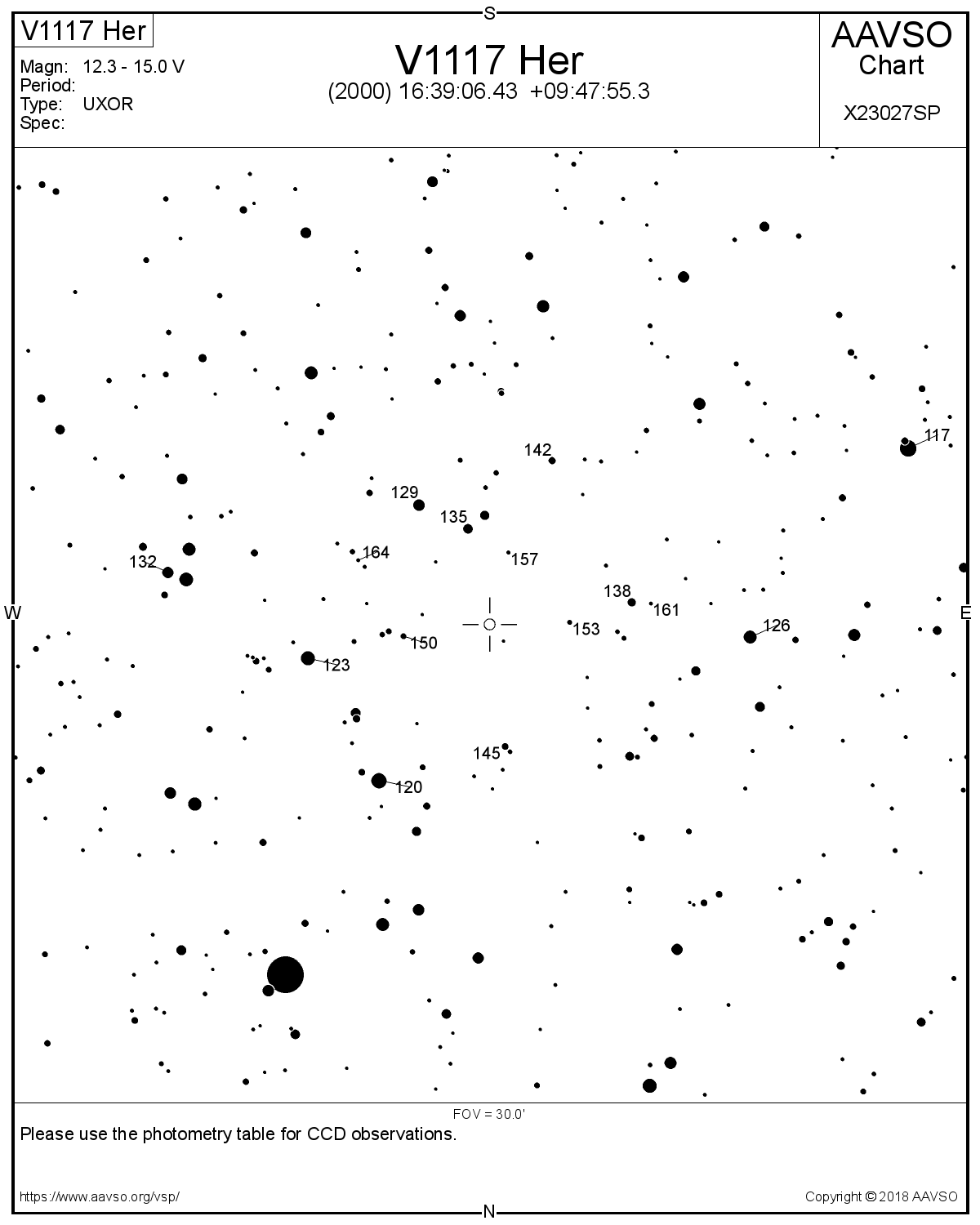
Table of photometry:
https://www.aavso.org/apps/vsp/photometry/?fov=30.0&scale=E&star=V1117+HER&orientation=visual&maglimit=16.5&resolution=150&north=down&east=right&type=chart

Juin 2018