

|
RX AND
RX AND is a UGZ-type star, belonging to the archetype of U Germinorum and Z Camelopardalis stars. Z Cam-type stars can be considered a transition between "Novae-like" and "dwarf novae." These are symbiotic stars composed of a main-sequence star and a white dwarf in close orbit. Due to gravity, the more massive white dwarf attracts matter towards itself, creating an accretion disk. |
|
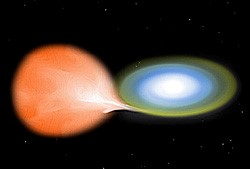
Spécifications :
AD (eq. date) : 01h 05m 37,1s
DE (eq. date) : +41° 23' 46,2"
Constellation : Andromède
Numéro 16 dans Andromède
Type variabilité : UGZ
Magnitude maximale : 10,2
Mag. min. (ou amplitude) : 15,1
Syst. phot. pour les mag. : V
Période : 13 jours
Découvert par : A. Stanley Williams (1904)
___________________________________________________________
Dwarf novae are similar to classical novae, but their triggering mechanisms differ. Classical novae are caused by the accumulation of hydrogen that fills their Roche lobe until saturation, triggering the outburst process.
Nova-like stars can be defined as cataclysmic variables whose mass transfer rate is consistently high enough to maintain them in an outburst state.
(http://www.astronomie-amateur.fr/Variables%20Cataclysmiques%20NovaLike.html)
According to current theories, dwarf novae are more likely triggered by instability in the accretion disk. Three families of UG-type stars are known: UGSS (SS Cygni), UGSU (SU Ursa Majoris), and UGZ, to which our star RX AND belongs.
What makes RX AND special is that, in addition to its cyclical periods of 13 to 14 days, it also exhibits behaviors between Z CAM and VY SCL. Therefore, besides its periods, it experiences periods of inactivity and stability, making it a subject of study and observation that is sometimes very interesting. (https://www.aanda.org/articles/aa/pdf/2002/10/aaea021.pdf)
___________________________________________________________
Variability:
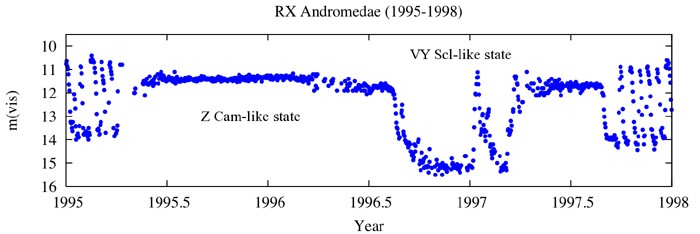
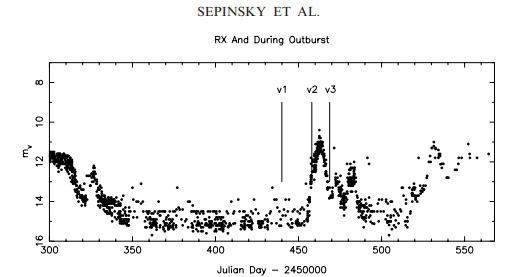 http://iopscience.iop.org/article/10.1086/341009/pdf
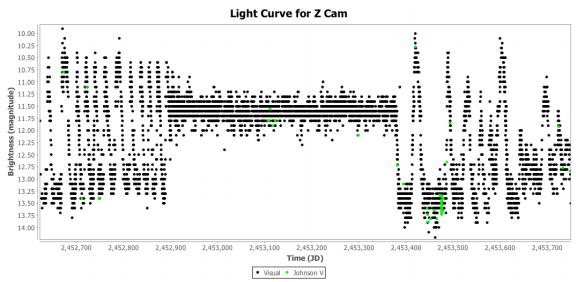
___________________________________________________________
Localisation :
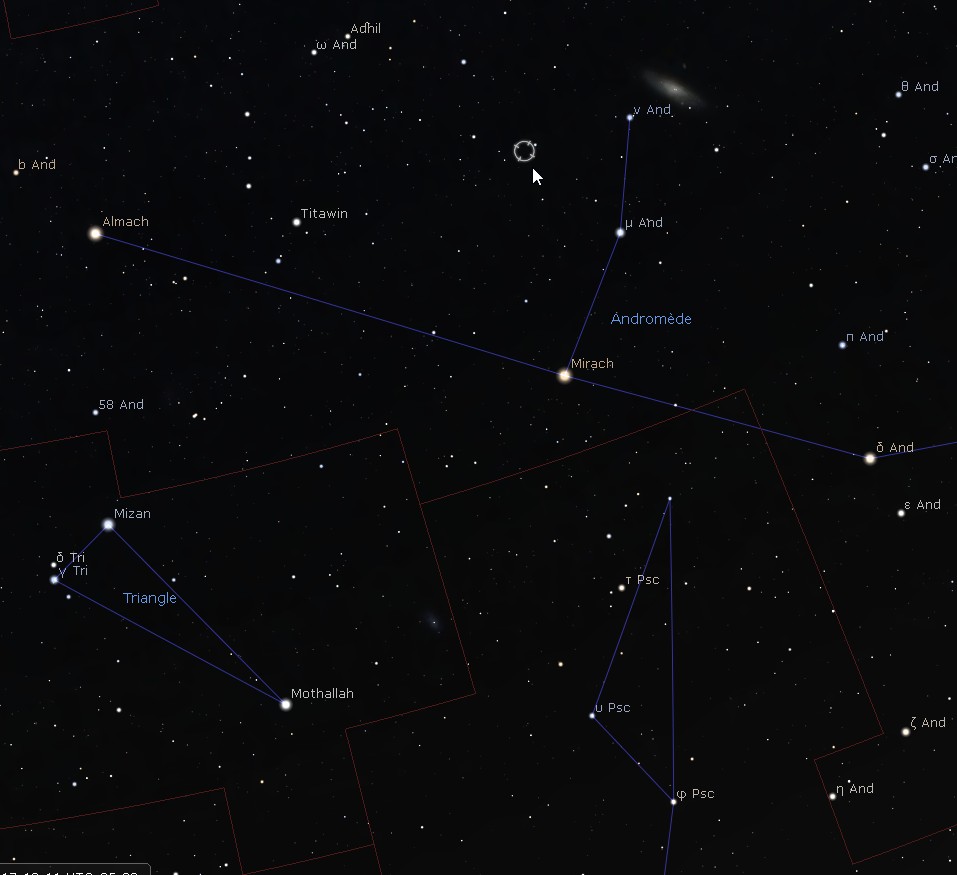 Stellarium
___________________________________________________________
Other notes:
Interestingly, on July 20, 2016, I was taking a photometric reading of this star and was surprised by a change in brightness that occurred simply during the exposure time of the ten 60-second images I took. The two reference stars are shown in diamonds, the check star in black squares, and our RX AND star in triangles.
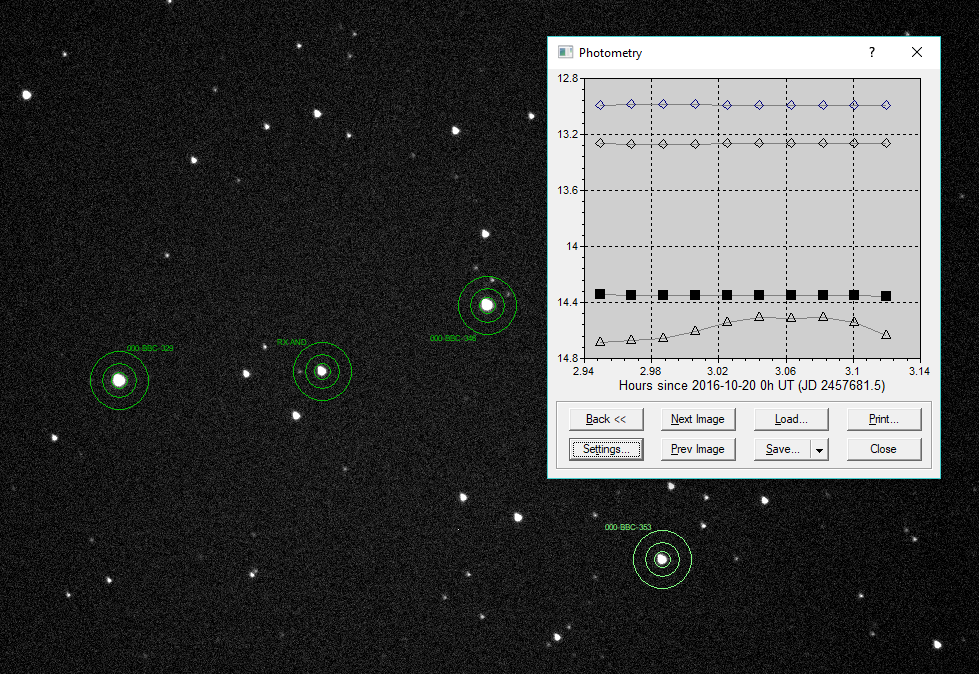
Seeing this curve, I'll stay longer next time.
This star is definitely full of surprises and ones to watch!
___________________________________________________________
Carte AAVSO : (Cliquer sur la page)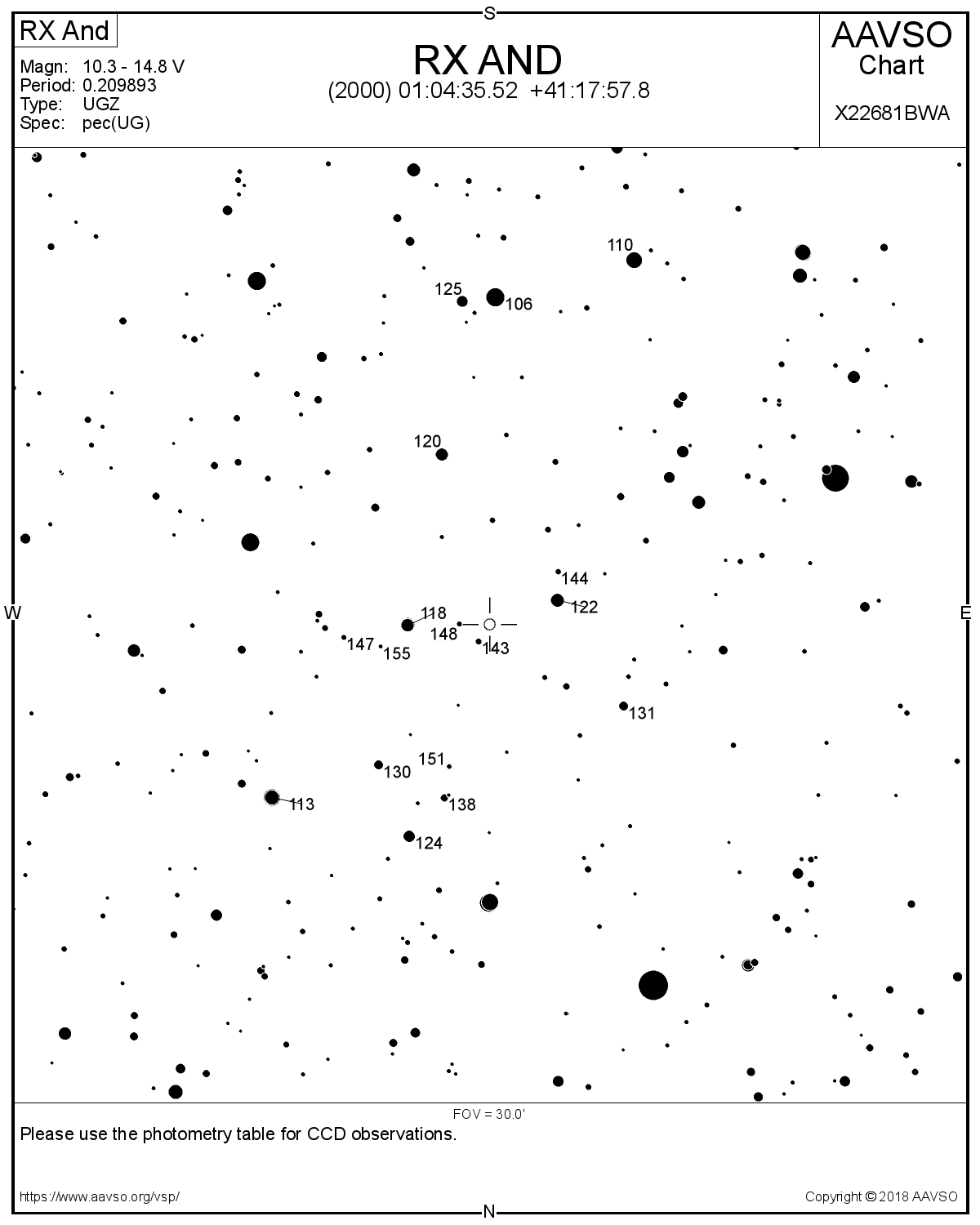
Suggested reading:
Artistic vision of a Z CAM explosion : https://www.youtube.com/watch?v=UnOoaTHPwLI
Also: https://www.aavso.org/vsots_rxand
Avril 2018