

|
The PV CEP Star
AD (eq. date) : 20h 46m 04,8s |
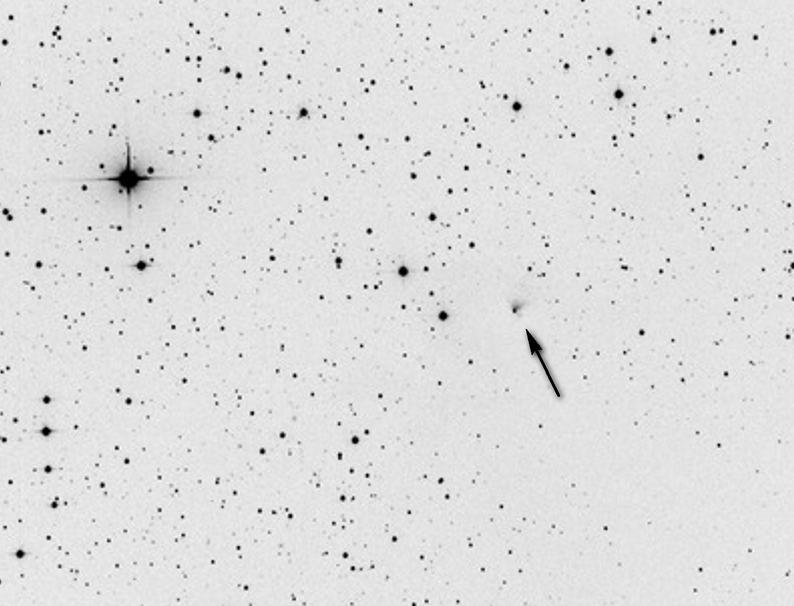 |
It was during my inspections for the SRO Observatory in Arizona that I first saw this star.
I immediately and innocently thought they had photographed a comet… They had a good laugh!
In fact, this intrinsic variable star is a Young Stellar Object (YSO) of the Herbig Ae type [1] and therefore, of main presequence, at 3.5 solar masses and a distance of 500 parsecs (1630.75 LY).
*Stars of the main sequence with a mass less than about two solar masses are classified as T Tauri stars; those between two and eight solar masses as Herbig Ae stars.[2]
Its age is estimated at less than a million years, and its formation, associated with the nearby Iris Nebula (NGC 7023), is linked to the aptly named Gyulbudaghian Nebula. It is thought to have been ejected from the Iris Nebula at least 100,000 years ago and is moving at an estimated speed of 22 km/sec..[3]
Since February 2017, I have observed a decrease in photometry, which is confirmed by other AAVSO observers. However, my research shows that it has undergone significant variations throughout its history..[4]
I also note that most of the observations are made with the ‘R’ filter.

My photometric validation charter:
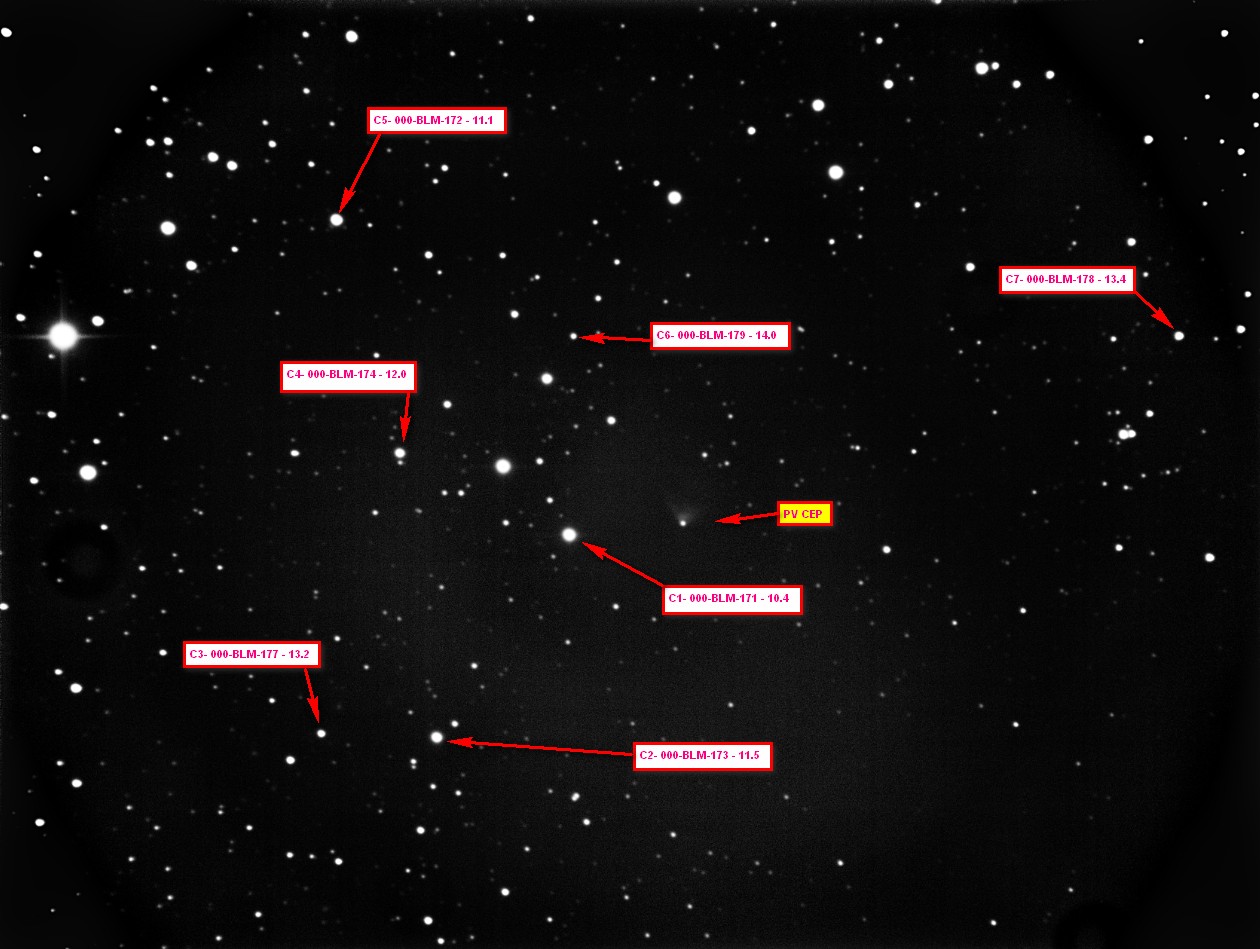
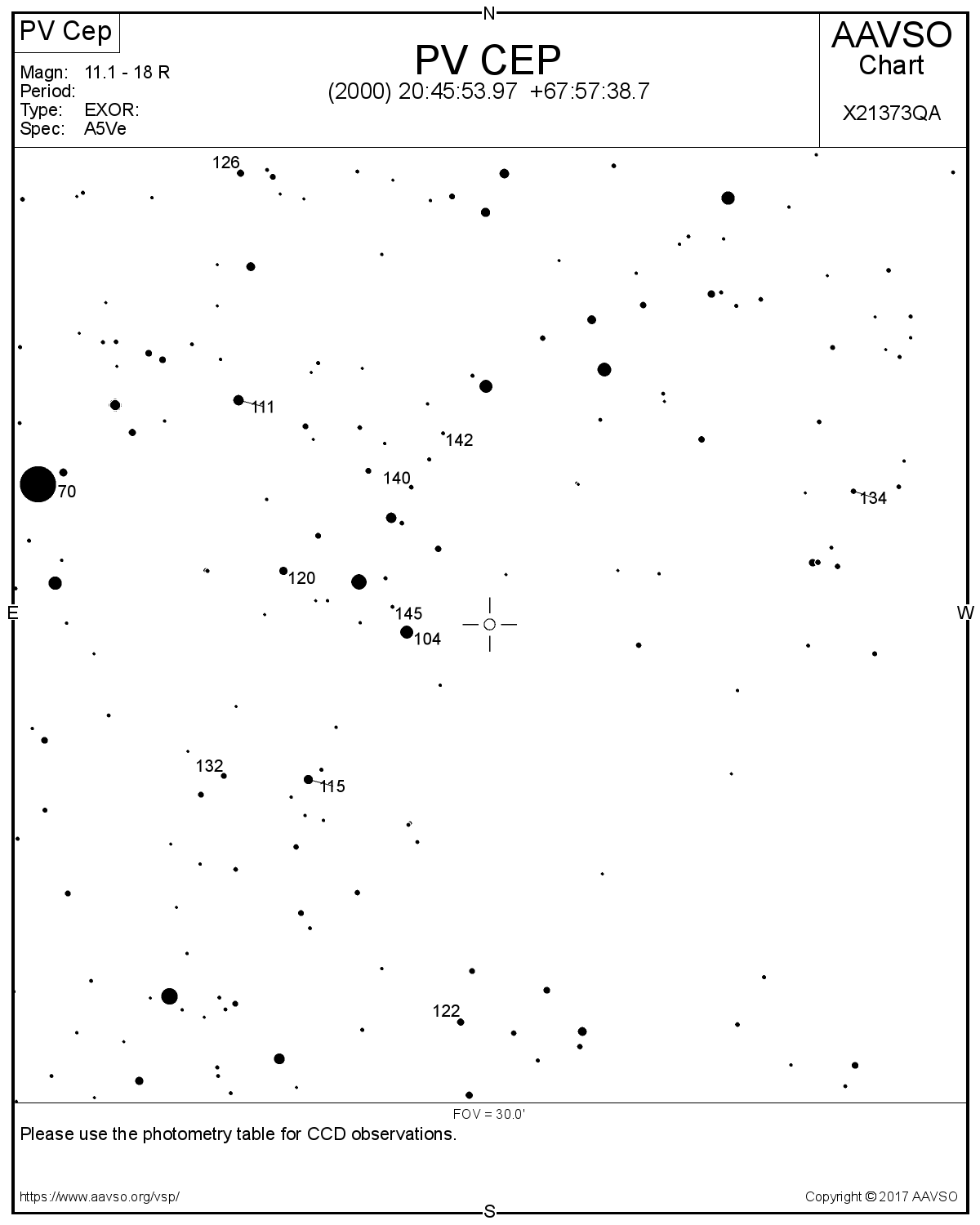
Variable Star Plotter
Field photometry for PV CEP from the AAVSO Variable Star Database
Data includes all comparison stars within 0.25° of RA: 20:45:53.97 [311.474875°] & Dec: 67:57:38.7 [67.96075°]
Report this sequence as X21373QB in the chart field of your observation report.
|
AUID |
RA |
Dec |
Label |
V |
B-V |
|
|
[312.10638428°] |
68:01:57.5 [68.03263855°] |
70 |
7.022 (0.100)24 |
-0.107 (0.173) |
|
|
|
000-BLM-171 |
20:46:21.76 [311.59066772°] |
67:57:23.9 [67.95664215°] |
104 |
10.448 (0.008)29 |
0.939 (0.018) |
|
|
000-BLM-172 |
20:47:18.52 [311.82717896°] |
68:04:39.8 [68.07772064°] |
111 |
11.095 (0.012)29 |
1.029 (0.021) |
|
|
000-BLM-173 |
20:46:54.47 [311.72695923°] |
67:52:45.8 [67.8793869°] |
115 |
11.464 (0.006)29 |
1.046 (0.010) |
|
|
000-BLM-174 |
20:47:03.17 [311.76321411°] |
67:59:17.6 [67.98822021°] |
120 |
11.971 (0.006)29 |
0.443 (0.021) |
|
|
000-BLM-175 |
20:46:03.63 [311.51513672°] |
67:45:09.6 [67.75267029°] |
122 |
12.187 (0.006)29 |
0.621 (0.017) |
|
|
000-BLM-176 |
20:47:18.23 [311.82595825°] |
68:11:48.1 [68.19669342°] |
126 |
12.571 (0.011)29 |
0.805 (0.022) |
|
|
000-BLM-177 |
20:47:22.64 [311.84432983°] |
67:52:51.9 [67.88108063°] |
132 |
13.188 (0.050)29 |
0.584 (0.088) |
|
|
000-BLM-178 |
20:43:51.76 [310.96566772°] |
68:01:47.0 [68.02972412°] |
134 |
13.411 (0.018)29 |
0.815 (0.036) |
|
|
000-BLM-179 |
20:46:20.37 [311.58486938°] |
68:01:57.4 [68.03260803°] |
140 |
13.954 (0.064)29 |
0.603 (0.111) |
|
|
000-BLM-180 |
20:46:09.51 [311.53961182°] |
68:03:38.9 [68.06080627°] |
142 |
14.226 (0.122)29 |
0.830 (0.214) |
|
|
000-BLM-181 |
20:46:26.45 [311.61019897°] |
67:58:11.7 [67.9699173°] |
145 |
14.461 (0.207)29 |
1.082 (0.372) |
|
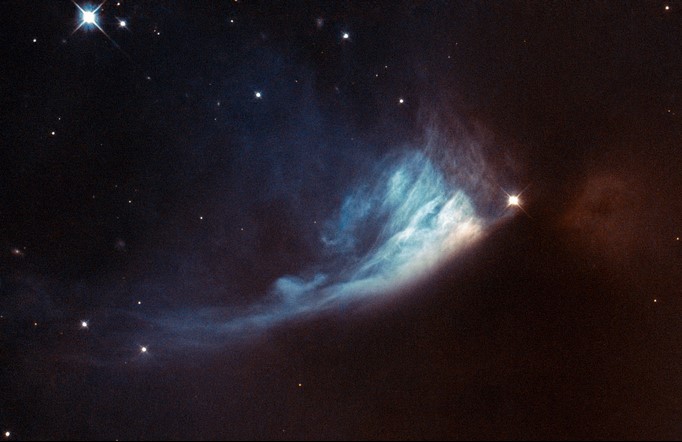
Image by the Hubble telescope, processed by Alexey Romashin.
[1] * https://fr.wikipedia.org/wiki/%C3%89toile_de_Herbig_Ae/Be
https://fr.wikipedia.org/wiki/Objet_Herbig-Haro
[2] « PV Cephei and Gyulbudaghian’s Variable Nebula »’ David Boyd
British Astronomical Association, Variable Star Section
[3] « PV CEPHEI: YOUNG STAR CAUGHT SPEEDING? » Goodman & Arce
The Astrophysical Journal, 608:831–845, 2004 June 20
[4] « Continuing changes in the peculiar nebulous object PV Cephei » Cohen | Kuhi | Harland | Spinrad
The Astrophysical Journal 245 :920-926. 1981 May 1