

Our era is exciting; science is constantly evolving and discovering new notions and concepts every day. This is especially true in astronomy, and we are only at the beginning: less than 100 years ago, we thought our Universe was limited to the Milky Way.
It was in 1922 and 1923 that Edwin Hubble made his observations of Cepheid variables in the Andromeda Galaxy, proving beyond any doubt that a larger universe existed.
Since we know that our universe is becoming increasingly clear and even accelerating in its explanation, without us understanding why, many questions remain unanswered and continue to raise new ones in astronomical circles.
Therefore, we will only discuss the basic types here, those with an established and proven classification. Stars are classified into two main categories: intrinsic and extrinsic. Prefixes reveal the meaning of words.
The 'in' in intrinsic means "by itself," so the star's behavior depends solely on itself.
For example, a Cepheid variable star that begins to convert its helium into carbon through regular, pulsating variations.
Similarly, the 'ex' in extrinsic describes behavior that depends on factors other than those originating from the star itself.
For example, a binary star that appears to eclipse us.
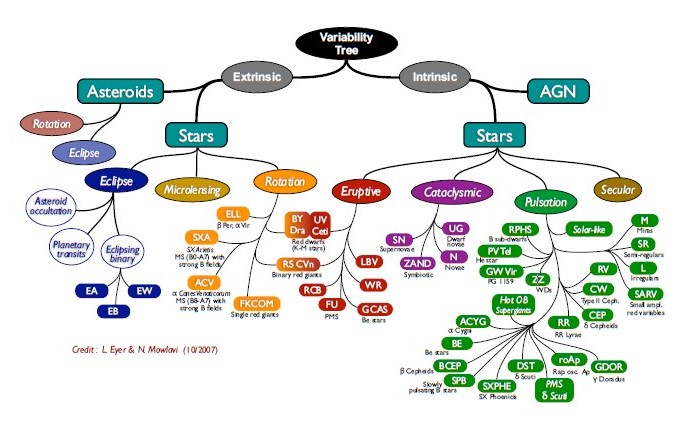
https://obswww.unige.ch/~mowlavi/index.php?section0=research
_______________________________________________________________________________________
Intrinsic Star
An intrinsically variable star means that all of its radiation and its variability depend solely on the star itself and no external factors.
This family of stars includes:
- Pulsating variables vary as their stellar radius increases and decreases, resulting in differences in magnitude and spectra. They can be periodic, semi-periodic, or irregular variables.
- Eruptive variables experience irregular episodes of variability due to mass ejection or chromospheric activity.
- Cataclysmic variables are generally interacting binary systems containing white dwarfs or systems that undergo large-amplitude explosions.
- X-ray variables are binary systems containing neutron stars or black holes.
_______________________________________________________________________________________
Extrinsic Star
Extrinsic variables are stars whose variability is caused by external properties such as rotation or eclipsing. The star's total energy output does not vary (or this is not the primary reason for its variability), but the amount of light we see from our perspective on Earth does. The main types of extrinsic variability are:
Eclipsing variables vary because the orbital plane of the star and its companion coincide with our line of sight to the system. As one component passes in front of the other, from our perspective, we see a dip in the light output.
Rotating variables can have a number of reasons for varying. There may be stars that rotate in front of us and out of sight, while the star itself rotates and varies more or less cyclically. A pair of stars can be so close that they are in contact, and if one star overheats a portion of the other star opposite it, the latter then reflects additional energy back into space, which we perceive as a brightening each time it passes within view. Other rotating variables can orbit each other so closely that their components are stretched by gravity into non-spherical shapes.
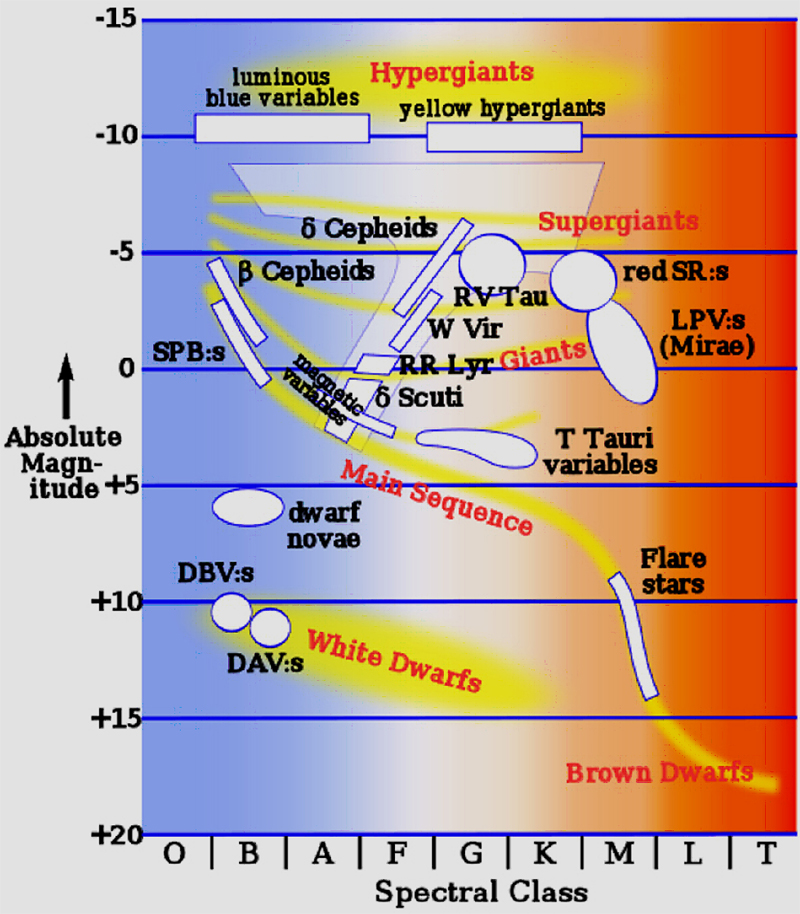
More detailed documentation is available on the AAVSO website, such as: "Variable star type designation in VSX"
* The source of several of the texts is an adapted translation of the book "Variable Star Classification and Light Curves Manual 2.1" by the AAVSO. It was translated and adapted with their permission and is also referenced by them.
JBD 2020