

Article en Français
Eruptive variables
Eruptive variables are a group of heterogeneous objects. The reasons for their behavior may be unique, unrelated to other eruptive variables, or in some cases, they are poorly defined or poorly understood. In fact, several stars labeled as irregular in the GCVS (General Catalogue of Variable Stars) may actually be assigned to other star classes once they are better understood.
YSO - Young Stellar Objects
Whether originating from a nebula or a Herbig-Haro object, stars are born from the gas of a giant molecular cloud in the interstellar medium contracting into a protostar. During this pre-main sequence phase of their evolution, variability can occur due to instabilities in their accretion disks. YSO can be used as a general term to describe all such pre-main sequence stars, or it can refer to a pre-main sequence star of unknown type.
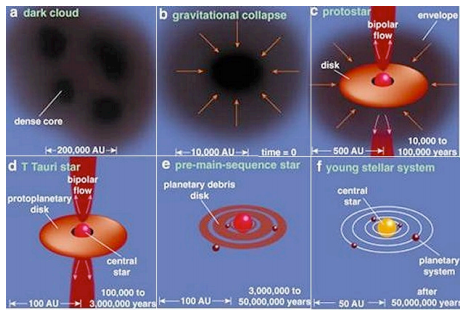
Stellar and planetary birth model
|
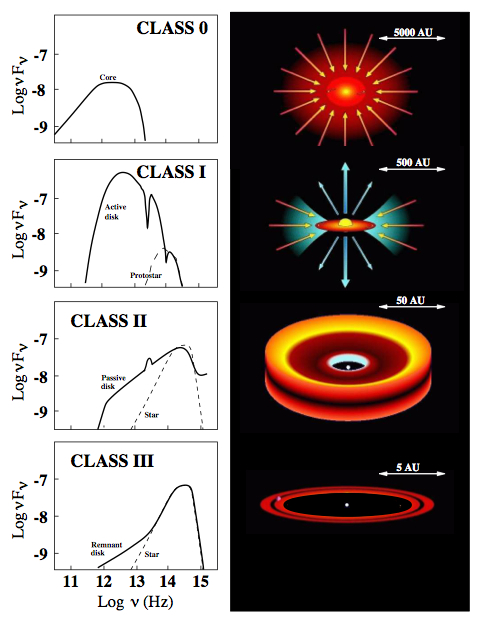
Classification of protostar evolution
|
Astronomers classify these stars into four classes, O, I, II, and III, according to the effect of the infrared radiation emitted by the star. The higher the infrared radiation, the more cold matter surrounds the star, indicating that it is still in the stage of gravitational collapse. A graphical overview of the four stages of protostar evolution is shown on the left (Andrea Isella's thesis, 2006). Class 0 objects are only a few thousand years old and are characterized by a highly integrated central core within a much larger accretionary envelope. The nuclear fusion process has not yet begun, and is therefore undetectable.
The mass of the central nucleus grows in Class I objects, and a flattened circumstellar accretion disk develops, along with the fusion reactions. Around the star, gas and dust are still present, making it difficult to track its evolution except in infrared and radio astronomy.
For Class II objects, the majority of the circumstellar material is now contained within a disk of gas and dust.
Finally, for Class III objects, the disk emission becomes negligible, and the SED resembles a pure stellar photosphere. A few protoplanets may already be beginning to form within it. |
T Tauri (TTS) stars are very young and light stars, less than 10 million years old and with less than 3 solar masses. A T Tauri is still undergoing gravitational effects during its evolution to become a low-mass main-sequence star, like the Sun.
T Tauri stars are found only in nebulae or clusters of very young stars. They have low-temperature spectra (type G to M) with strong emission lines and large absorption lines.
They often have large accretion disks left over from star formation. Their erratic behavior and changes in brightness can be due to instabilities in the disk, violent activity in their stellar atmosphere, development, or eclipses of gas and dust clouds that sometimes block the light from these stars.
Two main types of Tauri stars are recognized. These two classes are differentiated by the characteristics of their electromagnetic spectra: classical T Tauri stars (CTTS) and weak-lined T Tauri stars (WTTS).
Classical T Tauri stars have extended disks, resulting in strong emission lines.
Weak-lined T Tauri stars (WTTS) are surrounded by either a very faint disk or none at all.
Weaker T Tauri stars (WTTS) are of particular interest because they provide astronomers with a glimpse into the early stages of stellar evolution, uncluttered by nebulous material. Some of the missing material from the accretion disk may have been used in the formation of certain planetesimal objects (protoplanets), from which planets could eventually form.
According to one estimate, about 60% of T Tauri stars younger than 3 million years old may possess dust disks, compared to only 10% of stars that are 10 million years old.
To learn more:
The Trapezium, BM Orionis, and young stellar objects
http://www.aavso.org/vsots_bmori
T Tauri
http://www.aavso.org/vsots_ttau
The commentary and the reason behind the YSO!
http://www.starman.co.uk/ysosection/whatandwhy.php
http://www.starman.co.uk/ysosection/whatandwhy2.php
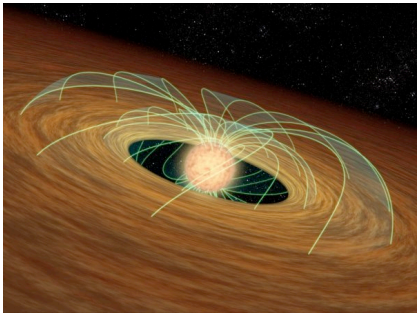
This artist's concept art depicts a young stellar object
and the swirling accretion disk surrounding it.
NASA/JPL-Caltech
________________________________________
FU Orionis variables (FUORs) are YSOs, like T Tauri stars. They are the stars with the greatest amplitude of variation in this group of "stellar children." They are characterized by a gradual increase in brightness of 4-6 magnitudes and can then stabilize at their maximum brightness for years or undergo a slow decline in intensity.
The prototype FU Orionis became famous in 1937 when the object, which was dim and had a magnitude of 16.5, suddenly increased to a magnitude of 9.6 and has remained stable there ever since. It achieved a record increase of 6 magnitudes in a period of less than a year (100 to 200 days). A similar reflection nebula also accompanies all known FUORs.
Learn more:
VSOTS- FU Orionis: http://www.aavso.org/vsots_fuori
"T he Furor Over FUOrs ": http://simostronomy.blogspot.com/2010/11/furor-over-fuors.html
________________________________________
EXORS (EXORs), named after the star EX Lupi, are eruptive T Tauri stars that exhibit episodic bursts of a few magnitudes on timescales of several months or more. Their eruptions are attributed to the temporary delay in the accretion of a circumstellar disk toward the forming star. These explosions are less luminous than FUOR explosions and can repeat. They form a subclass of T Tauri variables.
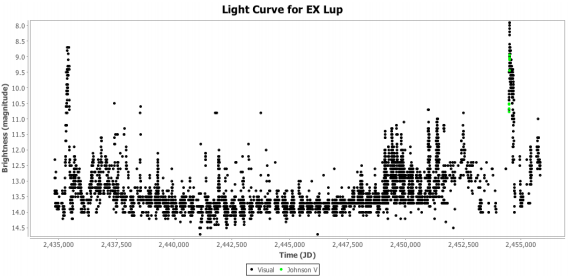
Courbe de lumière historique AAVSI de EX Lupi
________________________________________
The UXOR group (UXOR) is a subset of Herbig-Ae variable stars, intermediate-mass pre-main-sequence stars, named after the prototype star UX Orionis. The nature of UXORs is the subject of ongoing debate, but one current theory is that they are young systems viewed through their circumstellar environment, which sometimes obscures the central star. Their light curves are therefore characterized by irregular variations on timescales, and sometimes mean changes on longer timescales, and irregular episodes of deep minima.
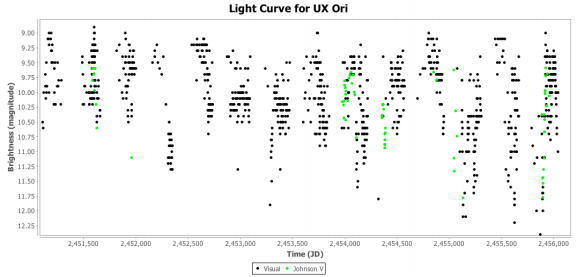
UX Orionis Light Curve - AAVSO
________________________________________
UV-type stars, like the prototype star UV CET, are stars that exhibit flashes of light, of varying amplitudes, occurring within seconds and subsiding within seconds or minutes. These changes in brightness can be quite dramatic: in 1952, UV CET increased its magnitude 75 times in just 20 seconds. These stars are generally red dwarfs of spectral types K Ve to M Ve.
The amplitude is greatest in the ultraviolet spectral region. The maximum brightness is reached in seconds or tens of seconds, like after the start of a flare. The star then returns to its normal brightness within minutes or tens of minutes. (Reference: AAVSO/vsx)
________________________________________
Gamma Cas (GCAS) stars are irregular, rapidly rotating variables of spectral type O, B, or A that possess an equatorial bulge.
This, combined with their high luminosity, results in a loss of matter that forms a disk around the star. Emissions and variations in brightness are likely processed by this disk. The formation of equatorial rings or disks is accompanied by a temporary brightening or fading of up to 1.5 magnitudes.
For more information:
See VSOTS: Gamma Cassiopeia and Be Stars
http://www.aavso.org/vsots_gammacas
https://en.wikipedia.org/wiki/Gamma_Cassiopeiae
________________________________________
Doradus stars (SDOR) are also known as Light Blue Variables (LBVs). These are extremely luminous stars whose variations occur on timescales ranging from days to decades. S Doradus is the brightest star in the Magellanic Clouds. The brightest members of our galaxy include P Cygni and Eta Carinae. Although rare, their luminosity allows them to be seen from great distances, making them interesting and useful to astronomers.
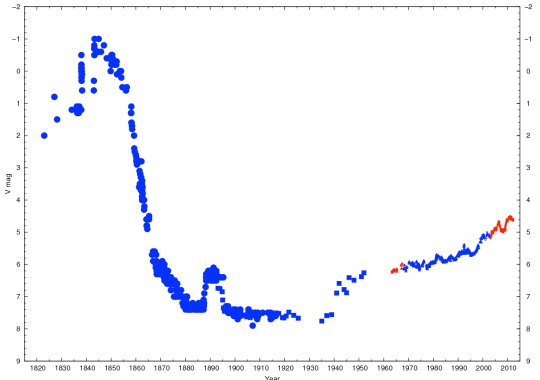
This light curve represents the apparent visual brightness of Eta Car from 1822 to the present day. It is based on references given by Fernández-Lajús et al. (2009, A & A, 493, 1093) and observed data. It contains visual (large circles), photographic (squares), photoelectric (triangles), and CCD (small circles) estimates obtained using various visual filters and photometric systems. All have been adjusted for consistency across the dataset. The red dots are observations from La Plata (Feinstein 1967; Fernández-Lajús et al. 2009a, 2009b, 2010). New CCD data obtained from RXTE Star Tracker have been plotted to complement the light curve prior to 2003 (Craig Markwardt and Mike Corcoran, private communication, 2009).
To learn more:
VSTOTS- Eta Carinae
http://www.aavso.org/vsots_etacar
Eta Carinae, an enigma to be seen with the naked eye:
http://simostronomy.blogspot.com/2009/12/eta-carinae-naked-eye-enigma.html
________________________________________
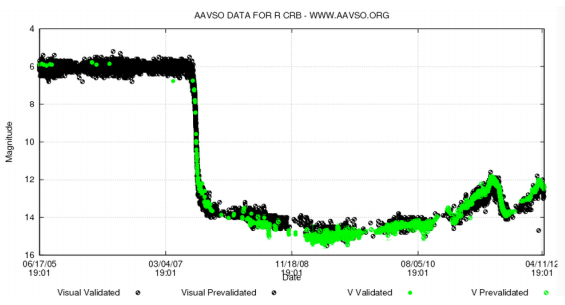
R Corona Borealis (RCB) stars are unlike any other class of variable stars, and although generally included in the category of eruptive variables, they probably deserve their own distinction. RCBs are a small group of carbon-rich, hydrogen-poor supergiants that dim unpredictably and rapidly to magnitude 9 and remain at or near their minimum for several weeks or months, or even years in some cases. It is generally accepted that these dimmings result from the formation of a cloud of carbonized soot that obscures the stellar photosphere and that this condensation takes place within the material that has been ejected from the stellar surface toward the observer.
Some RCBs exhibit more or less regular variations that can be interpreted as pulsations. The amplitudes of these changes are small, on the order of a few tenths of a magnitude, and have periods of about 30 to 150 days. These pulsations do not appear to be related to the dimming episodes; they have been observed repeatedly.
RCBs are intriguing because they challenge our models of stellar structure and evolution. Initially, it was thought that these stars were highly evolved after the AGB*, but most scenarios failed to explain their abundant hydrogen levels or to trace their evolution through the AGB (Asymptotic Giant Branch)*.
To learn more:
Corona Borealis
http://www.aavso.org/vsots_rcrb
North R Cor Bors: the best, the worst, and the unknown
http://simostronomy.blogspot.com/2011/10/n
northern-r- cor- bors-good-boring-and.html
«CHRONOLOGIE DE LA FORMATION DU SYSTÈME SOLAIRE» by Marc CHAUSSIDON
http://www.planetastronomy.com/special/2017-special/08mar/Chaussidon-SAF.htm
Fiche de Eddy Szczerbinski
http: //www.faaq.org/bibliotheque/naissancedesetoiles.pdf
Works by Gilbert St-Onge and Lauraine Morin
http://iopscience.iop.org/article/10.1086/524649/pdf;jsessionid=
http://astrosurf.com/ stog / Travaux-Recherches-% c9tudes / xrytau_1 / ryt_francais_page1.htm
PV CEPHEI: YOUNG STAR SPEED UP?
http://iopscience.iop.org/article/10.1086/383139/pdf
LBT/LUCIFER near infrared spectroscopy from PV Cephei
https://arxiv.org/abs/1304.6267
* The source of several of the texts is an adapted translation of the book "Variable Star Classification and Light Curves Manual 2.1" by the AAVSO. It was translated and adapted with their permission and is also referenced by them.