

Article en Français
Rotating variables
Rotating variables... All stars move and rotate on their axes, we can all agree on that!
However, some stars are more active than others... Furthermore, it's easy to understand that these spots aren't regular, and for some stars, they are very persistent.
We all know a similar main-sequence star: our Sun.
Depending on its activity, its surface is sometimes shaded by sunspots. This creates a very small, almost imperceptible, but nonetheless present variation in its brightness. We also see that these spots come and go, following the rotation of the Sun's surface, not only monthly, but also during long periods of increased and decreased activity: the well-known cycle of solar activity, which varies every 11 to 12 years.
Moreover, since the Sun is not a solid, it has an unequal rotation period of 25 days at the equator and 35 days at the poles. [1]
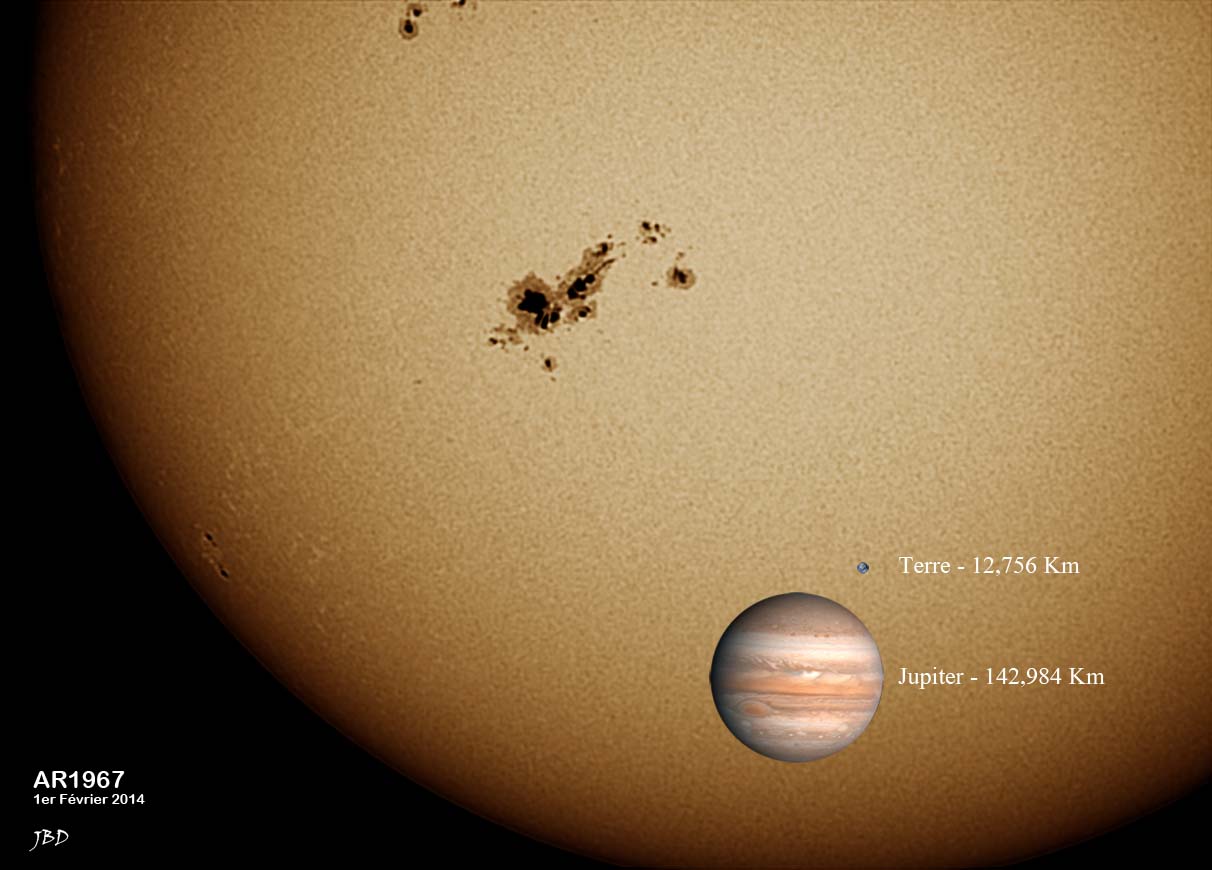
A large group of sunspots crosses the surface of the Sun. (Credit: JBD-OMSJ)
Even if we measured the Sun's brightness from thousands of light-years away with highly sensitive instruments, we could theoretically determine the Sun's approximate rotation period in days and hours. We could also determine the already known 11-year cycle from the amplitudes of these periodic variations in the rotation of sunspots on the Sun's surface, as seen from our perspective.
We could also deduce that we are not facing one of its poles; otherwise, we would see no variation, since we would always see the same hemisphere from our vantage point, regardless of the sunspots' longitude.
Indeed, it is by observing stars similar to the Sun that we have learned a great deal about it and its possible evolution. What we observe is the amount of stellar activity linked to the speed of rotation, which produces magnetic fields that, in turn, generate sunspots on the stars. As newly formed stars move toward the main sequence, their rotation speed increases as they stabilize.
As they age and swell, they begin to slow down. The Sun is a middle-aged star, rotating more slowly and probably much less active than when it was younger. Stars with rapid rotation periods also tend to be more chaotic. Stars with periods similar to the Sun's tend to exhibit more regular activity cycles, like the solar system with its 11-year cycles.
Compared to other stars studied, the Sun has relatively modest sunspots. Even at its peak solar activity, its sunspots cover only a very small percentage of its surface. The fact is that some stars have enormous sunspots in proportion to their overall size. And we are able to see the variation in brightness that occurs when these gigantic sunspots on stars rotate in front of our telescopes.
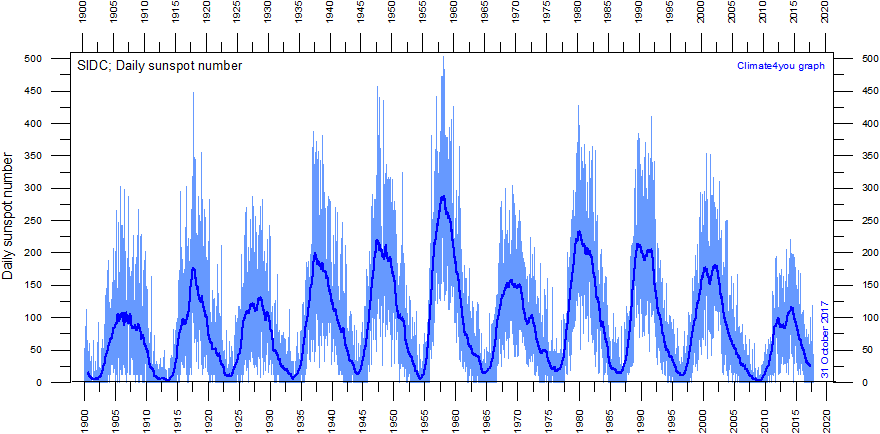
Variations in the Sun's cycles since 1900
BY DRA stars are variables, primarily of the 'red dwarf' type, that exhibit nearly regular variability. Their periods range from a few hours to 120 days due to non-uniform areas of their surface and radiation (dark spots versus bright spots) that are visible when the star rotates around its axis.
The amplitude of the variations fluctuates from 0.001 to 0.5 magnitudes in V. Interestingly, BY DRA stars can be binary or single.
Some of these stars, in addition to having strong chromospheric activity, can have flares, producing further variations of the UV Ceti type. [2]
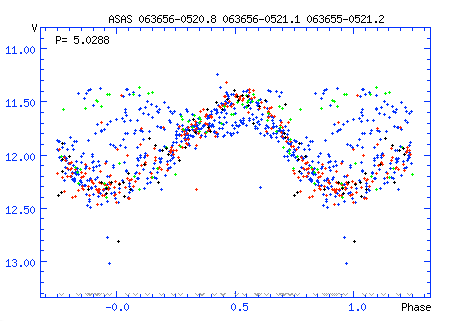
Courbe lumineuse d'une variable BY DRA utilisant des données ASAS (Crédit: AAVSO)
The RS Canum Venaticorum stars are binary red giants. Their spectra show variable emission lines, radio and X-ray emissions, and indicators of solar-like chromospheric activity, but on a much larger scale. This high level of activity is caused by very strong magnetic fields and rapid rotations within the binary system. The RS Canum Venaticorum stars' rotation speeds were driven by tidal effects with their companions, resulting in rotation speeds far exceeding those of "normal" stars of comparable size and mass.
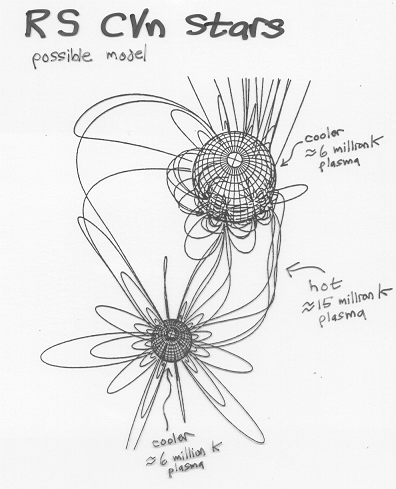
RS CVn stars are "chromosphere-active" because they are rapidly rotating stars with strong magnetic fields. (Credit: AAVSO)
RS Canum Venaticorum is a variable star in the northern constellation Canes Venatici. It is the paradigm of its class, composed of close binaries with active chromospheres exhibiting brightness variations of around 20% [2] (0.2 magnitudes).
Viewed from Earth, RS CV stars exhibit primary and secondary eclipses, as well as a "distortion wave" that runs along their light curve. This distortion wave is caused by spots on the stars that migrate in longitude, thus allowing a slight fluctuation along the light curve obtained through observations.
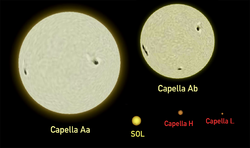
Most RS CVn variables are relatively luminous, and their amplitudes can be 0.2 magnitudes greater, making them suitable for amateur photometric observations. [3] A well-known example is the star Capella [4]:
Rotating ellipsoidal variables (ELLs) are close binary systems that vary with periods equal to their orbital motion. The components of ellipsoidal variables are stretched and changed shape in response to the enormous gravitational stress exerted on them by their ultra-close companion star. The mathematical response to the orbital plane of these systems coinciding with our line of sight, resulting in one star completely eclipsing the other, is almost zero.
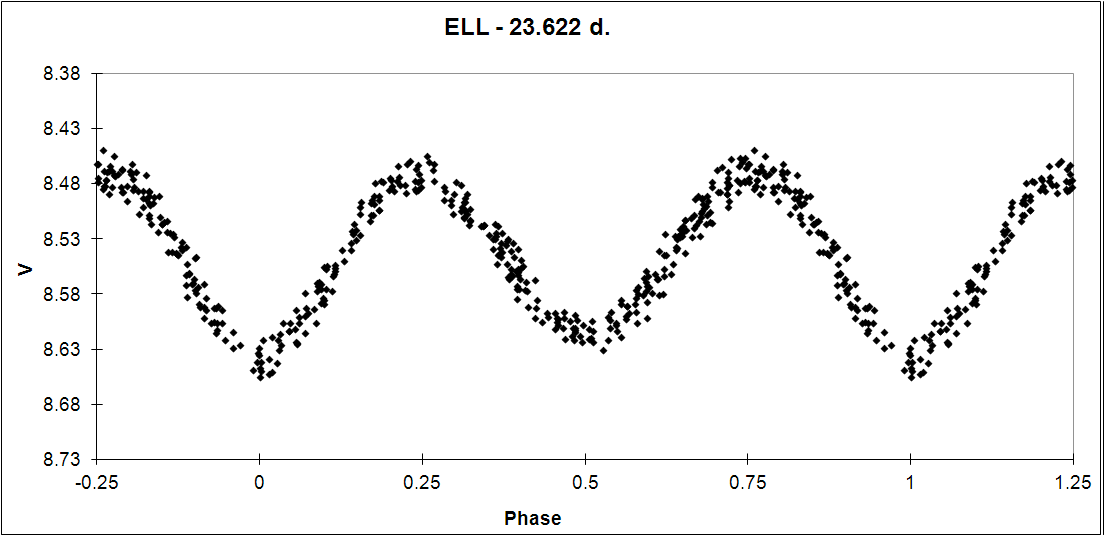
(Crédit: AAVSO)
There is debate as to whether or not stars can be classified strictly based on arbitrary observational phenomena that have nothing to do with physical processes. After all, viewed from another planet in the galaxy, these binary systems can eclipse each other!
This star classification, defined rather broadly, undoubtedly also contains stars that are still poorly classified but are very interesting and on which amateur astronomers can conduct serious research.
[1]https://en.wikipedia.org/wiki/Sun
[2] https://en.wikipedia.org/wiki/BY_Draconis_variable
[3] https://en.wikipedia.org/wiki/RS_Canum_Venaticorum
[4] https://en.wikipedia.org/wiki/Capella
* The source of this text is an adapted translation from the AAVSO's book "Classification of Variable Stars and Manual of Light Curves 2.1".
It was translated and adapted with their permission and also referenced by them.