

Article en Français
What is a supernova?
Okay... As I already wrote in my review (http://omsj.info/index.php/documentation), I'm not a professional astronomer, but simply a somewhat hyperactive, passionate, and very curious amateur. My goal is to collaborate with professional astronomers. So, if you're researching and monitoring variable stars, supernovas, and other celestial objects, you still need to be well-informed!
Supernovae are, in fact, the end of a star's life. When they explode, they brighten to between 10 and 20 magnitudes, reaching an absolute magnitude of -15 to -20, then slowly dim over periods of months and even years. Depending on certain characteristics of the star, its explosion and the collapse of its core can even result in a neutron star or a black hole.
Despite the similarity to nova explosions, the mechanism of eruptions and their consequences are completely different. A supernova is the end of the line in a star's evolution. It is either completely destroyed or transformed into an exotic object.
Astronomers classify them according to the absorption lines of different chemical elements that appear in their spectra. The primary element used to classify supernovae is hydrogen. Type II supernovae show the presence of hydrogen in their spectra, unlike Type I supernovae, which do not. Within these main types, there are subdivisions based on the presence of absorption lines from other elements and the shape of the light curve.
Because Type Ia supernovae have similar light curves and a reduced range of absolute magnitudes,
they are used as standard candles to measure large distances in the Universe.
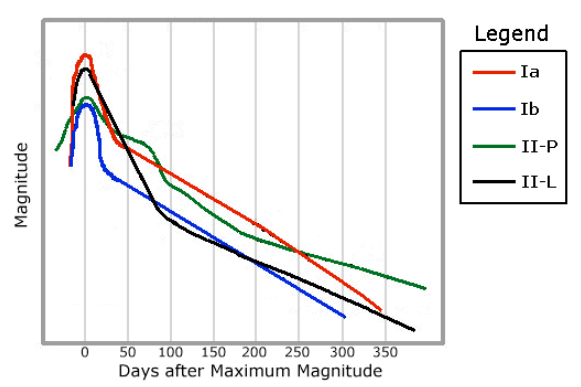
Average absolute magnitudes

https://iopscience.iop.org/article/10.1088/0004-6256/147/5/118
Some other explanations found on the web:
"It's a star at least ten times more massive than our Sun that, at the end of its stellar life, collapses in on itself. This collapse is so violent that in a single second, the star is reduced to just a few kilometers in diameter. Then, the star explodes with such intensity that it releases, every second and for weeks on end, more energy than billions of Suns. It thus shines brighter than the hundreds of billions of stars that make up the galaxy where it resides. The supernova explosion releases carbon, oxygen, and all the other chemical elements into interstellar space, which will eventually be incorporated into the formation of new generations of stars and planets."
http://www.astrosurf.com/astro_virtu/fiches/f_fiches6.htm
There are several main types of supernovae: Type I and Type II.
Type I supernovae are divided into sections: Ia, Ib, and Ic.
Type Ia, however, is a thermonuclear supernova, while Ib and Ic are core-collapse supernovae, like Type II supernovae.
Type II also includes classes: II-L, II-P, IIb, and IIn (https://en.wikipedia.org/wiki/Type_II_supernova#Type_IIb_supernovae). The "P" (plateau) curve can exhibit near-horizontal stability for more than 100 days after the rapid ascent (Supernova Explosion, David Branch and J. Craig Wheeler, Springer). The "L" (linear) curve, as the name suggests, is a gradual descent.
It should also be noted that in spectroscopy, they have hydrogen-marked lines. (NASA, January 2011)
Type 1b supernovae are classified by the significant presence of helium.
Type 1c supernovae are characterized by the absence of both hydrogen and helium.
There is also the impressive Hypernova (https://fr.wikipedia.org/wiki/Supernova#Type_II.2C_Ib_et_Ic).
Type Ia supernovae (SN1a) do not contain helium in their spectra, but rather silicon.
They are also considered "standard candles" because their magnitudes appear stable at an absolute magnitude of -19.5 at the peak of maximum brightness*. (*Absolute magnitude is the magnitude of a star or object at 10 parsecs.)
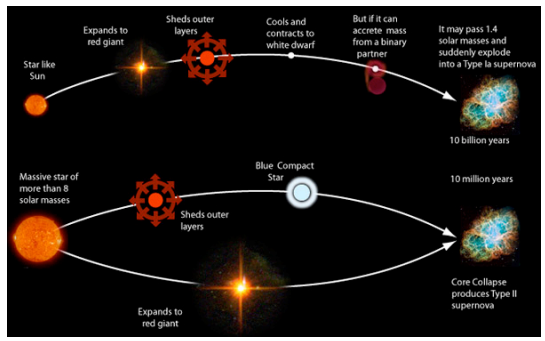
Type Ia supernovae occur in a binary system that contains at least one white dwarf. It's probably fair to say that many astrophysics textbooks at least ten years old explain the origin of Type Ia supernovae as a white dwarf accreting matter until it reaches the famous Chandrasekhar limit mass. We know that stars in the Milky Way mostly evolve in binary systems. Many are less massive than the Sun, and like it, they will end their lives peacefully as white dwarfs. In theory, at least, because if they are part of a binary system containing a star that hasn't yet reached the same stage of evolution, their fate can be much more spectacular. For example, if they are close enough to a red giant, or even a main-sequence star, the tidal forces of the white dwarf can be so strong that a transfer of matter from the star to the dwarf occurs, increasing its mass.
When a star reaches 1.4 solar masses, the laws of quantum mechanics and special relativity inevitably render it unstable, and it must collapse. The process primarily triggers thermonuclear reactions involving the fusion of carbon and oxygen, culminating in an explosion that obliterates the entire star.
"Type II supernovae occur when massive stars exceeding approximately 8 to 10 solar masses have exhausted their nuclear fuel. This causes the gravitational collapse of the core, whose gravitational force is no longer counterbalanced by the radiation pressure released by the thermonuclear reactions. According to a scenario that is still poorly understood, a vast amount of energy is released, ejecting the star's outer layers and leaving behind only a neutron star or, in extreme cases, a black hole."
http://www.futura-sciences.com/magazines/espace/infos/dico/d/univers-supernova-60/
Regarding Type II supernovae, their spectra reveal traces of hydrogen still present in their composition.
__________________________________________________________________________________________________________________________________
Visually, the two families may be identical, however, it is through tracking and spectroscope analysis that they can be distinguished.
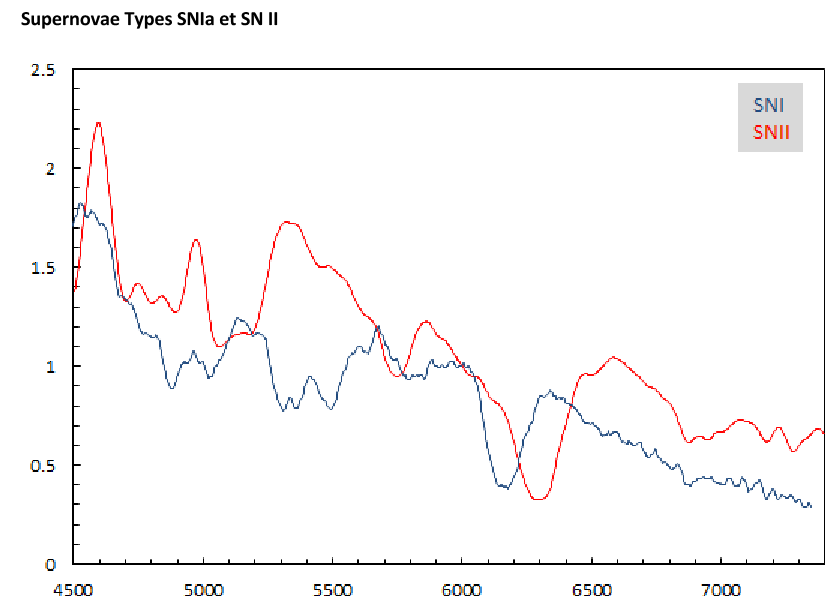 Credits : François Teyssier
Also, in the monitoring, we will distinguish them during their extinctions; Ia will disappear more quickly, while II, for its part, will take months, and this with some upheavals.
__________________________________________________________________________________________________________________________________
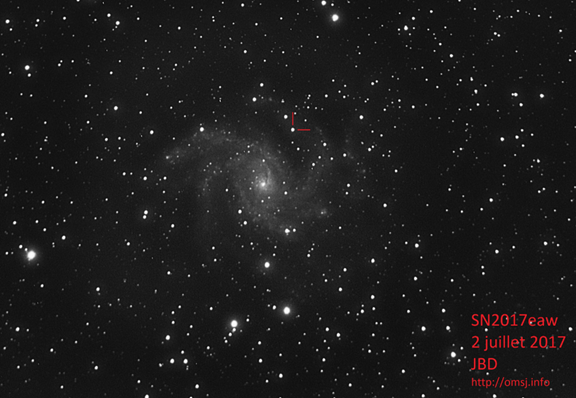
SN 2017eaw was discovered on May 14, 2017, by Patrick Wiggins in Utah.
A beautiful example of a Type IIP supernova (P for plateau): see the curve below, which was formed by the accumulation of all observations, both visual and using V, R, and I filters.
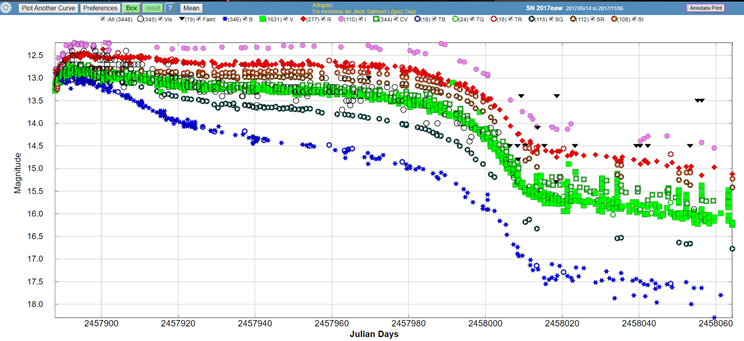
https://www.aavso.org/LCGv2/
(Courtesy of the AAVSO)
Regarding chemical elements:
Previously, it was thought that the elements of the periodic table were created during the Big Bang (hydrogen and helium), and that all the others were created during supernovae. However, since 2014 and the advent of gravitational wave detection, which revolutionized this field, new theories have been developed about the creation of elements, particularly so-called heavy elements like gold, platinum, etc.
Supernovae, due to their intensity, remain the primary source of element creation, but several advances and developments have added many interesting new details to this classification.
A periodic table found on the AAVSO website provides a more accessible overview:
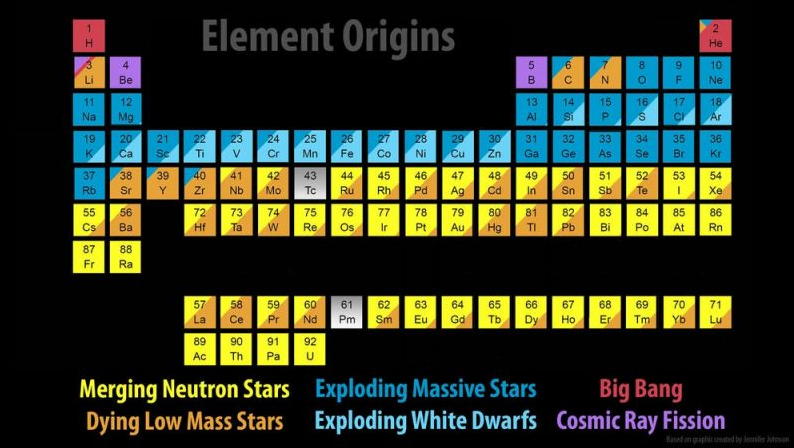
https://www.aavso.org/how-universe-creates-gold-and-other-elements
Suggested reading:
http://astronomy.swin.edu.au/cosmos/T/Type+Ia+Supernova
JBD 2017