

Article en Français
KIC 8462852, the incredible story of a bizarre star
| "The Tabby star"! | 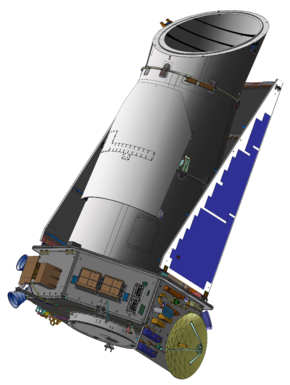 |
|
It all started with the Kepler satellite, launched in 2009. Then, on March 4, 2011, a star suddenly dimmed by more than 15%. It was also noticeable on February 28, 2013, but this time by 22%[1]. It happened again on May 11, 2013, and May 19, 2017. Of course, the press seized upon this with all sorts of fantastical theories, because in fact, no one knew how such a variation could occur. Something enormous was thought to be periodically obscuring this star. The latest theory, which is also the most plausible[2]:
Crédit: "KIC 8462852: Will the Trojans return in 2021?" F. Ballesteros, P. Arnalte-Mur, A. Fernandez-Soto et al.[2] But there have been so many publications about this star that we will limit ourselves here to focusing on astronomical observations. However, I would like to mention a paper from astronomer Tabetha S. Boyaijian's research group, published in January 2018, to which yours truly contributed. Announcement on "SpaceRef": http://spaceref.com/news/viewsr.html?pid=50966 Article on the Cornell University website: The best thing amateurs can do is continue their observations and thus provide as much information as possible to the professionals to help them solve the enigma. Time sometimes works in mysterious ways... [3].
|
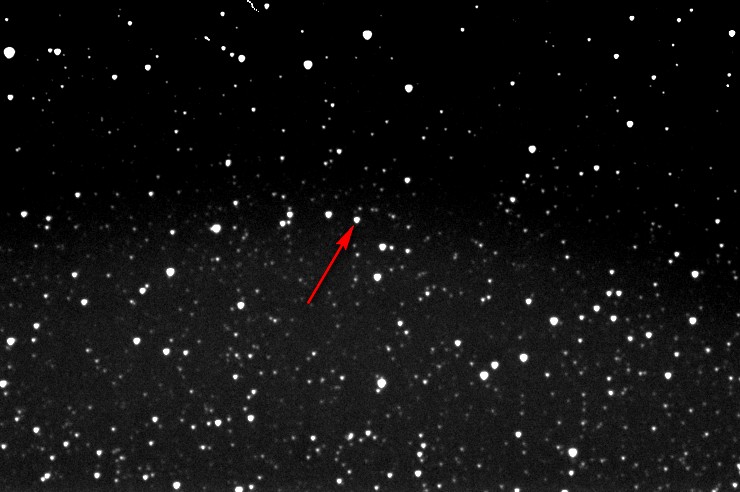 Crédit JBD-OMSJ Crédit JBD-OMSJ |
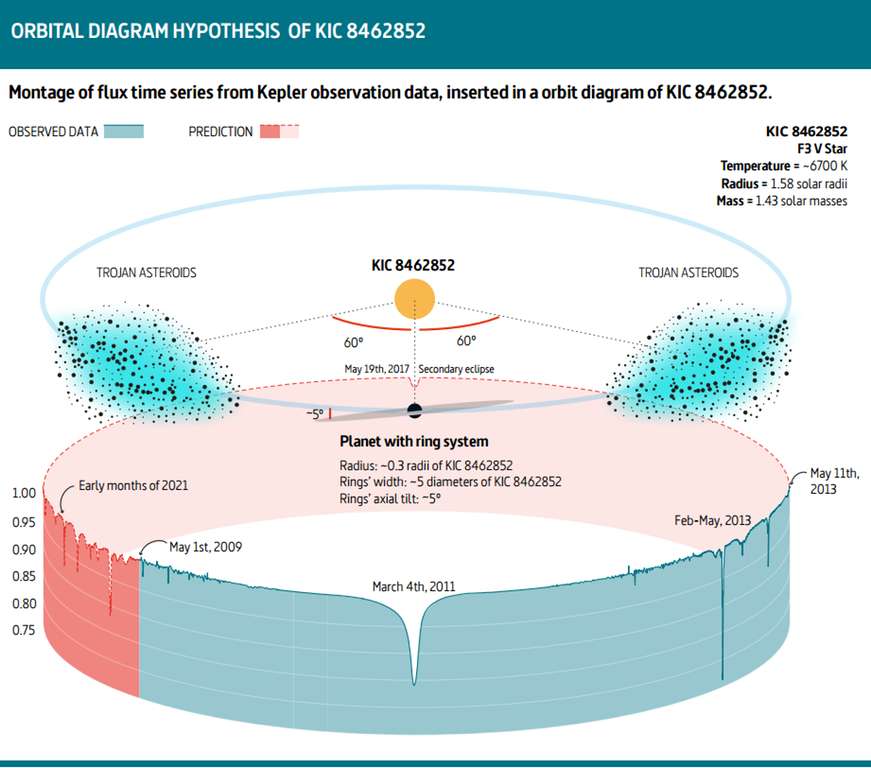
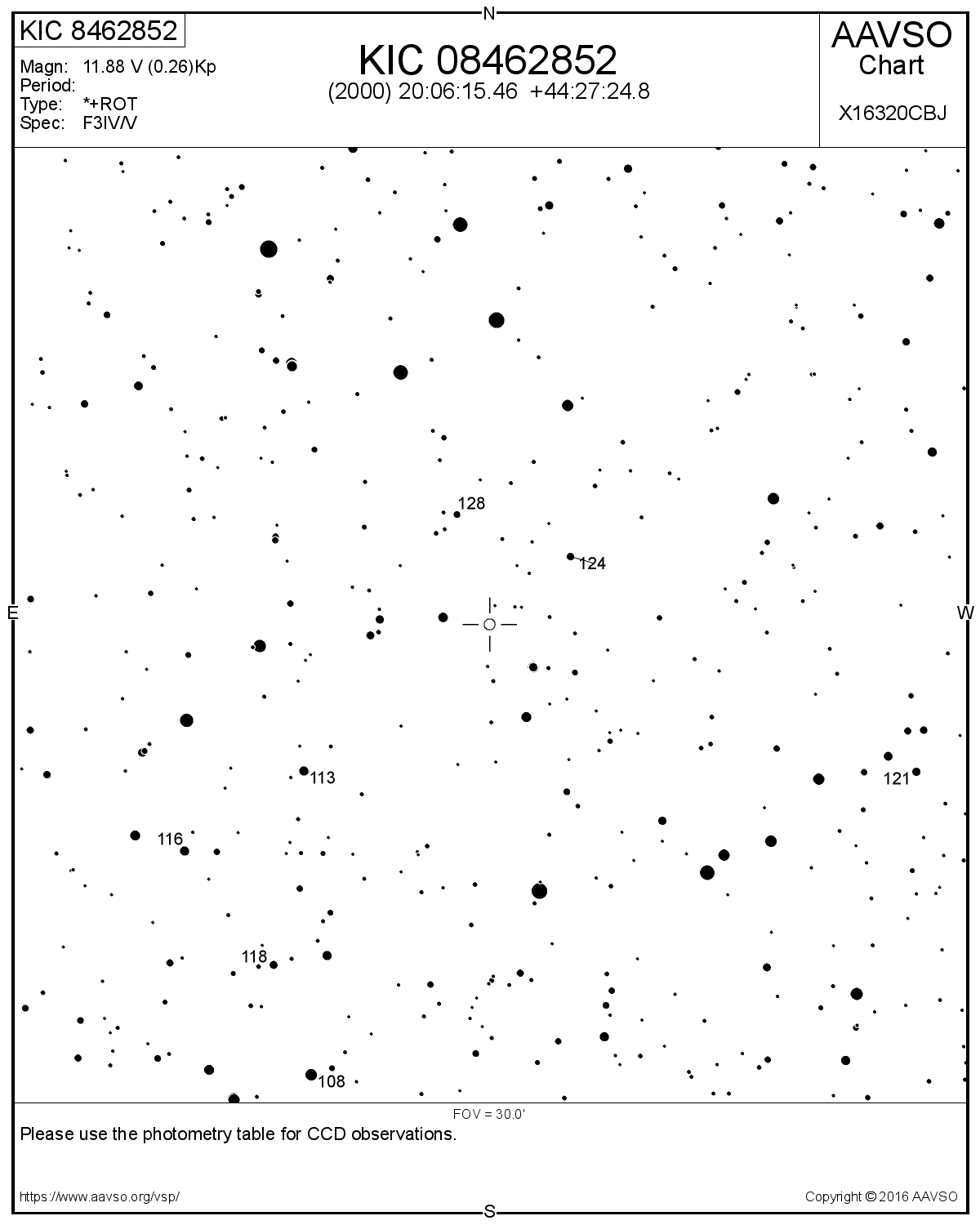
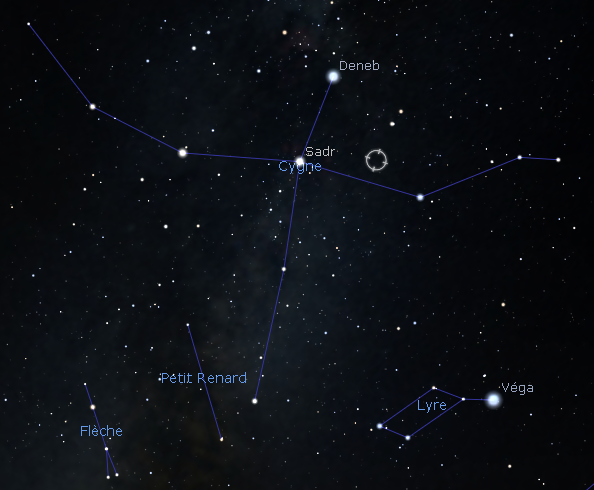
Image provenant de Stellarium
Variable Star Plotter
Plot Another Chart
Star Chart for this Table
Field photometry for KIC 8462852 from the AAVSO Variable Star Database
Data includes all comparison stars within 0.166666666667° of RA: 20:06:15.46 [301.56441667°] & Dec: 44:27:24.8 [44.45688889°]
Report this sequence as X16262ZG in the chart field of your observation report.
|
AUID |
RA |
Dec |
Label |
V |
B-V |
Comments |
|
000-BLS-551 |
20:06:48.09 [301.70037842°] |
44:22:48.0 [44.38000107°] |
113 |
11.263 (0.054)29 |
0.458 (0.102) |
|
|
000-BLS-553 |
20:07:09.09 [301.78787231°] |
44:20:17.0 [44.33805466°] |
116 |
11.590 (0.050)29 |
0.543 (0.093) |
|
|
000-BLS-549 |
20:06:01.23 [301.50512695°] |
44:29:32.4 [44.49233246°] |
124 |
12.427 (0.029)29 |
0.803 (0.063) |
|
|
000-BLS-555 |
20:06:21.25 [301.58853149°] |
44:30:54.0 [44.51499939°] |
128 |
12.789 (0.050)29 |
0.481 (0.098) |
|
[1] http://plus.lapresse.ca/screens/80694039-391c-4013-82c4-8a78d6345bf1%7C_0.html
[2] "KIC 8462852: Will the Trojans return in 2021? " : https://arxiv.org/pdf/1705.08427.pdf
[3] http://www.futura-sciences.com/sciences/actualites/astronomie-etoile-tabby-poussiere-elle-cle-mystere-63872/
JBD - Janvier 2018