

CHI CYG, also sometimes called KHI CYG, is an "S" type Mira star that pulsates every 408 days.
What's also unusual is that its spectral type is S6.2.
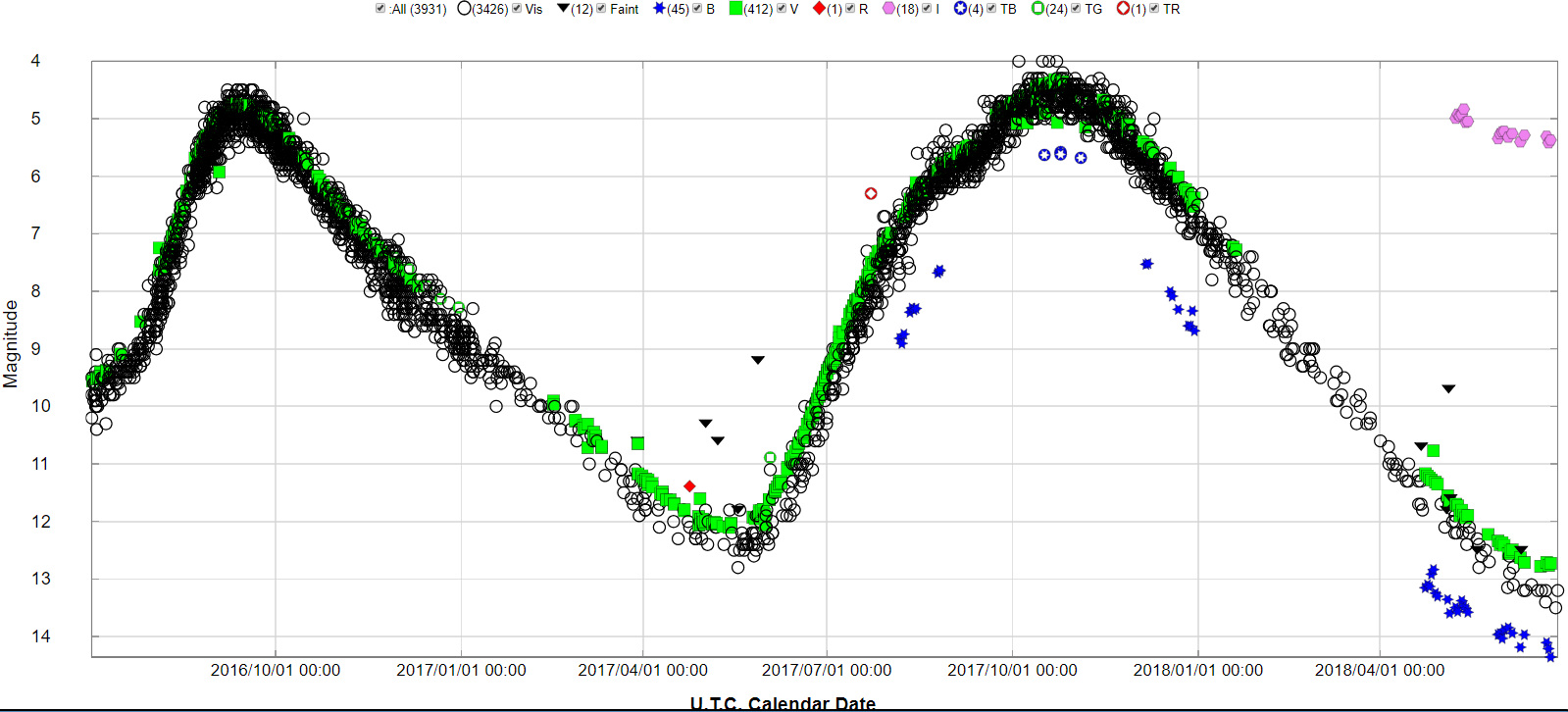
To be more precise, this star is a long-period variable (LPV) Mira giant star that can reach a magnitude of 3.5 during a 408-day period of variation, then plummet to a magnitude of 14.2, 1500 times fainter than what is visible to the naked eye. It is located in the Milky Way at a distance of approximately 600 RA (approximately 180 pc).
Furthermore, what makes Chi Cyg so fascinating is that it's a rather rare S-class (S6) star, as stated in a very interesting article on the website:
http://stars.astro.illinois.edu/sow/chicyg.html
On the AAVSO website and with the VStar software, it's easy to obtain a frequency curve and track its evolution. This summer, it will be at its minimum.
S-class stars lie midway between carbon and M-class stars and possess zinc oxide (ZnO) lines in their spectra rather than titanium monoxide (TiO). They have nearly identical oxygen and carbon abundances, with both elements occurring almost exclusively as carbon monoxide (CO). When a star is cool enough for CO to form, it consumes a maximum of oxygen and carbon, leaving only the excess element: oxygen in main-sequence stars, carbon in carbon stars, and virtually none in S-class stars.
The classification of S-type stars is based on two parameters. The first number following "S" indicates the temperature: an S1/x star has the same temperature as an M1 star, an S2/x star the same as an M2 star, and so on.
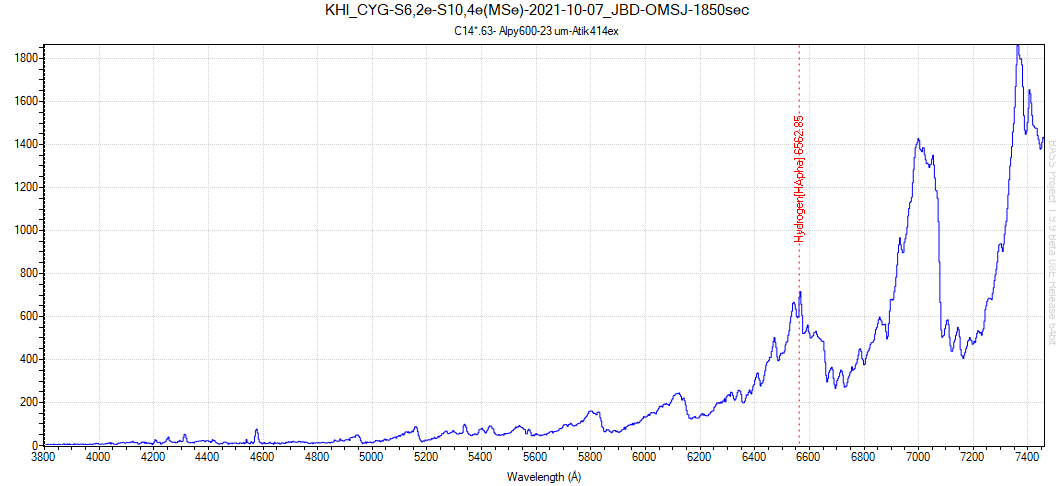
The second number (from 1 to 9) indicates the abundance of ZrO relative to TiO. When this second number is 1, ZrO is rare and its emission bands are very weak. The higher the number, the greater the amount of ZrO (as in the example in Figure 2, representing an S5/5 star). For a value of 9, only ZrO is visible, as TiO has completely disappeared. The second number therefore indicates anomalous chemical abundances within the star. (https://www.astrogeo.va.it/astronom/spettri/stelle-sen.htm)
This is why, in the spectrum above, the star CHI CYG has a classification of S6,2e (the "e" for emission), "S6" indicates its temperature (around 2800 to 3100°C - B-V 1.82), and its ZrO concentration is 2.
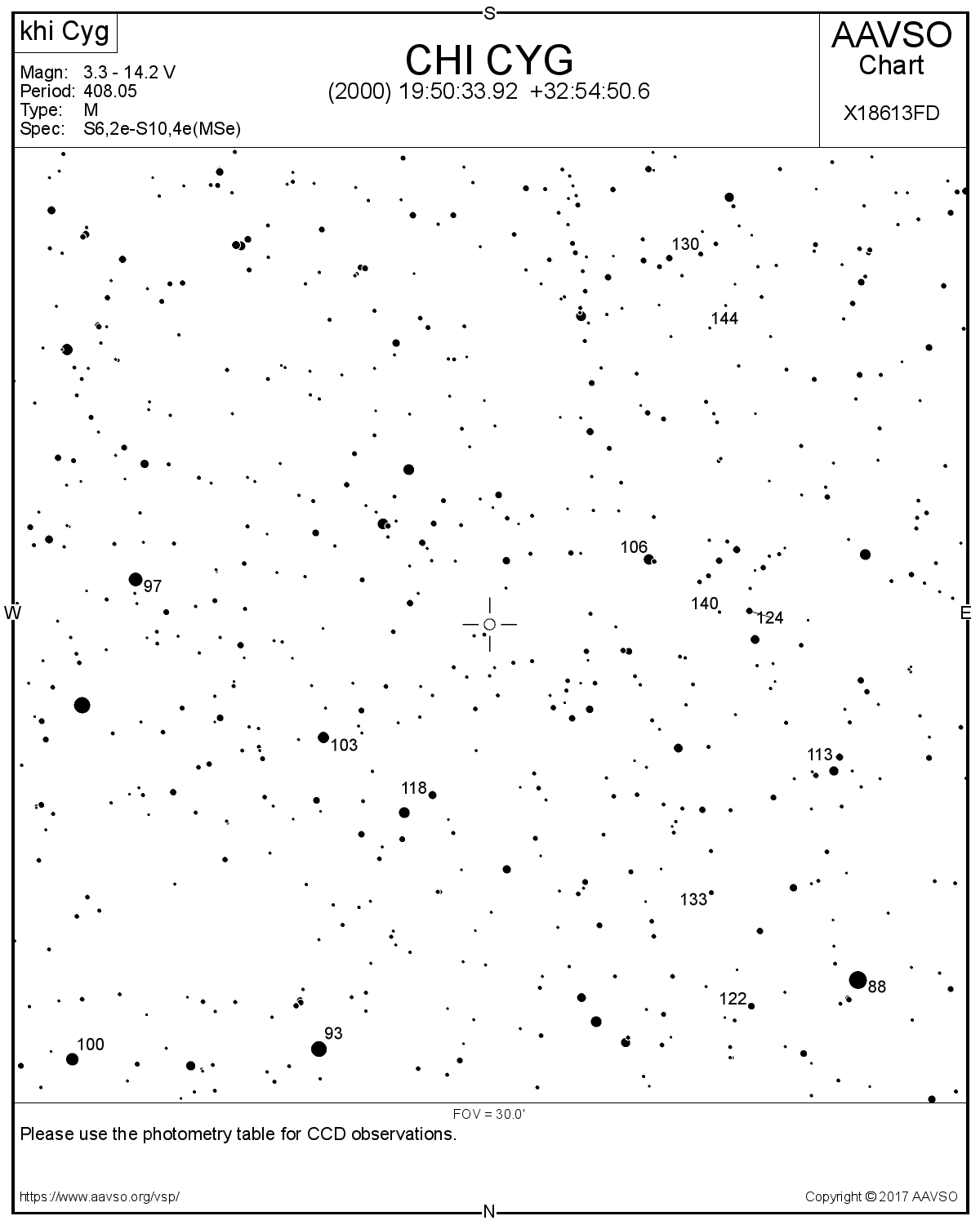
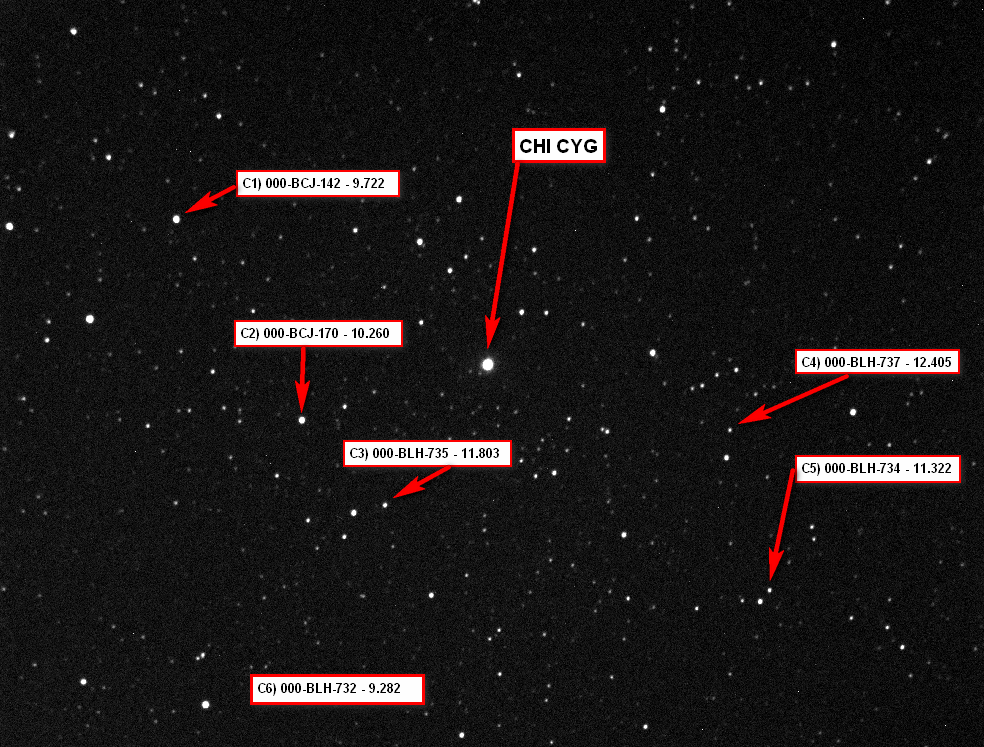
Table de photométrie: https://aavso.org/apps/vsp/photometry/?chartid=x18613fd
JBD 2021 - Révision 2025