

Article en Français
Cataclysmic variables (CVs)
CVs are semi-detached, closed binary systems consisting of a white dwarf (WD) and a secondary star that transfers mass to it. In most known CVs, the secondary is (almost always) a main-sequence star, and the mass transfer from the secondary to the white dwarf occurs via an accretion disk. The orbital periods of CVs are typically between 75 minutes and 6 hours, although there are exceptional systems—usually with evolved or compact donor stars—with periods outside this range.
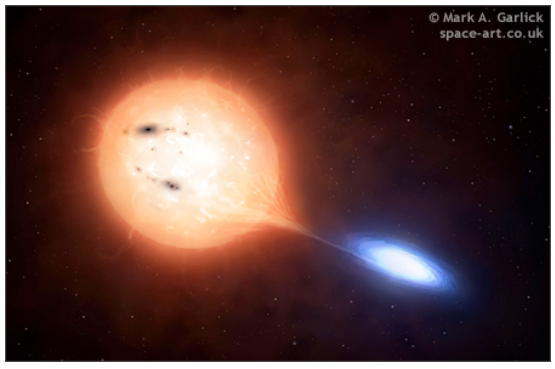
A typical cataclysmic variable, consisting of a secondary red dwarf that has filled its Roche lobe and is losing material,
by having an accretion disk, in favor of a white dwarf.
Dwarf Nova
UG-type variable stars are CVs consisting of a close-packed star system in which one component is a white dwarf accreting matter from its companion. They are similar to classical dwarf novae in that the white dwarf is involved in periodic outbursts, but the mechanisms are different. Current theory predicted that dwarf novae would result from an instability in the accretion disk, when the gas in the disk reaches a critical temperature that causes a change in viscosity. This process leads to the collapse of the white dwarf, which then releases large amounts of gravitational potential energy.
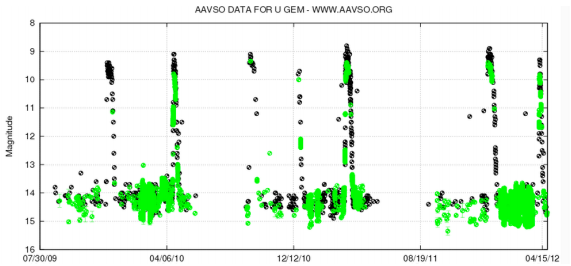 Courbe de lumière de 1000 jours de U Gem
There are three subtypes of U Geminorum (UG) stars, primarily distinguished by their light curves: UGSS, UGSU, and UGZ.
SS CYG – UGSS stars reach a luminosity of magnitude 2-6 in a V-filter within 1-2 days, returning to their original brightness after a few days. Periods between supermaxima (outbursts) range from a few days to a few years. Orbital periods are generally longer than 3 hours.
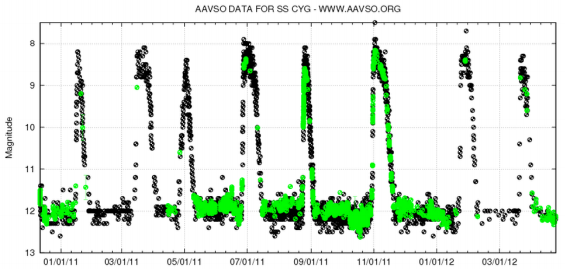
500-day light curve of SS Cygni. Note the two distinct types of spillovers.
The stars of Ursae Majoris (UGSU) exhibit brighter and longer supermaxima. Their orbital periods are typically around 2 hours.
During supermaxima (outbursts), a UGSU shows an additional modulation of its light curve, the supermaxima (outburst), which is caused by the precession of the accretion disk. The resulting overshoot appears in the light curve as a modulation with a period slightly longer (a few percent) than the orbital period.
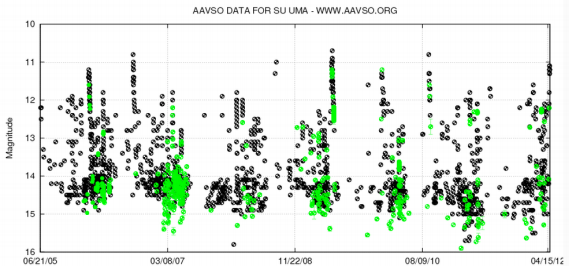
2500 days of SU UMa light curve showing normals and "supermaxima" (super-explosions) - AAVSO.
UGSUs have two recognized subclasses:
WZ Sagittae stars (UGWZ) are ultrashort-period UGSUs (generally 90 minutes or less) that exhibit only breaks or irregularities, and their cycle times between explosions vary from a few years to several years. The amplitudes of the explosions can rival those of novae (magnitudes 6-9). Many UGWZs also display reverberations or "echo flashes" while they are at high intensity.
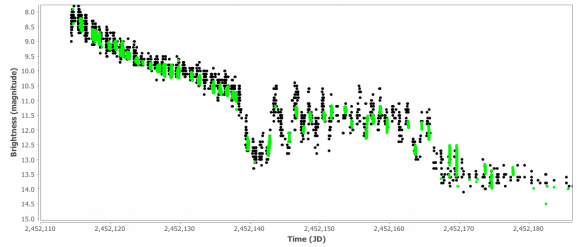
Triggering of WZ Sge in 2001 and subsequent echoes
For more information:
SU Ursae Majoris
Http://www.aavso.org/vsots_suuma
WZ Sagittae Http://www.aavso.org/vsots_wzsge
ER Ursae Majoris (UGER) stars are dwarf novae with exceptionally short intervals between supermaxima (outbursts) (only 20 to 50 days). ER UMa stars typically spend one-third to one-half of their lifetime in supermaxima. When not in supermaxima, these stars exhibit frequent outbursts. (They are sometimes referred to as the RZ LMi star).
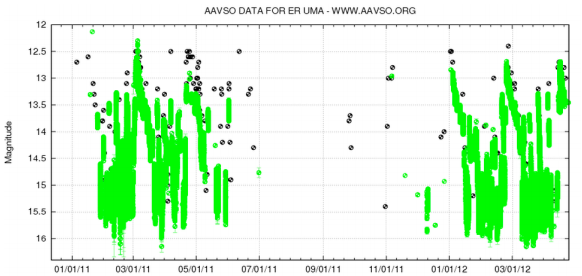
500 jours de courbe de lumière de ER UMa visualisant de fréquents de sursauts normaux et plusieurs super-éclats.

Illustration of a tilted disk in the same orbital phase while the inclination undergoes precession through the cycle.
Camelopardalis Z (UGZ) stars are DNe stars that share characteristics with both dwarf novae and nova-like stars, exhibiting normal U Gem-type bursts (a brightness increase of 2 to 6 magnitudes lasting 1 to 3 days) as well as random stops. A stop consists of a period of constant minimum brightness, 1 to 1.5 magnitudes below maximum brightness, lasting from a few days to 1000 days. These stops are thought to occur when the mass transfer rate from the secondary star into the accretion disk around the primary star is too high to produce normal bursts.
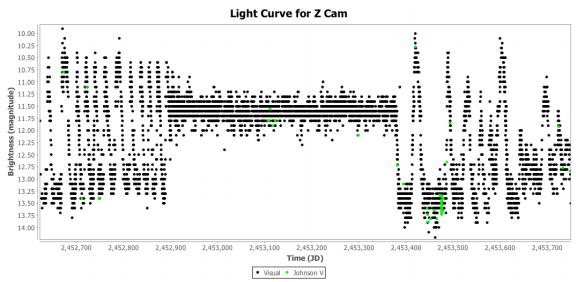
Un arrêt dans la courbe de la lumière du prototype de Z CAM.
Suggested reading:
Why observe the stars with the Z Cam?
https://sites.google.com/site/thezcamlist/why-observe-z-cam-stars
RX Andromedae
http://www.aavso.org/vsots_rxand
Nova (NL) type variables are those with such a high mass transfer rate that they are essentially stuck in continuous bursts. Their light curves are fundamentally flat, displaying fluctuations on the order of one magnitude at most.
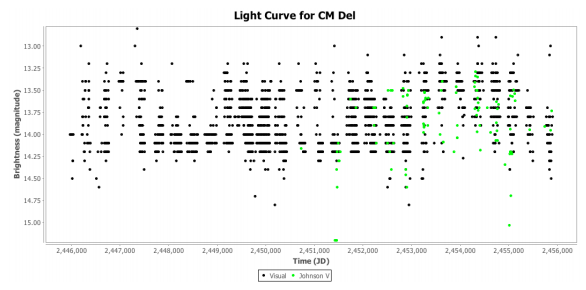
Light curve of CM Del, a nova-type variable showing limited activity at about 1 magnitude in the V spectrum.
The name is confusing and deserves some explanation. Early observers were familiar with new and new dwarf stars, but they also discovered stars that resembled the remnants of old novae from the past. They called these "nova-likes" because they assumed (correctly) that nova-likes and old novae were of the same type, the only distinction being whether they had been observed while they were erupting or not.
Suggested readings:
UX Ursae Majoris
Http://www.aavso.org/vsots_uxuma
Dwarf Novae: Http://www.aavso.org/vsots_archive#ugem
The Novae
Novae (N) are closely spaced binary systems with orbital periods ranging from 0.05 to 230 days. The cause of a new eruption is a thermonuclear reaction on the surface of the white dwarf. After years of mass exchange between the binary star pair, the temperature and pressure on the white dwarf's surface become high enough to explode the accreted layer of material like a hydrogen bomb. The difference is that this bomb can have the mass of 30 Earth-sized planets!
Once the temperature becomes high enough, this layer begins to expand. In less than a minute, the shell can radiate at 100,000 solar luminosities, and the expansion can reach speeds of 3,000 km/s. Eventually, the envelope of the entire binary system and the orbital motion of the pair act like a helix. After about 1,000 days, the envelope expands to the point where it can be seen as a nebula surrounding the system. This shell then dissipates into the interstellar medium over the following centuries.
Most novae likely erupt more than once in their lifetime; the mass of the white dwarf determines the amount of material accumulated before the eruption process begins. Systems with a white dwarf of 0.6 solar masses have been observed to have up to 5 million years between eruptions. A system with a white dwarf of 1.3 solar masses, on the other hand, might have only 30,000 years between eruptions.
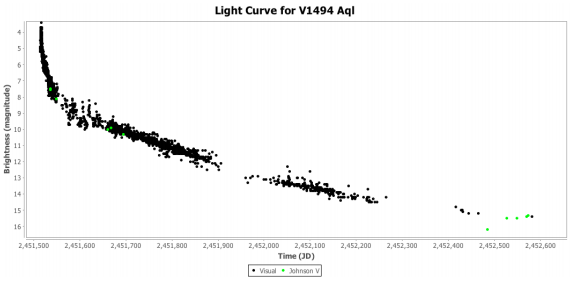
Light curve of V1494 Aql (NA) showing its rapid decline from the maximum
Novae with the largest explosion magnitudes are also the fastest.
Novae are further subdivided by the time they are predicted to decrease by three magnitudes from their maximum intensity.
(NA) Fast novae, with a rapid increase in brightness, followed by a luminosity decline of three magnitudes within 100 days.
(NB) Slow novae, with a decrease of three magnitudes in 150 days or more.
(NC) Very slow novae, remaining at maximum brightness for a decade or more, decreasing in intensity very slowly. It is also possible that NC novae are objects that are very different physically from normal novae. The components of these systems are likely giants or supergiants, sometimes semi-regular variables, and even Mira variables. They may also be planetary nebulae in formation.
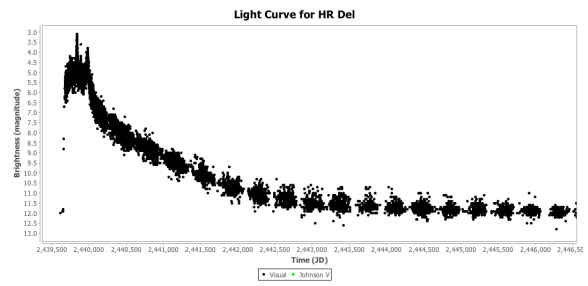
Typical slow-blow (NB) HR LED light curve - AAVSO
Suggested reading:
Novae (2012 edition)
http://www.aavso.org/vsots_novae
Recurrent Novae (NR)
In the General Catalogue of Variables (GCVS), recurrent novae are included in the same category as other novae, the main distinction being the characteristics of their light curves. Based on the characteristics of their light variations, novae are subdivided into fast (NA), slow (NB), very slow (NC), and recurrent (NR) categories.
Recurrent novae differ from typical novae in that two or more outbursts (instead of just one) separated by 10–80 years have already been observed (example: T CrB).
This implies that the supermaxima ("outburst") mechanism, orbital periods, spectra, and nature of the components of these nearby binaries are identical or very similar.
So, could recurrent novae simply be the same types of systems, but with an even more massive white dwarf?
The accretion rate of a system with a white dwarf of 1.4 solar masses could have a recurrence time of less than 100 years. The star T Pyx may resemble such a system, but it is not currently clear whether the bursting mechanism is the same for all recurrent dwarfs, or whether some are the result of accretion by Roche-lobe "overflow," stellar winds, or instabilities.
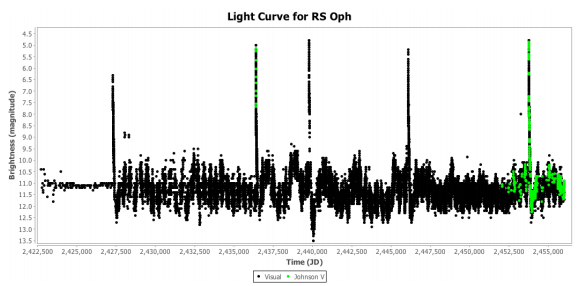
The complete historical light curve of RS Ophiuchi showing known explosions - AAVSO
Even more interesting is the possibility that these recurrent novae could actually be Type Ia supernova progenitors. Observations of nova eruptions and nebulae suggest that the mixing of the accreted layer with the white dwarf's outer layers can cause white dwarfs to lose mass over time and through repeated eruptions.
The most massive white dwarfs, with a higher accretion rate, can actually gain mass over time! Although much of the envelope mass is blown away by the wind, these primaries can retain a substantial portion of the envelope's mass. In some recurrent novae, the white dwarfs have now grown to near the Chandrasekhar limit and could soon explode as a Type Ia supernova.
Suggested conferences:
U Scorpii Http://www.aavso.org/vsots_usco
T Pyxidis Http://www.aavso.org/vsots_tpyx
RS Ophiuchi Http://www.aavso.org/vsots_rsoph
Hubble's 1923 Nova at Andromeda erupts again! : Http://simostronomy.blogspot.com/2012/02/hubbles-1923-nova-in-andromedaerupts.html
Amateur astronomers around the world are alerting to a rare stellar flare.: Http://simostronomy.blogspot.com/2010/01/amateur-astronomers-alert-world-to-rare.html
* The source of this text is an adapted translation from the AAVSO's book "Classification of Variable Stars and Manual of Light Curves 2.1".
It was translated and adapted with their permission and is also referenced by them.